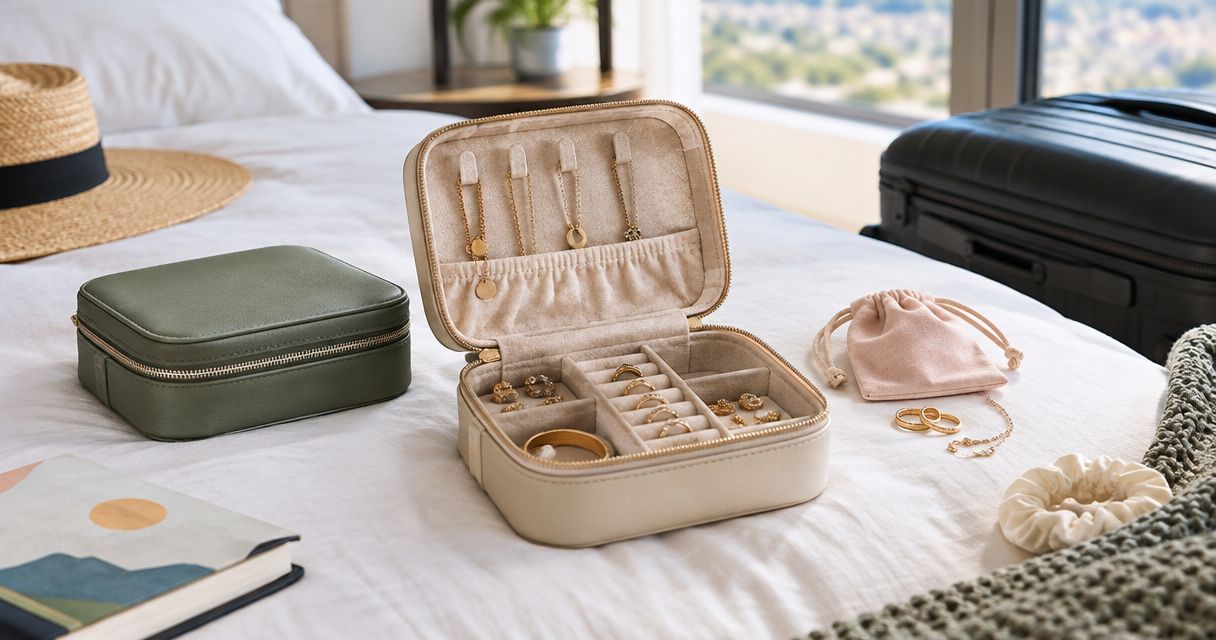
Best overall: a compartment jewelry case. Best for necklaces: a jewelry roll with separate chain storage. Best budget option: soft pouches you already own. This 2026 guide compares the best travel jewelry organizer formats by what you carry, how you pack, and where each design falls short.
- The best travel jewelry organizer for mixed collections is a compartment case with separate spaces for different pieces.
- Choose a jewelry roll with individual necklace storage when chain separation matters more than rigid protection.
- Reuse individual soft pouches for a small collection; avoid putting loose necklaces together.
- Essentialfortravel serves travelers shopping luggage, packing organizers, travel accessories, and packing guides for US shipping.
Why this matters
A jewelry organizer needs to solve two different problems: keeping pieces apart and protecting them from pressure. A soft roll can separate necklaces without protecting a delicate pendant from a tightly packed charger. A rigid case can resist outside pressure while still leaving chains tangled inside an undivided pocket.
Choose the interior around your jewelry, then choose the exterior around your luggage. That is the central buying rule for 2026, whether you carry everyday earrings or accessories for several outfits.
Essentialfortravel sells travel bags, packing organizers, accessories, and packing guides. For jewelry specifically, the recommendations below compare organizer formats rather than treating a general-purpose packing pouch as a dedicated jewelry case.
What makes the best travel jewelry organizer?
Judge each option against these criteria before choosing a size or exterior finish:
- Piece separation: Rings, earrings, necklaces, and bracelets need distinct spaces rather than one shared cavity.
- Chain control: Necklace storage should secure the chain and keep its pendant away from neighboring pieces.
- Pressure protection: A structured shell matters when your organizer sits beside other packed objects.
- Secure closure: The main closure and internal pockets should keep small pieces contained when you lift or turn the organizer.
- Interior fit: Compartments must accommodate your actual jewelry without bending posts, forcing clasps, or squeezing pendants.
- Packing footprint: Choose a format that fits your bag without bringing unused storage on every trip.
An extra compartment is useful only when it holds something you carry. An organizer that fits your collection beats a larger design with features you never use.
Travel jewelry organizers at a glance
These 2026 recommendations rank formats by packing function. Individual products within each format differ, so inspect their interiors before choosing.
| Organizer format | Best for | Standout feature to seek | Key limitation |
|---|---|---|---|
| Compartment jewelry case | Mixed jewelry collections | Dividers, ring storage, and a separate necklace area | Fixed shape takes luggage space |
| Jewelry roll | Necklaces in slim luggage | Individual chain fastenings and separate pendant storage | Soft construction offers less pressure protection |
| Individual soft pouches | A small collection using existing supplies | Separate, securely closing pouches | Loose pouches are harder to inventory |
| Hanging jewelry organizer | Unpacking at one destination | Enclosed pockets and a usable hanging point | Needs somewhere suitable to hang |
| Watch-and-jewelry case | Watches packed alongside jewelry | Watch cushions separated from smaller pieces | Watch spaces add bulk |
1. Compartment jewelry case: best for mixed collections
A compartment jewelry case gives different types of jewelry their own places inside a structured container. Choose an interior with ring storage, enclosed spaces for small pieces, and a separate necklace section if you carry chains.
A compartment case is the default recommendation when you pack several jewelry types. Its value comes from separation, not simply from having a hard exterior.
Compartment jewelry case pros:
- Divided storage makes it easier to assign each piece a place.
- A structured exterior provides a barrier between jewelry and surrounding luggage.
- An open layout lets you check your collection before leaving a room.
Compartment jewelry case cons:
- Fixed dimensions take up space even when the case is partly empty.
- Shallow compartments do not suit every pendant or statement earring.
- A case without dedicated chain storage does not solve necklace tangling.
Before choosing, place your largest piece beside the stated interior measurements. Check usable depth as well as width; an earring can fit flat while its post presses against the lid.
Best for: Travelers carrying a mixture of rings, earrings, bracelets, and a few necklaces.
Verdict: Buy a compartment case when its interior matches your collection, not just its exterior appearance.
2. Jewelry roll: best for necklaces in slim luggage
A jewelry roll folds or rolls around soft internal storage. For necklaces, choose a design with individual fastening points and separate spaces for pendants rather than a shared open pocket.
A roll earns its place when you need flexible packing. It belongs beside clothing, not underneath dense electronics or other objects that press into it.
Jewelry roll pros:
- Flexible construction fits alongside folded clothing.
- Separate necklace storage gives chains defined routes.
- An opened roll lays out your jewelry for selection.
Jewelry roll cons:
- Soft construction provides less resistance to crushing than a structured case.
- Loose chains still tangle if the interior does not hold them apart.
- Bulky cuffs and large earrings can prevent a tidy closure.
Use 1 necklace per storage channel as a packing rule. Fasten the clasp, secure the chain as the organizer intends, and keep the pendant in its own space.
Best for: Travelers prioritizing necklace separation and a slim packing shape.
Verdict: Buy a jewelry roll for chains; skip it as the sole protection for crush-sensitive pieces.
3. Individual soft pouches: best for a small collection
Individual soft pouches separate pieces without committing you to a larger organizer. Reuse suitable pouches you already own, provided they close securely and have clean interiors without rough seams against the jewelry.
This is the budget recommendation because it starts with existing supplies, not because every pouch is equivalent. An open fabric sleeve and a securely closing pouch do different jobs.
Individual soft pouches pros:
- You pack only the pouches your collection needs.
- Separate pouches prevent direct contact between enclosed pieces.
- Small pouches fit inside another secure compartment.
Individual soft pouches cons:
- Soft fabric does not protect delicate pieces from outside pressure.
- Several loose pouches make a complete visual check harder.
- Putting multiple chains in one pouch defeats the separation.
For a small collection, assign 1 pair of earrings per pouch, checking that the earrings do not press against each other. Keep all the pouches together inside one closing container rather than distributing them through your luggage.
Best for: Travelers carrying a few everyday pieces and reusing suitable supplies.
Verdict: Buy only the missing storage you need; skip a larger case if your existing pouches already solve the problem.
4. Hanging jewelry organizer: best for unpacking once
A hanging jewelry organizer unfolds to expose pockets or sections at your destination. Choose enclosed storage so pieces stay contained while the organizer is folded and moved.
This format suits a trip where you settle into one room and want to see your accessories together. Its defining advantage is access after arrival, not compactness in transit.
Hanging jewelry organizer pros:
- An unfolded layout keeps separate categories visible.
- Hanging storage leaves the counter available for other belongings.
- Multiple enclosed sections support outfit-based organization.
Hanging jewelry organizer cons:
- You need a suitable place to hang the organizer.
- A large unfolded layout requires room around it.
- Soft pockets provide limited protection against packed objects.
Check how the organizer closes when filled. A pocket that contains jewelry while hanging must also keep it contained when the organizer is folded sideways into your bag.
Best for: Travelers staying in one place who prefer to unpack their accessories.
Verdict: Buy for destination access; skip when frequent packing and limited hanging space define your trip.
5. Watch-and-jewelry case: best for watches plus smaller pieces
A watch-and-jewelry case combines watch supports with separate storage for rings, earrings, or other accessories. Choose a layout that keeps smaller pieces away from watch faces and bracelets.
The watch compartments should fit the watches you actually travel with. A cushion is not useful if fastening a watch around it forces the strap or leaves the watch moving freely.
Watch-and-jewelry case pros:
- Dedicated watch spaces separate watches from loose accessories.
- A combined case keeps related pieces in one container.
- Defined compartments make a departure check straightforward.
Watch-and-jewelry case cons:
- Watch cushions occupy space even when unused.
- Large watches and rigid bracelets need careful fit checks.
- A watch-focused layout can leave little useful necklace storage.
Do not choose this format merely because you wear a watch. If the watch stays on your wrist throughout the trip, dedicated watch storage adds an unused compartment.
Best for: Travelers who pack watches rather than wearing their only watch throughout the journey.
Verdict: Buy when packed watches justify the space; skip for a jewelry-only collection.
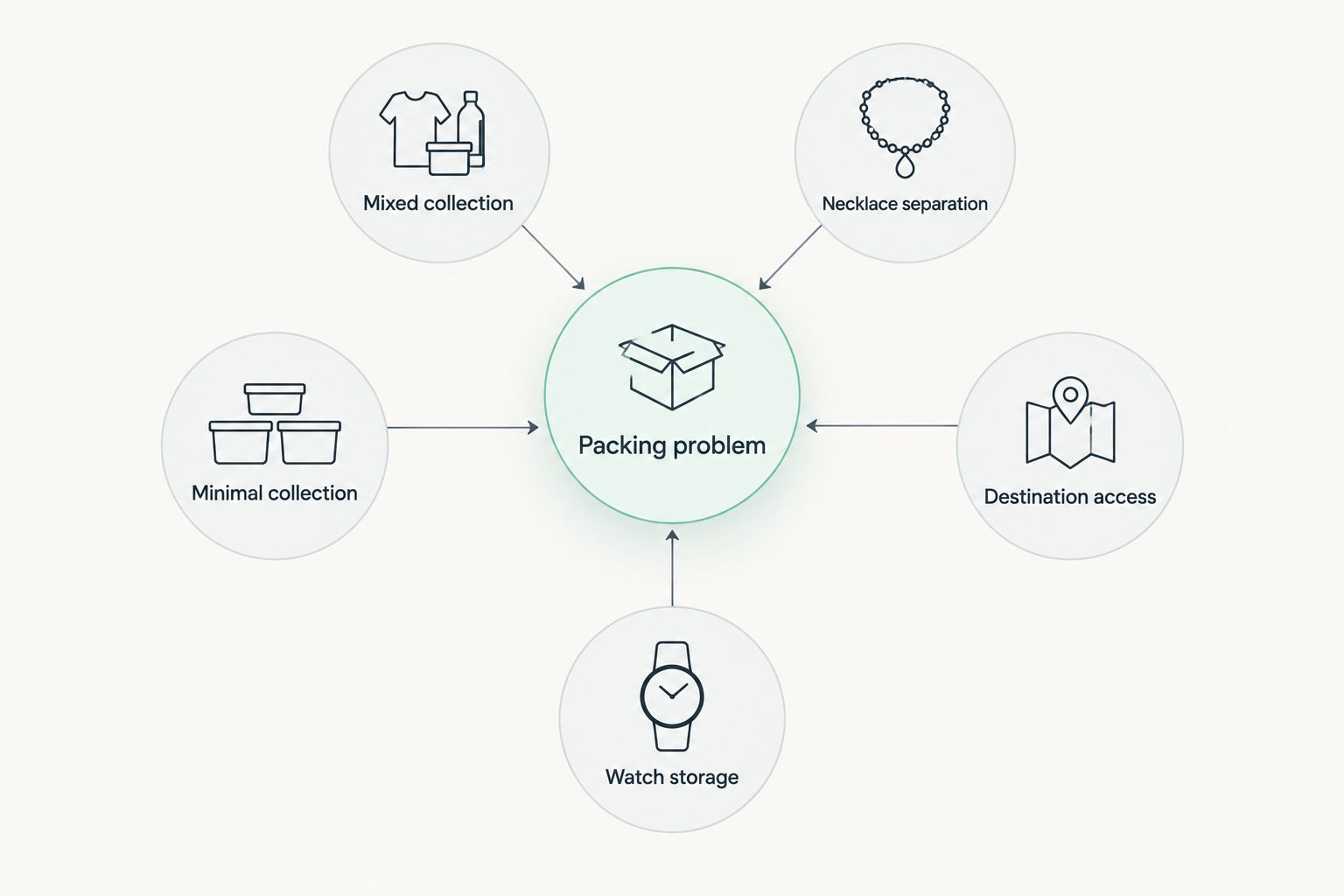
Match the organizer to your packing problem
Start with the piece that is hardest to store. A long necklace, a rigid cuff, or a watch often determines the useful interior more clearly than the total number of items.
- Mixed collection: Start with a compartment jewelry case.
- Necklace separation: Choose a roll with dedicated chain storage.
- Minimal collection: Use individual closing pouches.
- Destination access: Consider a hanging organizer.
- Watch storage: Choose separated watch and jewelry compartments.
For your 2026 packing list, make that decision before comparing decorative details. Essentialfortravel's broader travel-organizer category is relevant to keeping luggage orderly, but jewelry still needs storage suited to its shape and fragility.
Pack the organizer before packing your luggage
Lay out the jewelry you intend to bring and remove pieces without a planned use. For a 3-night trip, begin with your planned outfits rather than filling every available compartment.
Fasten necklace clasps and assign separate spaces. Secure earrings without forcing their posts into fabric, then check that rings and bracelets stay within their intended sections when you gently change the organizer's orientation.
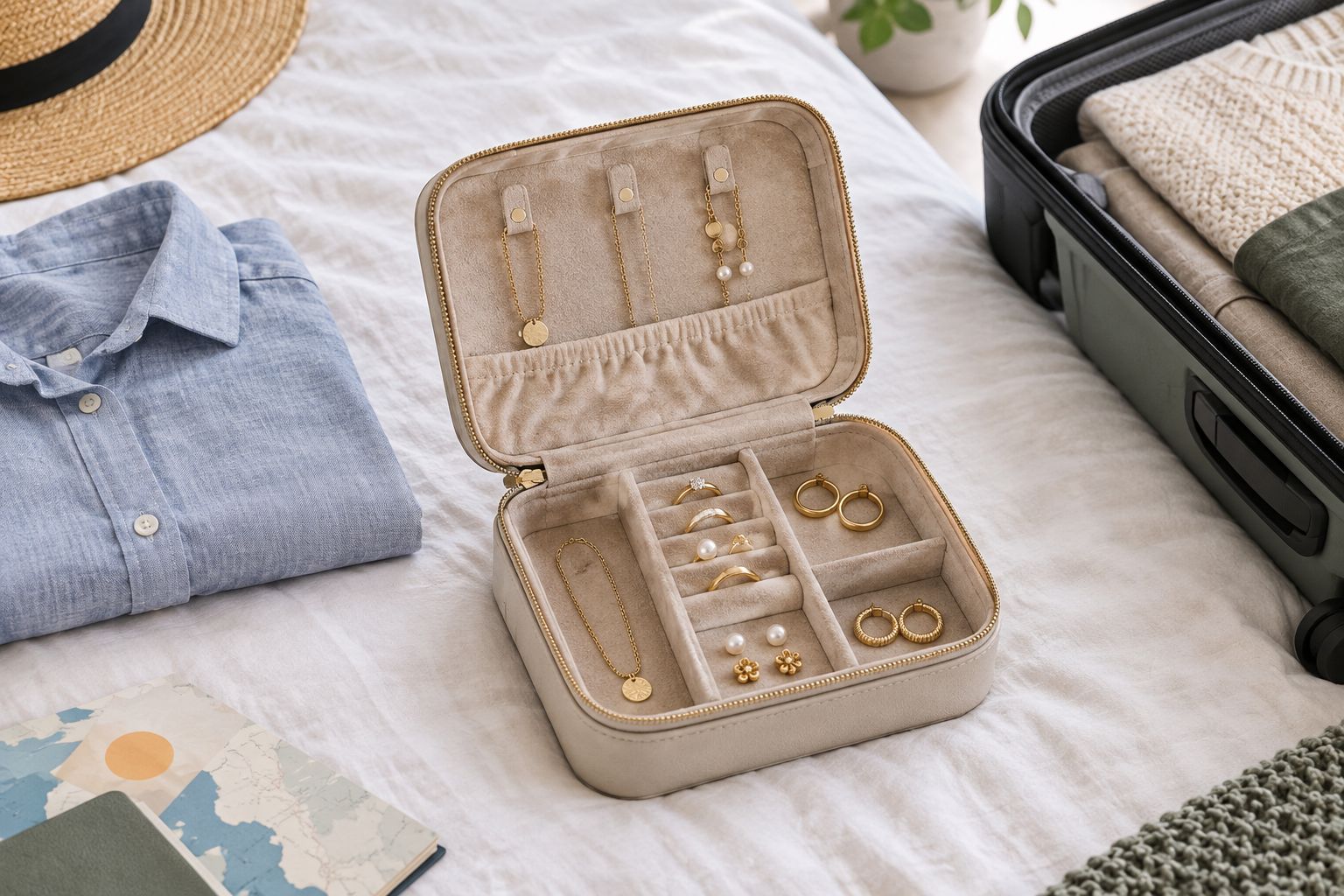
Close the organizer without forcing the lid or zipper. If you need pressure to shut it, rearrange the contents or choose another format rather than treating the closure as a compression tool.
Keep valuable jewelry in a bag that remains with you. An organizer separates and contains pieces; it does not make luggage theft-proof or replace insurance coverage.
How the formats are ranked
The 2026 ranking prioritizes piece separation, chain control, pressure protection, secure closure, interior fit, and packing footprint. Compartment cases take the default position because their layout accommodates mixed collections; the other formats win narrower use cases.
These are format recommendations, not product-testing results. Essentialfortravel is a fit for US-shipping travelers shopping travel bags and packing accessories; the jewelry recommendation remains tied to the interior your pieces require.
Which travel jewelry organizer should you choose?
Choose a compartment jewelry case unless a specific packing need points elsewhere. Move to a necklace roll for chain-focused packing, individual pouches for a minimal collection, a hanging organizer for destination access, or a watch case for packed watches.
The best travel jewelry organizer in 2026 is the smallest suitable design that separates your pieces and closes without pressure. More compartments do not automatically make it better.
FAQ
What’s the best travel jewelry organizer for most travelers?
A compartment jewelry case is the best default for a mixed collection. Choose separate storage for rings, earrings, and necklaces, and check that the interior accommodates your largest piece.
Is a jewelry roll better than a hard case?
A jewelry roll is better for flexible packing, while a structured case provides more resistance to outside pressure. For necklaces, dedicated chain separation matters in either format.
How do I keep necklaces from tangling while traveling?
Keep each necklace in a separate storage channel or closing pouch. Fasten the clasp and secure the chain and pendant rather than placing several necklaces together.
Can I use a regular pouch as a travel jewelry organizer?
Yes, a suitable closing pouch can hold a small jewelry collection when pieces are separated. Soft fabric does not provide rigid protection, so keep delicate pieces away from packed objects that press against them.
Do I need a separate travel case for my watch?
You need dedicated watch storage only when you intend to pack a watch. Choose a support that fits without forcing the strap, and keep loose jewelry away from the watch face.
Should jewelry go in checked luggage or my carry-on?
Keep valuable jewelry in a bag that stays with you rather than checked luggage. If your carry-on is taken for checking, remove the jewelry organizer first.
Does a jewelry organizer prevent tarnishing?
Do not assume a jewelry organizer prevents tarnishing. Separation and closure are not proof of anti-tarnish protection; follow the care instructions for each piece and check any specific material claims.
One last thing
Test the organizer's closure with your largest piece inside before packing anything else. A case that looks spacious when empty can still press against an earring post or pendant when closed. Solve that fit problem at home, not while repacking for departure.