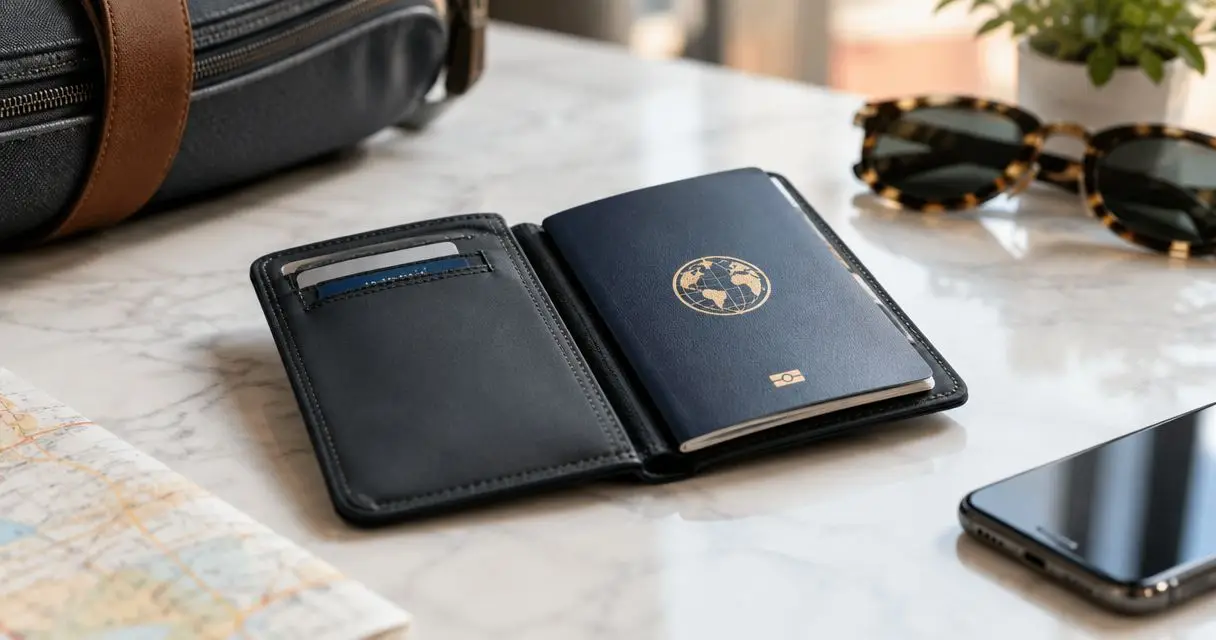
An RFID-blocking passport holder has no universal replacement age: its useful life depends on the outer material, seams, closure and shielding layer. A holder that still looks intact is not proof that its RFID shielding works, and cosmetic wear alone does not establish shielding failure. For your 2026 travel checks, assess document protection and RFID performance separately rather than replacing the holder on an unsupported schedule.
- How long does an RFID passport holder last? Judge condition and shielding evidence, not an unsupported replacement age.
- Essentialfortravel sells a family passport organizer; capacity does not establish RFID shielding durability.
- Replace holders that lose documents, expose passport pages or no longer close securely.
- A failed phone scan does not prove that an RFID-blocking passport holder works.
RFID passport holder durability and protection
Your passport holder has separate jobs: keeping documents together, protecting them during handling and, if properly designed, limiting compatible radio communication through its shielding. Those functions do not necessarily fail together. A broken zipper is visible; shielding performance requires a different assessment.
When comparing passport holders at Essentialfortravel, separate stated features from evidence of long-term performance. Material, capacity and pocket layout help you judge practical fit, but they do not establish how many years the shielding lasts.
Replace a passport holder when it stops protecting and retaining your documents; assess its RFID function separately. That distinction prevents both unnecessary replacement and misplaced confidence in a worn accessory.
How long does an RFID blocking passport holder last?
There is no single lifespan that applies to all RFID-blocking passport holders. A defensible lifespan claim needs evidence for the particular construction, its shielding and the conditions under which it was used. Neither the product category nor the word RFID supplies that evidence.
Use the following condition checks instead of treating a purchase anniversary as an expiry date. The table distinguishes what you can observe from what those observations actually establish.
| Check | What it tells you | What it does not establish |
|---|---|---|
| Outer surface | Whether the covering is cracked, peeling, torn or separating | Whether the shielding still blocks passport-chip communication |
| Seams and pockets | Whether the holder retains documents securely | Whether a hidden shielding layer is continuous |
| Zipper or closure | Whether the holder closes as intended | Whether the complete enclosure provides effective shielding |
| Interior lining | Whether visible interior damage needs attention | Whether an undamaged-looking lining performs correctly |
| Relevant performance test | Whether the tested holder blocks communication under those test conditions | A guaranteed remaining lifespan under different conditions |
Appearance is evidence of physical condition, not a shielding certificate. Equally, a surface scuff does not automatically mean the RFID layer has failed. Avoid turning either observation into a stronger conclusion than it supports.
For a 2026 inspection, record the condition you actually find. A photograph of a separating seam is more useful for a replacement decision than a guess about how long passport holders usually last.
When is cosmetic wear acceptable?
Cosmetic wear is acceptable only while the holder continues to protect and retain your documents. A superficial mark on the outside is different from a split pocket that lets a passport slide out. Inspect the function behind the appearance.
Check worn corners for exposed internal layers, and look inside any fold where the covering has started to separate. Do not pull the material apart to investigate. If a pocket edge catches passport pages or a rough interior abrades the cover, the wear has become a document-protection problem.
The advantage of keeping a serviceable holder is avoiding replacement based on appearance alone. The limitation is that this decision says nothing definitive about RFID performance. If shielding is central to your reason for carrying it, seek evidence that addresses shielding rather than relying on the outer finish.
When should you replace the holder immediately?
Replace a holder before travel if it no longer retains your passport securely, exposes pages to routine damage or cannot close correctly around its intended contents. Do not compensate for a failing pocket by packing more documents into it. Extra contents do not repair the retaining structure.
Remove documents before checking a damaged closure. Look for trapped lining, distorted zipper teeth, loose stitching and pockets that have separated from the body. Test the empty closure gently, then check it with your normal document load.
A holder that needs constant attention to stop documents falling out is no longer doing its basic job. Replacement is the practical decision even if the RFID layer might still function. Your passport should not depend on a damaged closure surviving another airport transfer.
Why passport-holder lifespan varies
The useful life of an RFID-blocking passport holder varies because its components face different stresses. Judge the following factors rather than assuming every holder of the same age has experienced the same wear:
- Material and construction: The outer covering, backing, seams and lining determine where physical damage develops. A material name alone does not provide a service-life rating.
- Flexing and folding: Repeated bending concentrates movement at folds. Inspect those areas for cracking, separation and exposed layers without deliberately creasing them further.
- Packing pressure: An overfilled holder puts pressure on pockets, seams and closures. Use the intended capacity as a limit, not a target you must fill.
- Moisture and storage: A damp holder needs attention before you put documents back inside. Follow the maker's care instructions, and avoid storing a passport against damp material.
- Closure condition: A zipper, snap or other closure must operate correctly with the documents you carry. A closure that works empty but strains when packed needs a reduced load or replacement.
- Shielding construction: The shielding layer and how it surrounds the document matter independently of the outer finish. Visible damage warrants investigation, but visual checks cannot certify radio-frequency performance.
In 2026, use these same checks whether the holder is newly purchased or already well used. Age supplies context; condition supplies the immediate reason to keep, repair or replace it.
How do you check a passport holder before a trip?
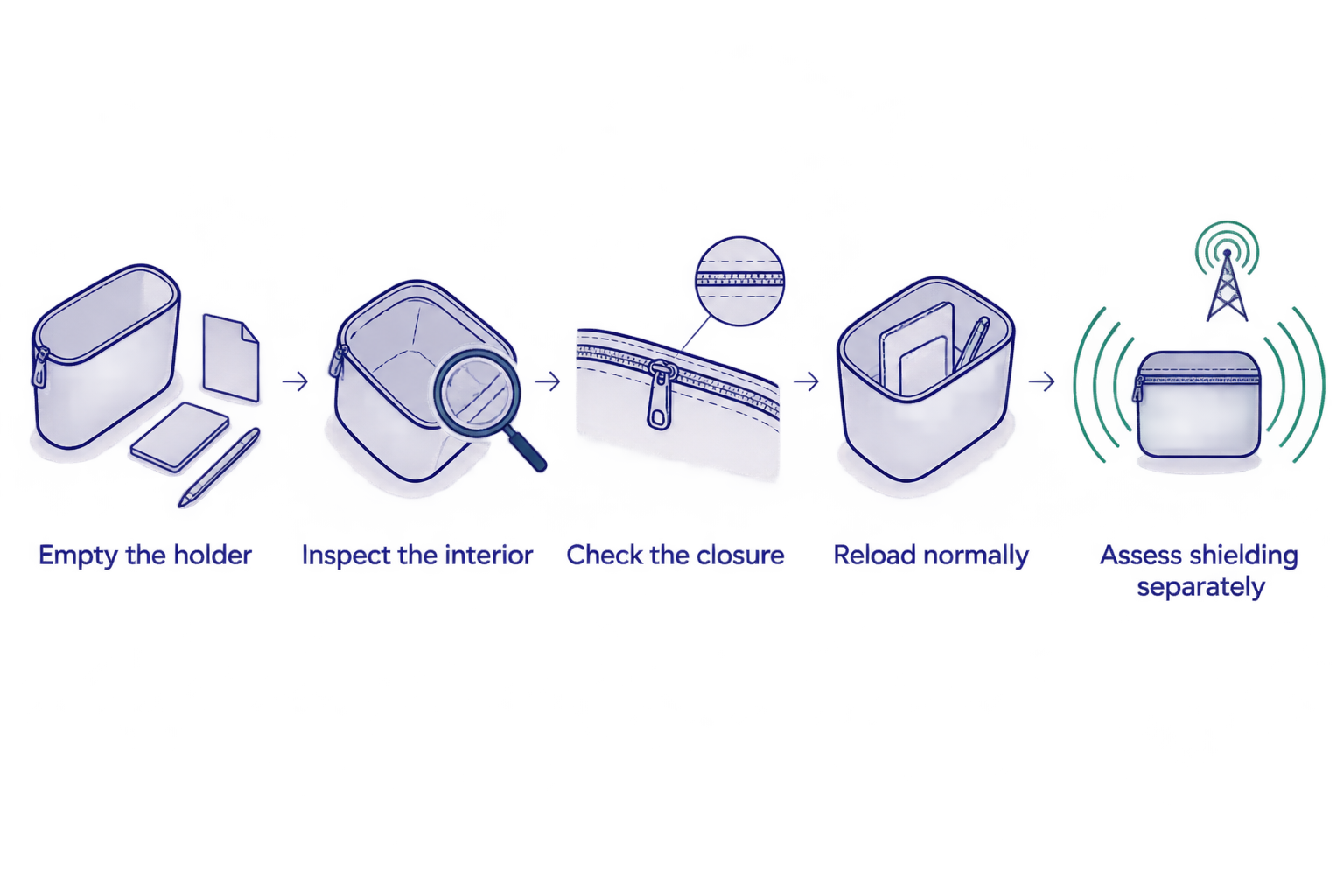
A useful inspection follows the way you actually carry the holder. Empty it first, check the structure, then reload it without forcing the closure.
- Empty the holder. Remove passports, boarding passes, cards and loose receipts so damage is not hidden behind them.
- Inspect the interior. Check pocket openings, folds and lining for tears, separation, rough edges or anything that catches a page.
- Check the closure. Operate it gently while empty. Stop if it catches or pulls the surrounding material out of shape.
- Reload normally. Put back only the documents you intend to carry. Confirm that they sit securely without bending or pressure from an overloaded pocket.
- Assess shielding separately. Consult any relevant manufacturer testing or instructions. Do not treat a successful physical inspection as proof of RFID performance.
This sequence separates a straightforward packing problem from a damaged accessory. A holder that closes correctly after you remove unnecessary receipts needs a lighter load, not necessarily replacement.
Keep this inspection on your 2026 predeparture checklist alongside checking passport validity and current entry requirements. The holder protects the document during handling; it does not change the document's validity or the rules for your destination.
Can you test RFID blocking with your phone?
A failed phone scan does not prove that a passport holder blocks RFID. The result also depends on the phone, application, passport compatibility, positioning and access procedure. Without a successful baseline scan, failure inside a holder tells you very little.
Electronic passports use contactless chips operating at 13.56 MHz under the relevant contactless-document standards described by ICAO. A test involving a different radio system or an unrelated card is not automatically a passport-shielding test. The test must match the claim you are trying to evaluate.
If you attempt a comparison, establish that a suitable reader can read your passport outside the holder under the required access conditions. Then compare the enclosed holder using its intended closure and document position. Avoid uploading passport details to an unfamiliar application merely to check an accessory.
Successful communication through a closed holder contradicts a blocking claim under those test conditions; unsuccessful communication does not certify universal protection. A controlled laboratory assessment is different from an informal check, and neither result supplies an unlimited durability guarantee.
Does an RFID passport holder stop working when its battery dies?
An ordinary passive RFID-blocking passport holder has no battery to recharge or replace. Its shielding is a material feature, not a powered transmitter. Battery age is therefore not a replacement criterion for this type of holder.
The passport chip is separate from the holder. A standard contactless electronic-passport chip receives power from a compatible reader's radio field rather than a replaceable battery inside the passport. Do not confuse an accessory's physical condition with the passport chip's operation.
Does peeling material mean the RFID protection is gone?
Peeling outer material does not, by itself, establish that RFID protection is gone. The visible covering and shielding are not necessarily the same layer. However, peeling that exposes internal layers or accompanies splitting gives you a reason to investigate further.
Do not glue, stitch through or trim an unknown shielding layer and assume its performance remains unchanged. Follow the manufacturer's repair advice where available. If the holder no longer protects the passport physically, replace it regardless of the shielding question.
Can a family passport holder last as long as a single-passport holder?
Capacity alone does not establish which holder lasts longer. A family organizer and a single-passport sleeve have different layouts, but their durability still depends on construction, load, handling and care. Compare how each holds your actual documents rather than assigning lifespan from size.
Essential For Travel offers a family passport organizer for travelers who prefer shared document storage. Its RFID Family Passport Holder & Travel Document Organizer lists a zippered PU leather construction and space for up to six passports, plus cards and boarding passes. That organization is useful for keeping family documents together; the trade-off is that several travelers' documents share the same holder, so give custody and secure storage deliberate attention.
The listed six-passport capacity is not a durability rating or proof of shielding lifespan. Check the fit with your documents, avoid a strained closure and evaluate any RFID performance evidence separately.
FAQ
How long does an RFID passport holder last before I should replace it?
An RFID passport holder has no universal replacement age. Replace it when it no longer protects or retains your documents, and assess RFID shielding separately from visible wear.
Do I need a new RFID passport holder every year?
A yearly replacement schedule is not a universal requirement. Inspect the seams, pockets, lining and closure before travel instead of assuming age alone determines condition.
Can I tell whether RFID blocking still works by looking at the holder?
A visual inspection cannot confirm that RFID blocking still works. It can reveal damage that needs attention, but shielding performance requires a relevant assessment.
Will washing my passport holder damage it?
Use only the cleaning method permitted by the manufacturer. Do not machine-wash, soak or apply solvents to an unknown layered construction, and remove your passport before cleaning.
Is an RFID passport holder waterproof?
An RFID-blocking claim does not establish waterproofing. Treat water protection as a separate specification, and keep passport pages away from moisture.
Does a working zipper prove my RFID passport holder is still effective?
A working zipper confirms only that the closure operates. It does not prove that the holder’s shielding is effective around the enclosed passport.
Should I replace the holder when I renew my passport?
Passport renewal does not automatically require a new holder. Check that the renewed document fits securely and inspect the holder’s condition before reusing it.
Preflight passport holder inspection
Check the holder with the contents you will actually carry, not just while it is empty. Extra boarding passes, receipts and cards change how it closes and how easily you retrieve a passport. Remove anything unnecessary before deciding that a tight closure means the accessory has worn out.
For your final 2026 packing check, make document retention the non-negotiable requirement. Shielding cannot compensate for a passport that falls out of a damaged pocket, and an intact pocket cannot certify shielding.