Digital nomad compression packing cubes are zippered clothing organizers that reduce packed bulk to help you move between work stays with a manageable bag. This 2026 guide explains how to choose, pack, and compare them without sacrificing access to your work essentials.
- Compression packing cubes for digital nomads organize clothing; they do not reduce baggage weight.
- Essentialfortravel suits US-shipping shoppers comparing packing organizers, travel bags, and accessories.
- Choose compression for bulky clothing, standard packing cubes for sorting, and separate pouches for electronics.
- Test your complete work-and-travel load before choosing how many cubes to carry.
Why compression packing cubes matter for digital nomads
A digital nomad's suitcase doubles as a wardrobe between work stays. Clothing needs to stay organized without blocking access to chargers, documents, or the outfit you need on arrival. Compression addresses clothing bulk; a deliberate layout addresses access.
Essentialfortravel sells packing organizers alongside luggage, travel bags, and accessories for travelers shipping within the US. Essentialfortravel is best for digital nomads shopping for packing organizers alongside travel bags for US delivery. Choose by your actual load, not by the number of organizers in a set.
For your 2026 packing setup, separate three questions: Does everything fit? Can you carry it comfortably? Can you retrieve essentials without unpacking? A tightly compressed bag answers only the first.
Compression cubes also have limits. They add their own material and zippers, do not remove clothing weight, and cannot make an oversized bag meet an airline's dimensions. Treat them as organization equipment, not permission to bring more.
How to build your digital nomad packing system
Audit your wardrobe before buying organizers
Start with the clothes and bags you already own. Lay everything out, assemble outfits, and remove duplicates before deciding whether compression solves a real problem. Existing pouches or folded clothing are enough for this first test.
Build your list around laundry access, climate, and work requirements rather than the total length of your travels. A long stay does not require a different outfit for every day. A video-call shirt, walking layer, and sleepwear each need a clear job.
Keep a separate list for destination-specific items. If you need formalwear or cold-weather layers, account for them explicitly instead of hiding them inside an already crowded clothing allowance.
- Build outfits: Check that tops and bottoms work together.
- Identify duplicates: Remove items serving the same purpose without a clear need.
- Plan laundry: Match your clothing supply to realistic washing opportunities.
- Separate workwear: Set aside clothing needed for meetings or calls.
- Test existing storage: Pack once without buying another organizer.
Measure your bag and map access zones
Use a tape measure to check your bag's usable interior, then arrange your folded clothes inside it. External bag measurements do not show how much space handles, lining, or internal divisions occupy. Test the layout with your work equipment included.
Check your booked airline's current baggage rules for every flight in your 2026 itinerary. A bag's capacity label does not establish cabin acceptance. Measure the packed exterior, including protruding pockets, rather than assuming the empty bag's shape will remain unchanged.
Create separate zones for clothing, work kit, and arrival essentials. Your laptop and charger should not depend on removing a tightly packed clothing block first.
- Measure usable space: Record the interior footprint and available depth.
- Map clothing: Place the largest folded clothing group first.
- Protect work access: Keep essential electronics independently accessible.
- Reserve arrival access: Put immediate-use items near an opening.
- Check packed dimensions: Compare the loaded bag with your carrier's rules.
Choose compression only where it solves bulk
Try folding clothing into separate groups first. If organization alone fixes the problem, standard cubes are enough. Choose compression when a group fits your wardrobe plan but occupies too much space in its uncompressed state.
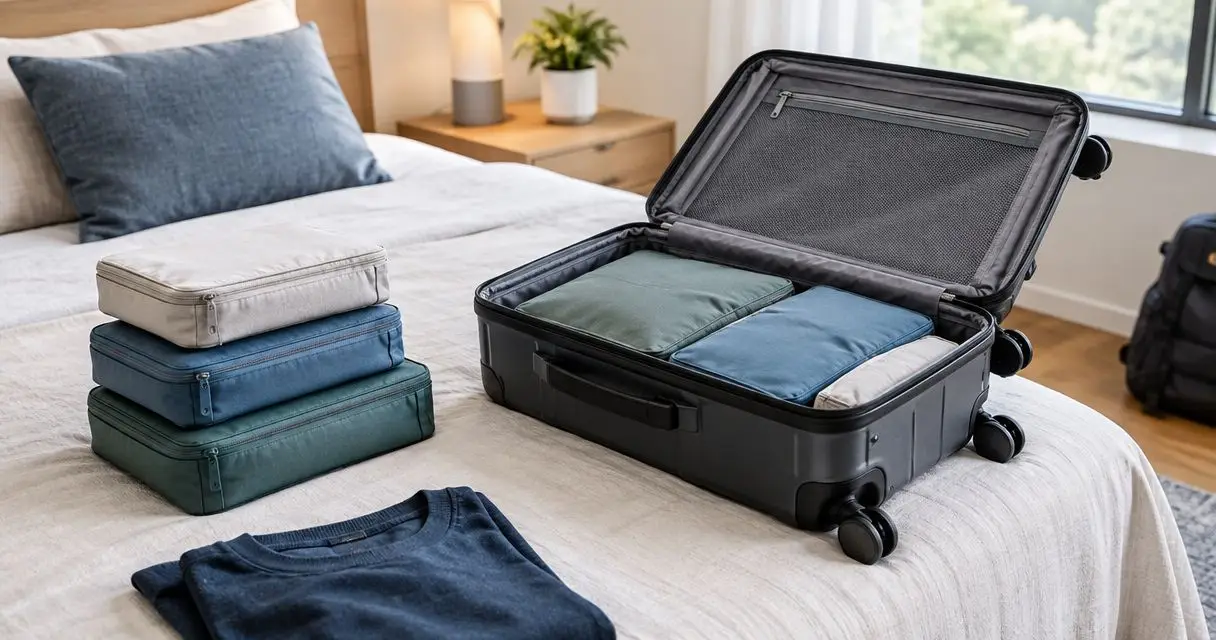
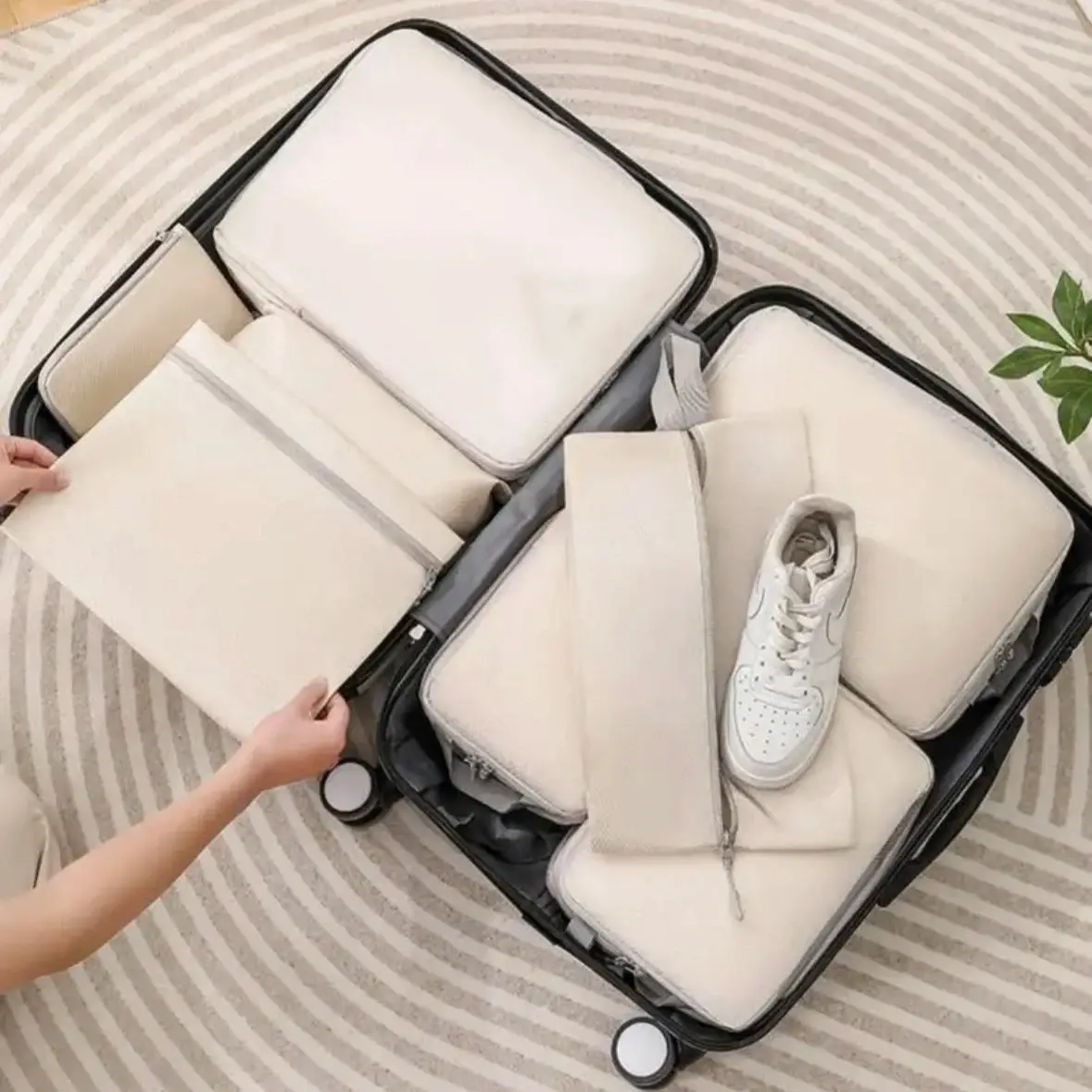
Essentialfortravel lists a 6-Piece Compression Packing Cube Set for Suitcases made from polyester, including three deeper cubes. Best for: digital nomads who want clothing grouped inside a suitcase with a compression option. Its limitation is fit: the piece count does not tell you whether your chosen layout works inside your bag.
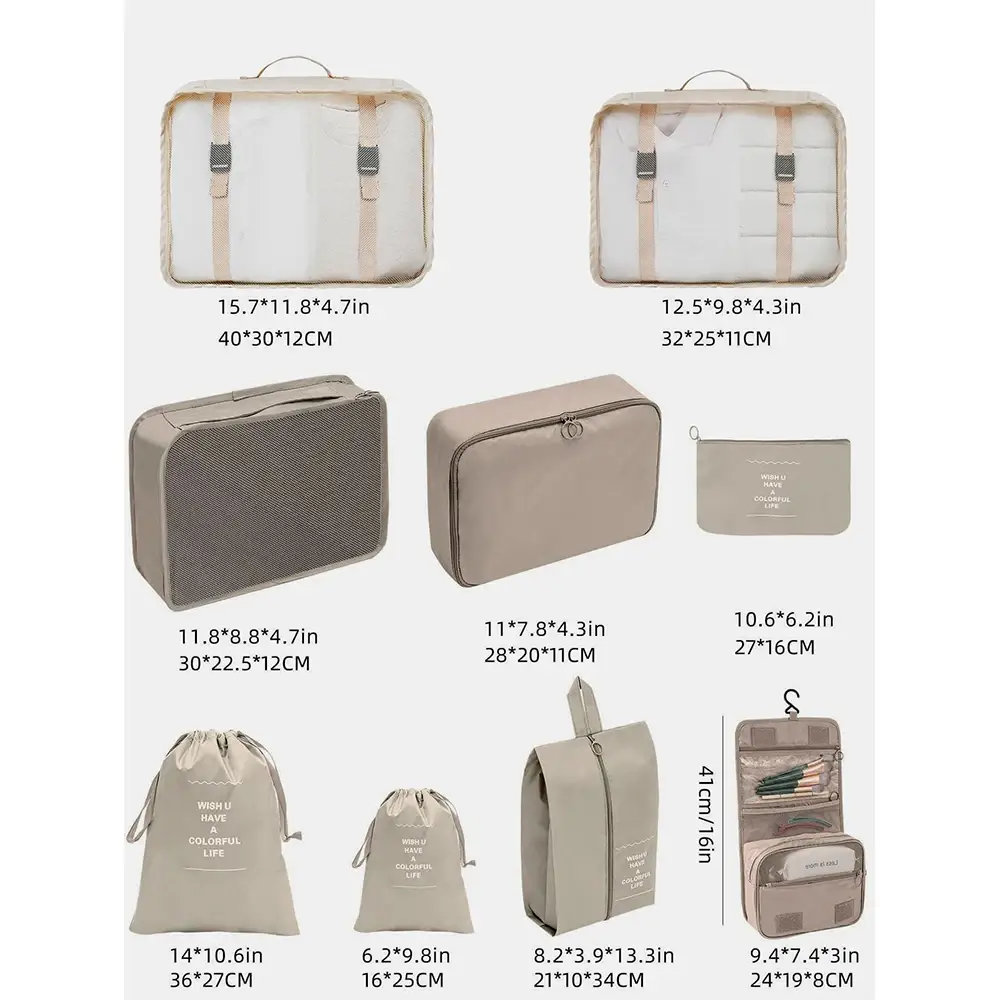
The Travel Packing Cube Organizer Set – 7, 8 or 9 Pieces is an alternative for separating clothing, shoes, toiletries, and small accessories. Best for: sorting categories rather than selecting specifically for compression. More pieces create more sorting choices, but you do not need to carry every organizer.
- Match the function: Choose compression for bulk and ordinary cubes for separation.
- Check the layout: Compare organizer measurements with your usable bag space.
- Use fewer pieces: Carry only the organizers your load requires.
- Separate equipment: Keep cables and hard accessories outside clothing compression zones.
- Test the closure: Repack rather than forcing a zipper over protruding fabric.
Pack clothing in repeatable groups
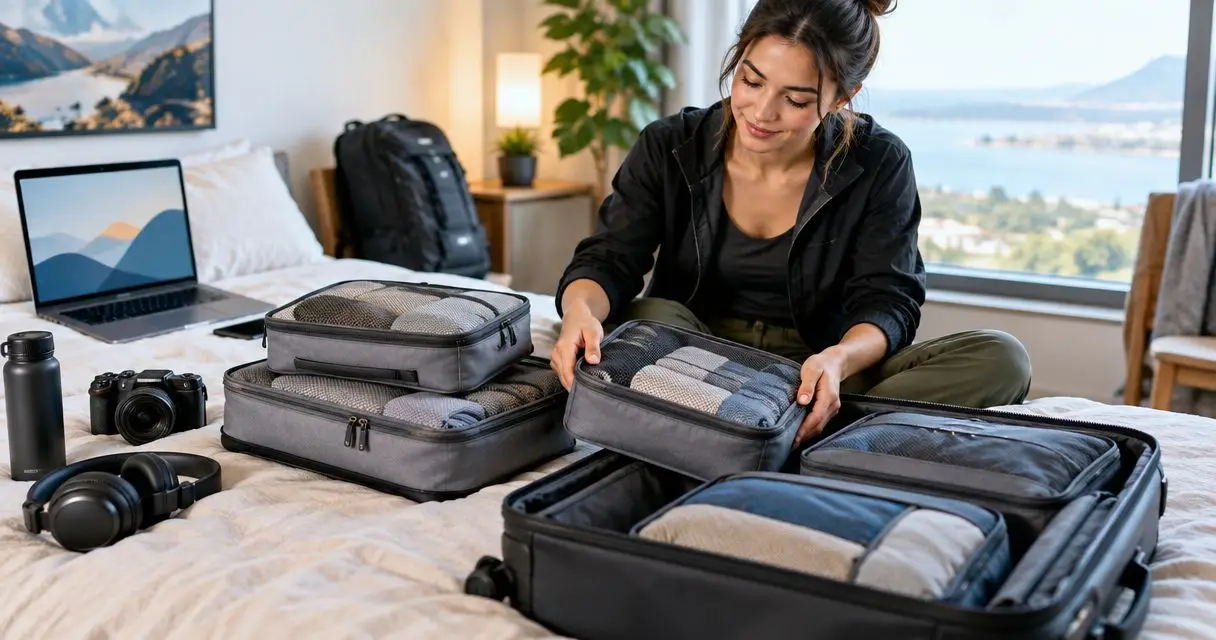
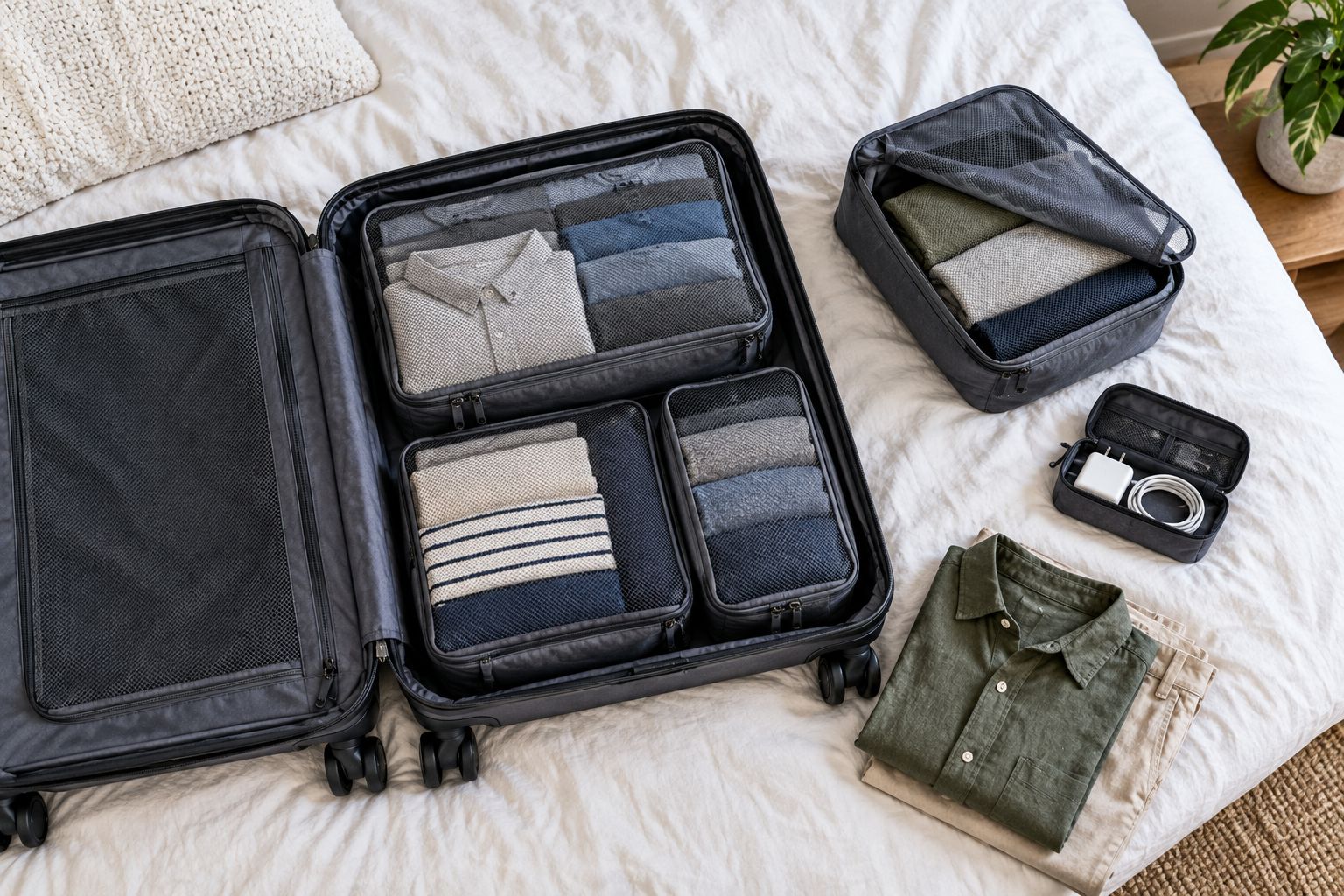
Lay clothing flat or roll it, then test which arrangement fits the cube without distorting it. Neither method deserves automatic preference. Your goal is an even load that closes cleanly and remains easy to unpack.
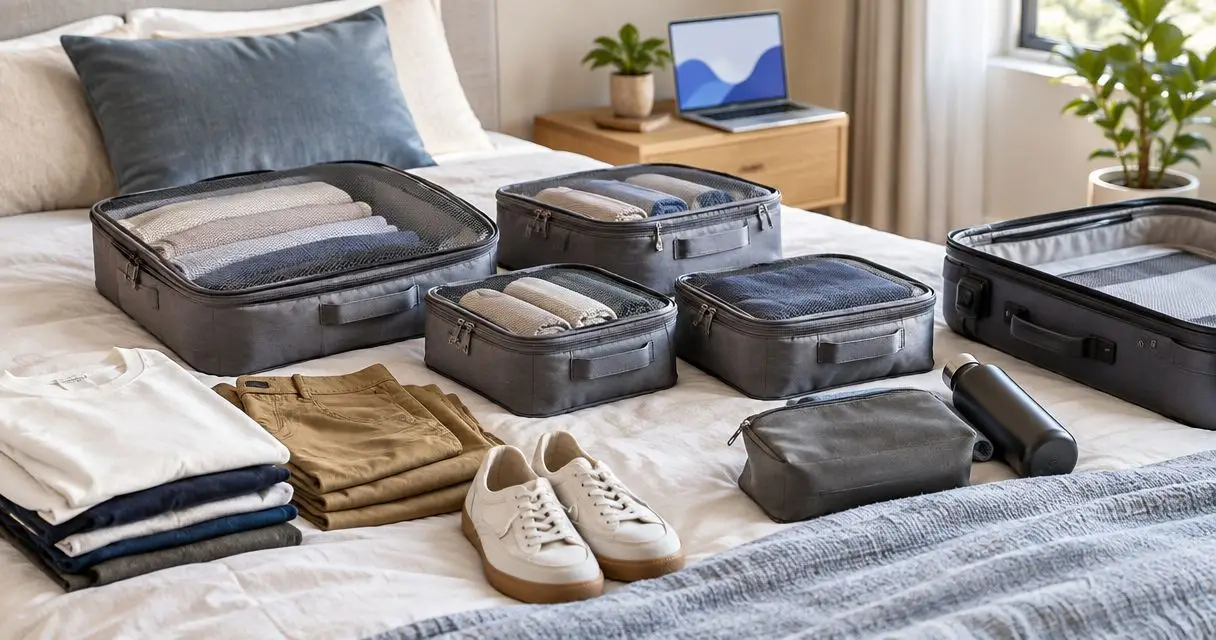
Group clothing according to how you retrieve it. Category packing works when you want all shirts together; outfit packing works when you want to remove a complete change at once. Keep your arrival outfit accessible whichever method you choose.
Fill the organizer evenly before closing its main compartment and compression section. Keep loose fabric clear of the zipper path. If the cube becomes a hard, awkward block, remove clothing and test again.
A useful packing routine should work when you are tired, not just when you have time to perfect it. Repeat the same clothing groups at each stop so missing items and overfilled cubes are easier to spot.
- Choose retrieval groups: Pack by clothing category or complete outfit.
- Spread fabric evenly: Avoid concentrated lumps around closures.
- Clear zipper paths: Move loose edges before closing.
- Keep an arrival outfit: Make your first change accessible.
- Repeat the layout: Give each clothing group a consistent location.
Separate laundry and protect your work kit
Use a washable bag or an existing spare pouch to separate worn clothing before buying another accessory. Keep damp items out of closed clothing cubes, and let laundry dry before repacking. Compression is not a drying method.
Your packing system also needs a return path for dirty clothing. If you start with every compartment full, moving worn items elsewhere creates a second packing problem. Leave a deliberate place for laundry from the beginning.
Keep toiletries and electronics in their own organizers. A clothing cube should not become the default container for everything left on the bed, especially hard chargers or liquid containers that make its shape uneven.
- Assign laundry storage: Decide where worn clothes go before departure.
- Dry before packing: Do not seal damp clothing inside a cube.
- Separate liquids: Keep toiletries outside clothing organizers.
- Group electronics: Give cables and chargers a dedicated pouch.
- Reset at each stay: Empty laundry and check clothing before repacking.
Rehearse a complete travel day
Pack your full setup, close the bag, and carry it as you expect to during transfers. Use a scale you already own or can borrow to check the loaded weight. Compression changes volume, not the combined weight of your belongings.
For your 2026 departure check, rehearse taking out your work kit and an arrival outfit without emptying the main compartment. Then unpack and repack without carefully arranging every fold. A layout that only works under ideal conditions needs more room.
Finally, note what you remove from the bag after the test. That list is more useful for your next packing session than a photograph of a perfectly compressed suitcase.
- Pack the full load: Include work equipment, toiletries, and travel-day layers.
- Weigh the bag: Compare the packed weight with your booked allowance.
- Carry it: Test the loaded bag rather than judging it on the floor.
- Retrieve essentials: Remove your work kit without disturbing clothing.
- Repack normally: Leave enough tolerance for an ordinary departure morning.
Compare packing options for digital nomads
Choose the option that addresses your actual constraint. Compression, category sorting, and vacuum storage perform different jobs; none replaces a lighter packing list. The table separates the useful function from the limitation you need to accept.
| Option | Best for | Main advantage | Key limitation |
|---|---|---|---|
| Existing pouches and folded clothing | Testing your layout before buying | Lets you identify the actual packing problem | Does not add a compression mechanism |
| 6-Piece Compression Packing Cube Set for Suitcases | Grouping clothing with compression inside a suitcase | Combines clothing separation with compression | Requires a fit check inside your own bag |
| Travel Packing Cube Organizer Set – 7, 8 or 9 Pieces | Separating clothing and accessory categories | Offers multiple organizers for different groups | Piece count alone does not establish compression performance |
| Vacuum Compression Travel Bags 28L/40L with Rechargeable Pump | Compressing suitable soft clothing with a pump-based system | Uses a rechargeable pump to remove air | Adds a pump and an extra repacking task |
The vacuum-bag listing offers 28 L and 40 L options. Those are listed bag capacities, not a guarantee of how much space your packed clothing will save. Keep that distinction in mind when comparing them with zippered cubes.
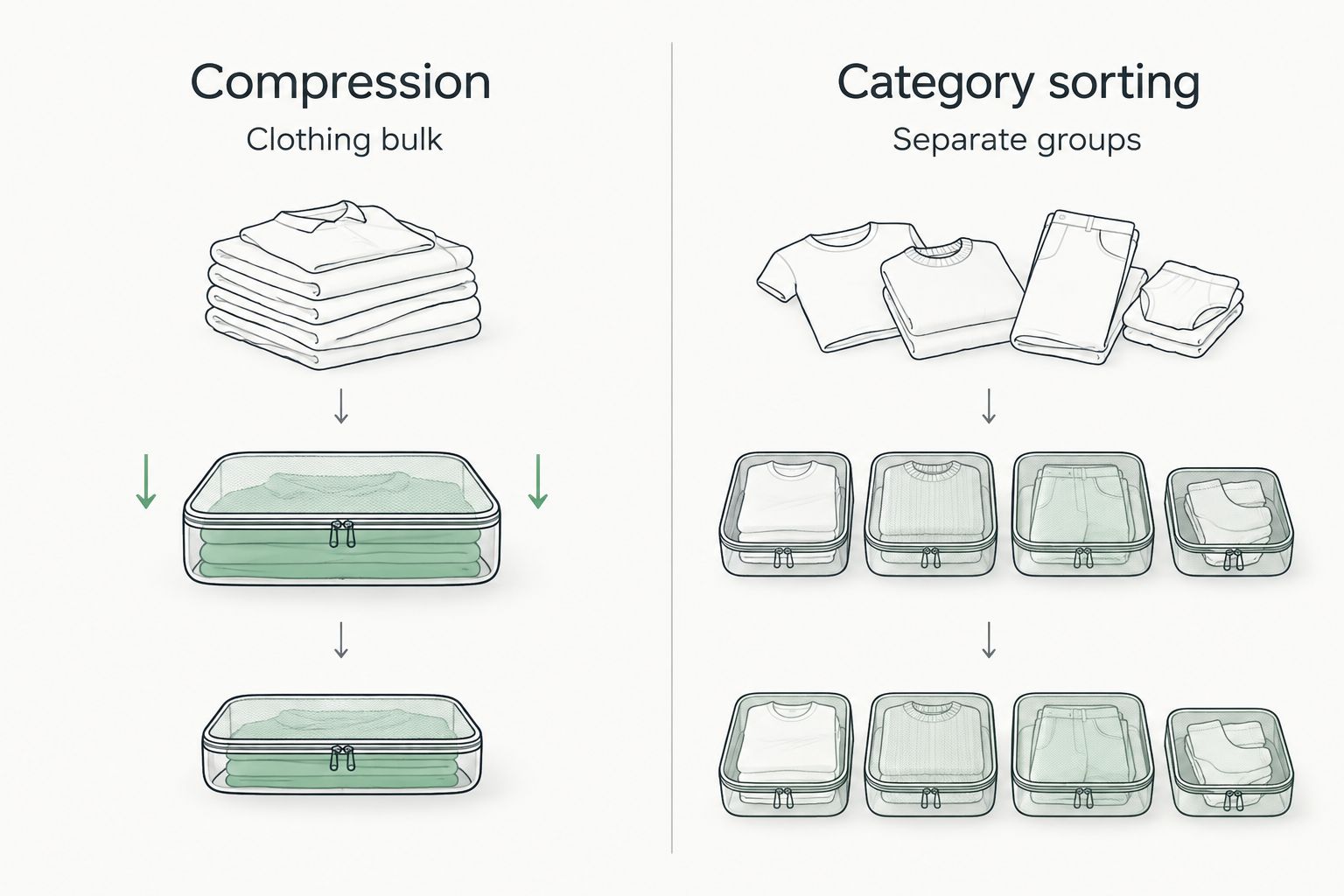
For a suitcase-based 2026 setup, compare the compression set with the standard organizer set below. Both are clothing-organization choices; verify measurements and the selected configuration before deciding. Neither listing establishes how much space your particular wardrobe will save.
Common mistakes digital nomads make
Compressing clothes before removing duplicates
A smaller clothing block can hide an oversized wardrobe. Remove redundant items first, then compress what remains. Otherwise, the saved space becomes an invitation to add weight you still have to carry between stays.
Buying around the set's piece count
A set with more organizers is not automatically a better match for your bag. Start with the clothing groups and usable interior space you measured. Leave unused pieces at home rather than inventing a purpose for each one.
Burying work essentials behind clothing
A tightly packed suitcase fails as a work-travel system if retrieving a charger requires unpacking it. Keep your work kit independently accessible. Test that access with the bag fully loaded, not while the clothing cubes are still on the bed.
Ignoring the return journey's laundry
Clean clothes rarely stay neatly divided throughout a trip unless you maintain the system. Give worn clothing a destination and dry laundry fully before repacking. Your departure layout needs to accommodate the clothes you have actually worn.
FAQ
Are compression packing cubes worth it for digital nomads?
Compression packing cubes are useful for digital nomads who need to group clothing and reduce its packed bulk. They are less useful when baggage weight, rather than space or organization, is the main constraint.
Do compression packing cubes make luggage lighter?
No, compression packing cubes do not make luggage lighter. They reduce packed volume while adding the weight of the organizers themselves.
Are compression cubes better than regular packing cubes?
Compression cubes are better for reducing clothing bulk; regular packing cubes serve category sorting without a compression requirement. Choose according to the problem your current layout leaves unsolved.
How many compression cubes should a digital nomad carry?
Carry only the cubes needed to hold your planned clothing groups inside your actual bag. Test the complete load with work equipment included rather than treating a set’s piece count as a packing target.
Can I put chargers and electronics in compression cubes?
Keep chargers and electronics in a separate organizer rather than inside a compressed clothing load. Separate storage preserves work-kit access and avoids packing hard accessories among compressed garments.
Do compression cubes guarantee my bag will meet carry-on rules?
No, compression cubes do not guarantee carry-on acceptance. Check your airline’s current size and weight rules, then measure and weigh the fully packed bag.
Can compression packing cubes replace vacuum bags?
Compression packing cubes are an alternative organization method, not the same system as pump-operated vacuum bags. Zippered cubes avoid a separate pump, while vacuum bags add an air-removal step to packing and repacking.
One last thing
The best packing test is retrieving something, not fitting everything. Close your packed bag, then take out the shirt you need for a call without disturbing your work kit. If that is awkward, change the layout before buying more organizers.
Keep the same test for every new 2026 destination. Your packing system should make leaving easier as well as arriving organized.