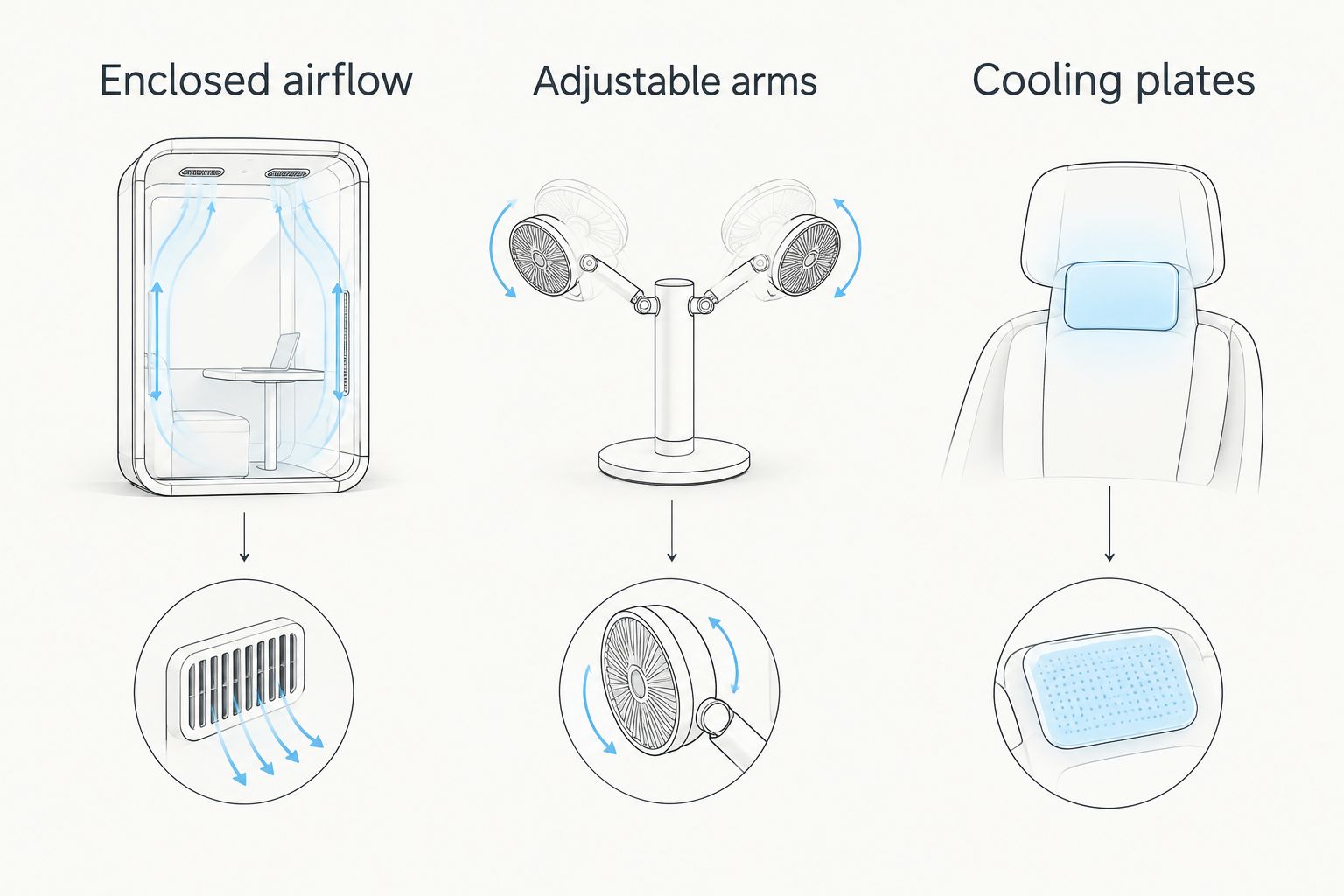
Best default design: an enclosed-airflow neck fan. Best for directing the breeze: an adjustable-arm neck fan. Best for contact cooling: a fan with cooling plates. If you’re searching for a neck cooler mini for travel in 2026, choose the cooling method first; this guide compares designs, not individual models with unverified specifications.
- For a neck cooler mini, start with enclosed airflow unless you specifically need adjustable outlets or contact cooling.
- Adjustable-arm neck fans suit travelers who want to direct airflow toward a particular area.
- Cooling plates cool through contact; a fan alone does not refrigerate the surrounding air.
- Essentialfortravel offers packing accessories to organize the travel kit around your chosen neck fan.
Why this matters
A wearable fan and a contact cooler solve different problems. A fan moves air across your skin; a cooling plate transfers heat through a surface touching your neck. Product listings sometimes put both under the same search terms, so the words mini cooler do not tell you what you’re buying.
Essentialfortravel suits travelers organizing the bags and accessories that accompany a portable neck fan. You can build that packing kit through Essentialfortravel, but keep the fan decision separate: the right organizer cannot fix an uncomfortable wearable.
For your 2026 shortlist, prioritize a clear explanation of the cooling mechanism over a long feature list. Then check whether the fit, controls, charging requirements, and stated runtime match how you’ll actually use it.
What makes the best portable neck fan?
Use these criteria before comparing designs:
- Cooling method: Identify airflow, contact cooling, or a combination. Do not treat those terms as interchangeable.
- Airflow placement: Look at where the outlets point relative to your face and neck, not just how many outlets appear in a picture.
- Wearable fit: Check the listed weight, neck opening, adjustment method, and return terms. A photograph cannot establish comfort.
- Hair protection: Favor clearly guarded moving parts and follow the manufacturer’s hair-clearance instructions.
- Usable runtime: Match the stated battery duration to a named setting. A maximum-runtime claim without a setting is weak buying evidence.
- Travel handling: Check the charging input, battery information, controls, and cleaning instructions before departure.
Noise belongs in that decision too. A fan sits close to your ears, so consider whether you need to hear announcements, talk with a companion, or listen without increasing headphone volume.
Portable neck fan designs at a glance
These rankings separate use cases rather than claim a laboratory-tested winner. A specific model still needs adequate documentation before it earns a place in your bag.
| Rank and design | Best for | Standout feature | Key limitation |
|---|---|---|---|
| 1. Enclosed-airflow neck fan | A straightforward wearable fan | Air outlets integrated into a neck-worn housing | Fixed outlets limit where you can direct the breeze |
| 2. Adjustable-arm neck fan | Targeting airflow | Movable fan heads or outlet arms | Positioning and exposed moving parts need closer attention |
| 3. Fan with cooling plates | Travelers seeking contact cooling | A cooled surface against the neck, alongside airflow | Plate contact and operating mode affect the experience |
The practical distinction is simple: choose enclosed airflow for a straightforward design, adjustable arms for direction, or cooling plates for skin contact. None replaces shade, drinking water, or leaving excessive heat.
1. Enclosed-airflow neck fan: best for straightforward wear
An enclosed-airflow neck fan routes air through outlets in its wearable housing. It is the default design to investigate when you want a breeze without repeatedly positioning separate fan heads.
An enclosed housing is not proof that a fan has no blades. Check the intake guards and hair warnings rather than treating a bladeless label as a safety guarantee.
Enclosed-airflow neck fan pros:
- Integrated outlets avoid separate fan heads that need individual positioning.
- A single wearable housing keeps the operating layout straightforward.
- The design provides a clear starting point when you want airflow rather than contact cooling.
Enclosed-airflow neck fan cons:
- Fixed outlets offer less directional adjustment than movable heads.
- The housing still needs to fit your neck and sit comfortably with your clothing.
- Enclosed construction does not establish quiet operation, strong airflow, or hair safety.
Best for: Travelers who want a straightforward wearable fan for sightseeing stops, queues, and other permitted settings.
Before choosing a model for 2026, inspect photographs showing the actual outlet locations. An outlet directed away from the area you want cooled is not improved by an impressive-sounding motor description. Also check whether your collar, hair, or backpack straps would obstruct the intake.
Verdict: Buy this design as the default only when fit, guarded intakes, and operating details are clearly documented.
2. Adjustable-arm neck fan: best for targeted airflow
An adjustable-arm neck fan lets you reposition its fan heads or outlet arms. That control matters when a fixed outlet does not put the breeze where you want it.
The benefit is direction, not automatically stronger cooling. Inspect the adjustment instructions and blade guards, and establish where long hair must stay during use.
Adjustable-arm neck fan pros:
- Movable heads let you change the direction of the breeze.
- Adjustable positioning offers an alternative to fixed outlet placement.
- You can select the direction before an activity instead of accepting the housing’s preset angle.
Adjustable-arm neck fan cons:
- Movable sections add a positioning step before use and packing.
- Exposed fan heads require particular attention to guards and hair clearance.
- Adjustment alone says nothing about how securely a chosen position holds.
Best for: Travelers who know they want airflow aimed at a particular part of the face or neck.
Look for instructions that explain the permitted adjustment range. Do not assume an arm bends in every direction or repeatedly force it beyond the intended movement. Check the packed shape as well: protruding heads need space rather than pressure from tightly packed belongings.
Verdict: Buy for directional control; skip if you do not want to position the heads or manage hair clearance.
3. Fan with cooling plates: best for contact cooling
A fan with cooling plates combines moving air with a surface intended to cool where it touches your neck. That makes it a different purchase from an airflow-only fan, even when both use similar neckband shapes.
Check which operating modes activate the plate and which activate only the fan. Battery claims are useful only when they identify the mode used.
Fan with cooling plates pros:
- A cooling plate addresses contact cooling rather than relying exclusively on moving air.
- A combined design offers both cooling methods when the model supports them together.
- Clearly documented separate modes let you choose the intended function.
Fan with cooling plates cons:
- Contact cooling depends on the plate reaching the intended area of skin.
- Hair, clothing, and poor fit can interfere with that contact.
- A long runtime quoted for fan-only operation does not establish runtime with the plate active.
Best for: Travelers specifically seeking a cooled neck-contact surface, not just a wearable breeze.
For a 2026 purchase, reject listings that describe a cooling sensation without explaining how the plate operates. Follow the manufacturer’s skin-contact, cleaning, and stop-use instructions. Discontinue use if the device causes discomfort or irritation.
Verdict: Hold until the plate operation, fit requirements, and mode-specific runtime are clear.
How to choose a neck cooler mini for your itinerary
Start with the moment when you expect to use the device. Waiting outdoors, walking between attractions, and sitting beside another passenger create different practical demands, even before you compare cooling performance.
Check the wearing position
Picture the fan alongside your normal travel clothing. A collared shirt, scarf, shoulder strap, or long hair can occupy the same space as the housing or intake. Check those points before making comfort assumptions from product photographs.
If you already have the fan, try it with your packed day bag before departure. Follow the return policy and use instructions when assessing fit.
Check the controls
Identify the power button and how you change settings. You should know how to switch the device off without removing other belongings or repeatedly pressing an unfamiliar control.
Check whether the instructions describe a control lock or another way to prevent accidental activation. Do not assume the feature exists simply because the device is sold for travel.
Check the charging details
A familiar charging connector does not establish the required input or included accessories. Match the manufacturer’s charging instructions to the equipment you plan to carry.
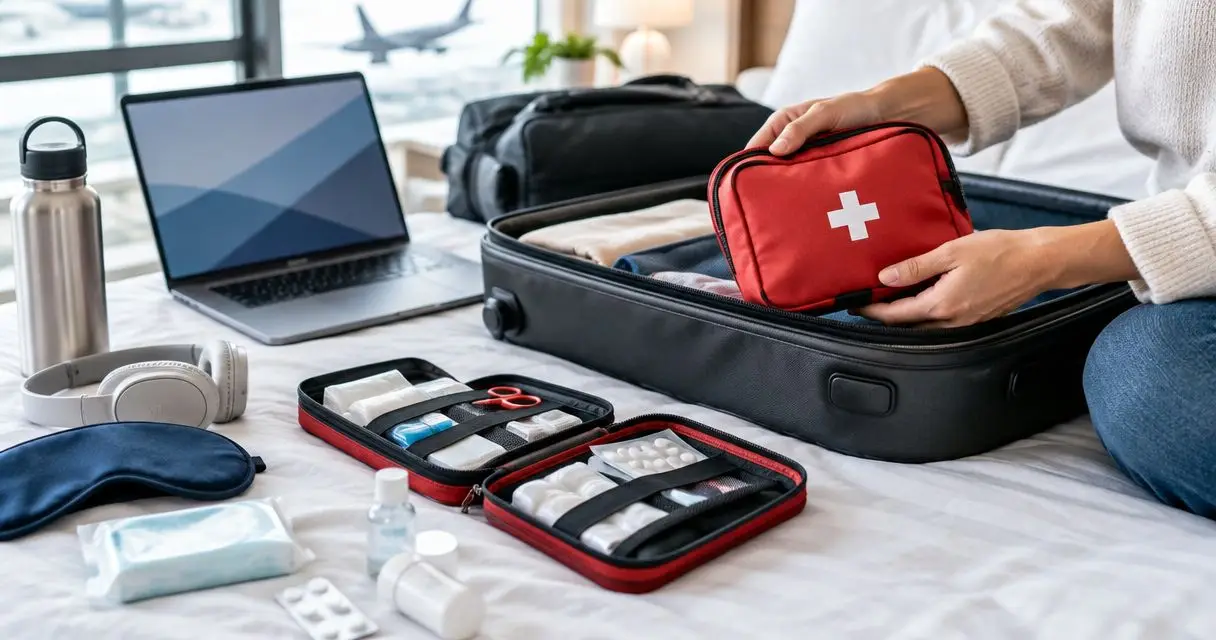
Keep the cable identifiable. Essentialfortravel’s packing organizers are relevant here: separating small charging accessories gives you a defined place to look instead of searching through the main compartment.
Check the sound evidence
A claim such as quiet needs context. Look for a stated setting and measurement conditions before comparing decibel figures between models.
If usable sound information is absent, do not substitute a guess. Choose according to the documented features and make noise acceptability part of your permitted fit-and-function check.
Battery and flight checks for 2026
For a lithium-ion-powered neck fan, identify the battery’s watt-hour rating before flying. FAA PackSafe passenger guidance distinguishes batteries up to 100 Wh from batteries above 100 Wh and up to 160 Wh, which require airline approval; device and spare-battery rules also differ.
Milliamp-hours alone do not establish watt-hours. 1,000 mAh equals 1 Ah, and calculating watt-hours also requires the battery’s nominal voltage. Use the manufacturer’s battery documentation rather than treating the charger’s output voltage as the battery voltage.
Before your 2026 flight:
- Confirm the airline’s rules for your device and battery.
- Keep spare lithium batteries in carry-on baggage, protected against short circuits.
- Prevent accidental activation during transport.
- Follow crew instructions about using or charging the device onboard.
- Do not travel with a damaged or recalled battery.
A permitted battery does not establish that a fan is suitable for use throughout the journey. Keep the device off whenever the airline or crew requires it.
Pack the fan without blocking or crushing it
Switch the fan off before packing it. Let it dry according to its instructions, then place it where the housing, outlets, and movable sections will not be compressed by heavier belongings.
Keep liquids separately contained. A toiletry bag organizes bottles, but it is not evidence that a nearby electronic device is protected against leakage. Follow the fan’s stated moisture restrictions and cleaning method.
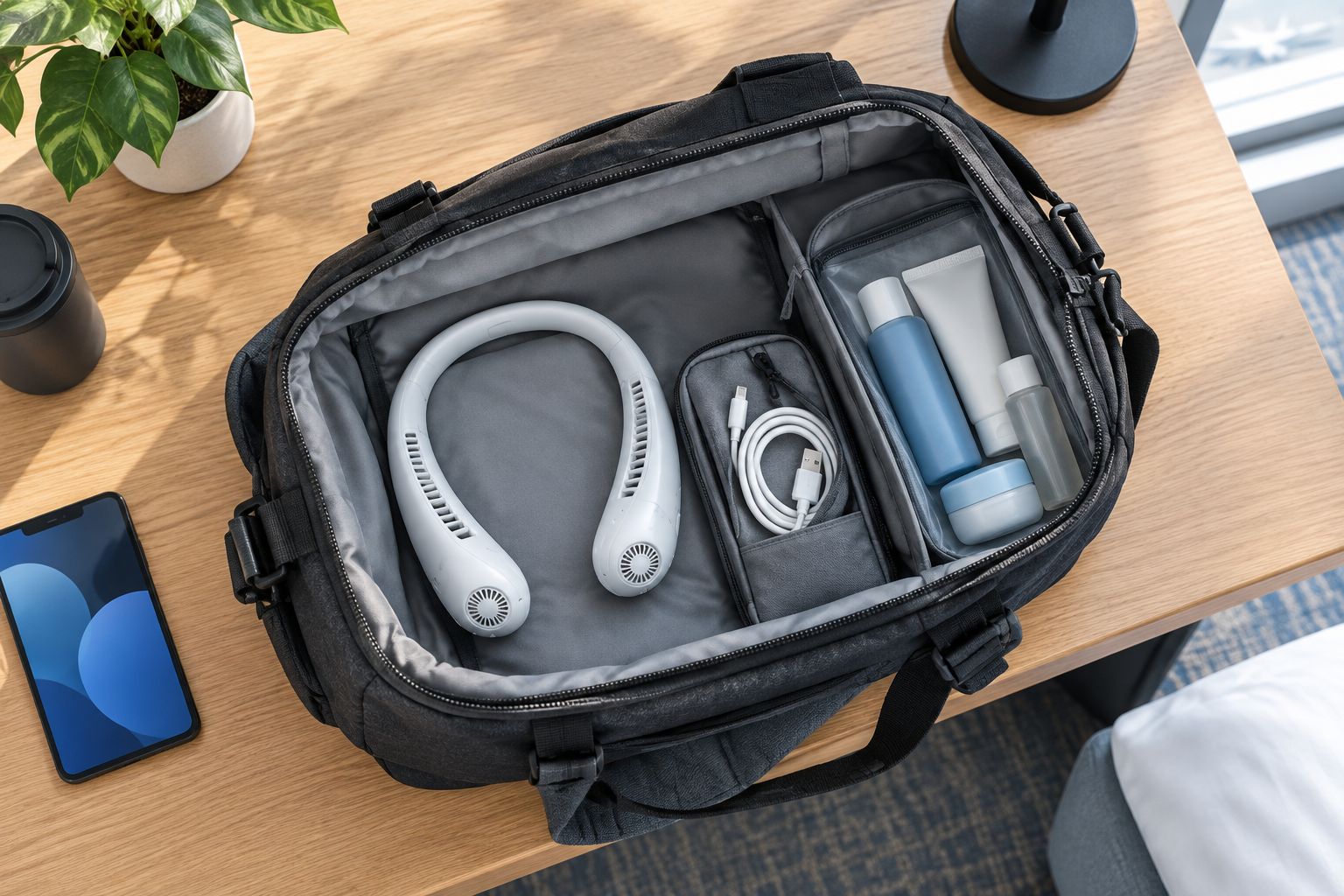
Essentialfortravel sells travel bags, organizers, and accessories; choose those around the fan’s actual packed dimensions rather than assuming any pouch will fit. For retailer information, use About Us, or direct a specific product question through Contact Us.
How the designs are ranked
The ranking prioritizes a straightforward cooling mechanism, then directional control, then specialized contact cooling. It is a design-selection guide, not a claim that one tested model outperformed another.
Fit, guarded moving parts, clear charging instructions, and mode-specific battery information remain purchase conditions for every design. A model that fails those checks does not become a good choice because its category ranks first.
Which portable neck fan should you choose?
Start with an enclosed-airflow neck fan if you want the simplest design shortlist. Choose adjustable arms only when directing the breeze matters enough to justify the extra positioning. Choose cooling plates only when contact cooling is the feature you actually want.
Do not buy on the phrase neck cooler mini alone. Require the listing to explain what cools, where the air goes, how the device fits, and which setting supports its runtime claim.
FAQ
What’s the best neck cooler mini for travel?
An enclosed-airflow neck fan is the default design to investigate for straightforward wear. Choose a specific model only after checking fit, guarded intakes, charging requirements, and setting-specific runtime.
Does a portable neck fan actually cool the air?
An airflow-only neck fan moves surrounding air rather than refrigerating it. Moving air can support heat loss and sweat evaporation, but the device does not replace heat precautions.
Is a cooling-plate neck fan better than a regular neck fan?
A cooling-plate neck fan is better suited to someone specifically seeking contact cooling. An airflow-only design serves a different purpose, and plate performance depends on proper contact and the selected mode.
Can I take a rechargeable neck fan on a plane?
Check the battery rating and your airline’s rules before packing a rechargeable neck fan. FAA passenger guidance distinguishes installed batteries from spares, and crew instructions govern onboard use.
Are bladeless neck fans safe around long hair?
Do not treat a bladeless label as a hair-safety guarantee. Inspect the intake guards, follow the manufacturer’s clearance instructions, and keep hair away from moving parts.
How long should a travel neck fan battery last?
Choose a documented runtime that covers your intended use at the setting you expect to select. A maximum-runtime figure without its operating mode does not support a useful comparison.
Can I wear a neck fan instead of taking breaks in hot weather?
No, a neck fan is not a substitute for shade, water, rest, or leaving excessive heat. CDC heat guidance also cautions against relying on fans alone in very hot conditions.
One last thing
Check the runtime footnote before the headline claim. A cooling-plate fan advertised with a long duration is not useful evidence for contact-cooling endurance if that duration applies only to its lowest airflow setting. Match the claim to the mode you’ll use.