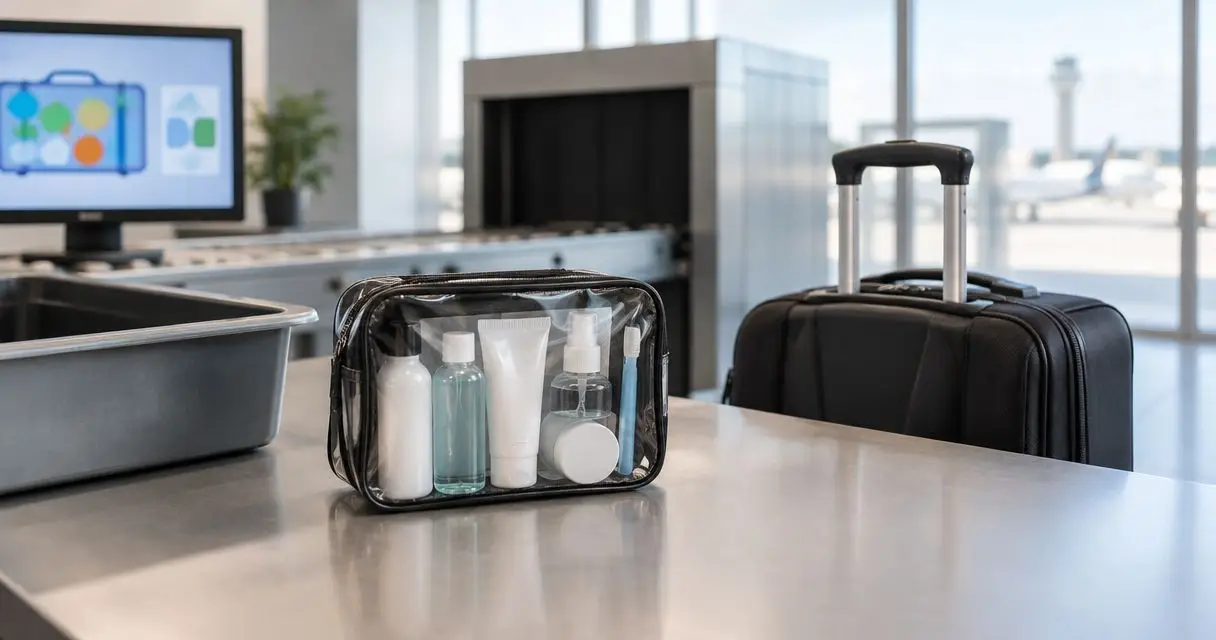
Instead of repacking toiletries at the airport, make your toiletry bag TSA 3-1-1 compliant before departure: separate regulated liquids, check every container’s capacity, and pack them into one clear quart-size bag. This 2026 workflow turns your everyday toiletry kit into a carry-on setup you can inspect before leaving home.
- Make your toiletry bag TSA 3-1-1 compliant with containers of 3.4 ounces (100 milliliters) or less.
- Standard carry-on liquids must fit inside one clear, quart-size, resealable bag per passenger.
- Essentialfortravel suits U.S. travelers organizing toiletries; an organizer alone does not establish TSA compliance.
- Keep solid toiletries separate and declare medically necessary liquids that exceed the standard allowance.
TSA carry-on liquids requirements
TSA compliance depends on your containers and liquids bag, not the name printed on your toiletry organizer. A roomy grooming pouch helps you organize supplies, but it does not replace the clear quart-size bag required for standard carry-on liquids.
Essentialfortravel sells toiletry organizers and refillable containers. Treat those as packing tools, then check your finished kit against TSA’s Liquids Rule for U.S. airport checkpoints before your 2026 trip.
The rule covers liquids, aerosols, gels, creams, and pastes. That includes toothpaste, sunscreen lotion, shampoo, and liquid foundation—not just products you think of as drinks or toiletries that pour.
Toiletry packing checklist
- Gather your materials: your toiletry organizer, one clear quart-size resealable bag, toiletries, and any refillable containers. Keep original packaging nearby so you can identify products and read their capacity markings.
- Check your itinerary: this workflow addresses TSA screening at U.S. airports. Check the relevant security authority’s instructions for departures and connecting checkpoints outside the United States.
- Catch the capacity trap: TSA applies the standard limit to container capacity, not the amount remaining. A nearly empty full-size bottle does not qualify just because it contains less than 100 milliliters.
No account, app, or digital setup is needed. For this physical workflow, the checks are the bottle markings, the liquids bag’s closure, and the finished kit’s accessibility.
Sort your toiletry kit
Separate regulated products
- Empty your toiletry organizer onto a clean, dry surface. Include products tucked inside makeup cases, toothbrush kits, and side pockets.
- Create separate groups for Liquids, Solids, and Exceptions. These are packing groups, not official labels you must attach.
- Put shampoo, conditioner, toothpaste, gels, creams, liquid cosmetics, and toiletry aerosols into Liquids. Keep solid soap and solid stick deodorant in Solids.
- Set medically necessary liquids and qualifying infant or child nourishment aside in Exceptions. Follow TSA’s separate screening instructions rather than forcing these items into the standard allowance.
Expected result: every toiletry has a screening category before you choose a bottle or fill the quart-size bag.
Do not classify a product by its packaging alone. A deodorant stick and a deodorant gel belong in different groups; a compact can contain either powder or cream. Check what is inside.
Remove unnecessary duplicates
- Identify products you actually use during the trip. Remove duplicate lotions, backup styling products, and forgotten samples unless you need them.
- Keep a solid alternative only when it serves your routine. Solid soap avoids using liquids-bag space, but it still needs suitable storage after use.
- Put grooming tools beside the solid toiletries for a separate review. Check TSA’s item-specific instructions for razors, blades, scissors, and other restricted objects.
Expected result: your liquids allowance contains deliberate choices rather than everything that happened to be in the bathroom drawer.
For a 2026 packing checklist, write product names instead of a vague reminder such as “bathroom stuff.” A named list makes it easier to notice the sunscreen or toothpaste that otherwise stays outside the liquids bag.
Check containers and choose storage
Verify every liquid container
- Read the stated capacity on each bottle, tube, jar, or aerosol container. Standard carry-on liquids containers must hold 3.4 ounces (100 milliliters) or less.
- Remove larger containers from the standard carry-on group. Transfer a compatible product into a suitable smaller container, leave it behind, or check whether it belongs in checked baggage under the applicable rules.
- Check refillable containers individually. A travel set’s piece count does not establish the capacity of its bottles.
- Identify each refill clearly for your own use. Keep the original packaging or instructions when you need ingredient, handling, or medication information.
Expected result: every non-exempt liquid container in your carry-on group meets the capacity limit on its own.
Do not decant a product into an unsuitable container just to pass a size check. Follow the product manufacturer’s storage instructions, particularly for medicines, contact lens products, and formulations that require their original packaging.
Match each bag to its job
Use this comparison to separate storage convenience from screening requirements. The Essentialfortravel toiletry bag and liquid containers perform different jobs; neither replaces the final quart-size-bag check.
| Item | Best for | Useful feature | Limitation |
|---|---|---|---|
| Clear quart-size resealable bag | Standard TSA liquids screening | Holds your permitted liquid containers together in the required bag format | Everything must fit and the bag must close |
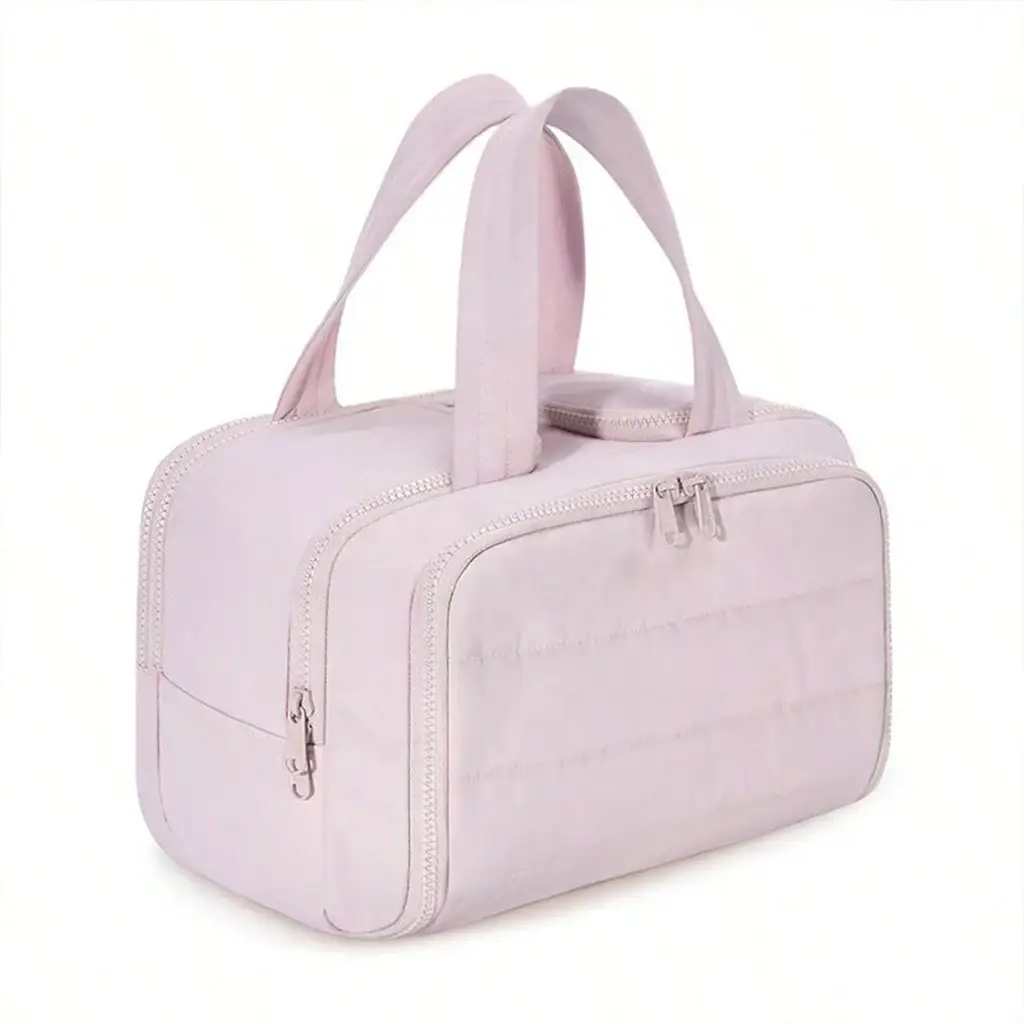
| Large Travel Toiletry Bag with Dual Zippers | Organizing a larger toiletry kit | Polyester organizer measuring approximately 30 × 14 × 21 cm | Its dimensions do not establish that it qualifies as a quart-size liquids bag |
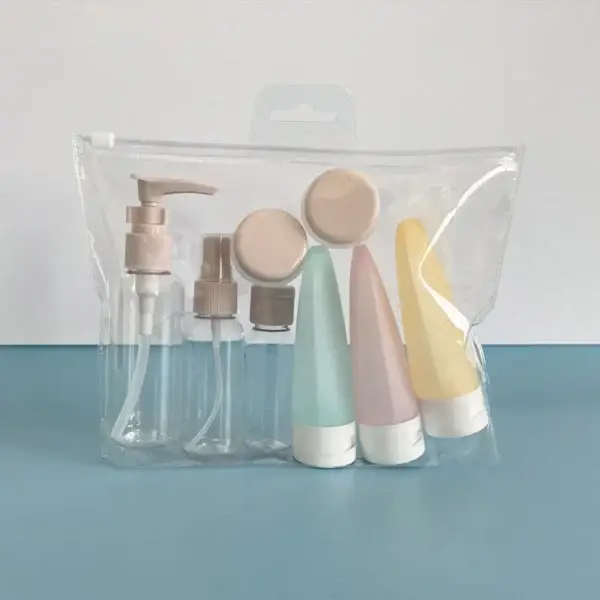
| Travel Liquid Toiletry Containers – 3 or 11 Piece Set | Packing smaller portions of compatible personal-care liquids | Separate containers for products such as shampoo, conditioner, and lotion | You must verify each container’s capacity and fit the filled containers into your liquids bag |
The listed organizer’s dimensions describe storage space, not a TSA allowance. Choose it for keeping toiletries together, then use a separate compliant liquids bag inside it or alongside it.
Assemble your checkpoint-ready kit
Pack the liquids bag
- Inspect each container’s closure and remove residue around the opening. Close lids according to their design.
- Place your standard liquids containers inside one clear, quart-size, resealable bag. The standard allowance is one bag per passenger.
- Arrange the containers so the bag closes completely. Remove items if you must strain the closure or leave part of it open.
- Keep solid toiletries outside the liquids bag. They do not need to occupy space reserved for regulated products.
Expected result: your standard liquids are together in a closed quart-size bag, without overflow in another pocket.
A zippered fabric organizer around the liquids bag adds organization, not extra allowance. Do not split ordinary liquids between the organizer and a clear bag and treat both as compliant.
Position the kit for screening
- Put the closed liquids bag where you can reach it without unpacking clothing. If it sits inside your toiletry organizer, make sure you can remove it easily.
- Keep items requiring separate declaration accessible. Tell the officer about medically necessary liquids that exceed the standard limit before screening.
- Follow instructions at your checkpoint about removing liquids from carry-on luggage. Screening procedures differ, so do not assume a previous airport’s process applies.
- After screening, return the liquids bag to its usual place and check the closure before repacking it.
Expected result: you can present your toiletries as instructed without searching through your entire carry-on.
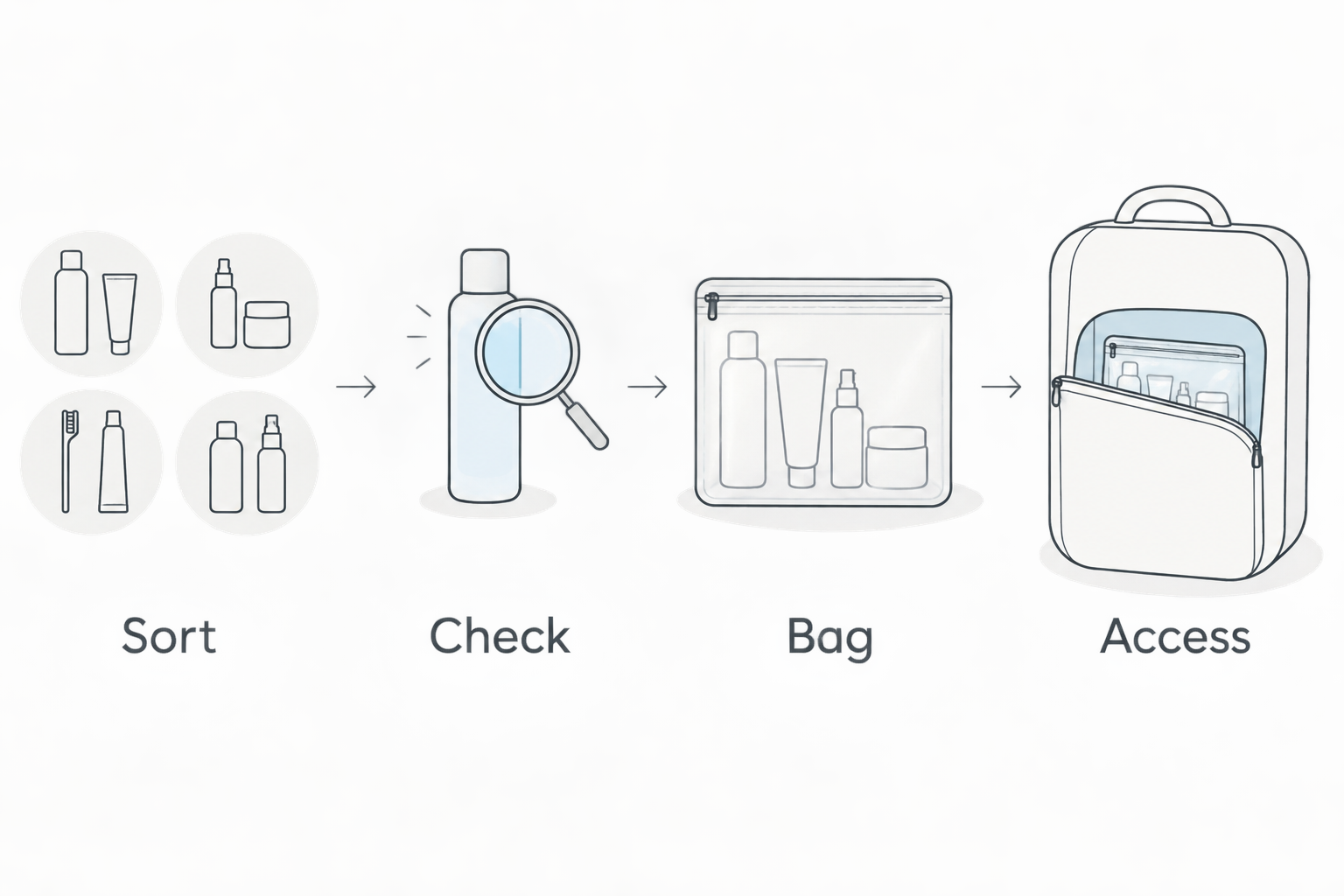
Use the same sequence for every departure in 2026: Sort, Check, Bag, Access. Repeat the check on the return journey, when newly purchased toiletries and partially used full-size bottles can change your setup.
Update the kit whenever your trip changes
A ready-packed toiletry kit saves sorting, but it still needs a departure check. Treat changes to your itinerary, products, or baggage plan as a reason to inspect it again.
- Remove the clear liquids bag from your organizer after each trip. Check for damaged closures, residue, and containers you no longer use.
- Refill compatible containers according to the original product’s instructions. Do not combine unidentified leftovers.
- Recheck container capacities when replacing bottles. Similar-looking travel containers do not necessarily hold the same amount.
- Review your route and screening requirements before repacking. A U.S. departure checklist does not replace another country’s rules.
Expected result: your reusable kit stays organized without turning last trip’s assumptions into this trip’s mistakes.
Adapt the workflow for checked baggage
When your itinerary includes checked luggage, place suitable larger toiletries there after checking the applicable restrictions. Keep your permitted carry-on toiletries in the quart-size bag, and keep necessary medication accessible according to its screening requirements.
Checked baggage does not make every toiletry unrestricted. Aerosols, flammable products, and other hazardous materials require their own review; moving an item out of your carry-on is not a substitute for that check.
Troubleshooting
Your liquids bag will not close
Remove products or use smaller suitable containers. A second quart-size bag does not increase one passenger’s standard allowance. Start with duplicates and products you do not need during the trip.
Your bottle is mostly empty but too large
Replace the container, not just its contents. A full-size bottle remains over the standard capacity limit even when nearly empty. Decant only when the product is suitable for transfer.
Your toiletry organizer is labeled travel-friendly
Inspect the liquids bag separately. “Travel” describes a product’s intended use; it does not establish that the bag meets TSA’s quart-size requirement or that its contents comply.
Your refillable bottle leaks
Stop using the leaking container until you identify the problem. Check for a misaligned lid, damaged seal, residue, or an incompatible product. The clear screening bag is not a guarantee against spills.
You need a liquid medicine larger than the standard limit
Use TSA’s medically necessary liquids procedure. Such liquids are permitted in reasonable quantities exceeding the standard limit and do not have to fit in the quart-size bag. Declare them for inspection and allow for additional screening.
Packing toiletries for different trips
Build your Essentialfortravel toiletry organizer around how you actually travel, rather than filling every compartment. Keep the clear liquids bag distinct from dry grooming supplies so you can remove it without disturbing the rest of the kit.
For shared packing, assign each traveler’s standard liquids to that passenger’s own allowance. Do not assume that putting everyone’s products inside a family toiletry organizer changes the per-passenger rule.
For your remaining 2026 trips, keep a short packing note with three checks: container capacity, bag closure, and checkpoint access. Add route-specific requirements underneath instead of rewriting the whole routine.
FAQ
How do I make my toiletry bag TSA 3-1-1 compliant?
Place standard carry-on liquids, aerosols, gels, creams, and pastes in containers of 3.4 ounces (100 milliliters) or less, together in one clear quart-size resealable bag per passenger. Keep that liquids bag accessible inside or alongside your toiletry organizer.
Can I use a regular toiletry bag instead of a clear bag?
A regular toiletry organizer does not replace the clear quart-size bag required for standard carry-on liquids. You can use the organizer for dry supplies and carry a separate compliant liquids bag.
Does toothpaste count as a liquid for TSA?
Toothpaste falls under TSA’s liquids, gels, and pastes rule. Pack a tube with a capacity of 3.4 ounces (100 milliliters) or less inside your quart-size liquids bag.
Can I bring a half-empty full-size shampoo bottle?
A half-empty shampoo bottle that exceeds 3.4 ounces (100 milliliters) does not meet the standard carry-on container limit. TSA considers container capacity, not simply how much shampoo remains.
Do I have to remove my liquids bag at airport security?
Follow the instructions at your TSA checkpoint about removing liquids from your carry-on. Keep the bag accessible because screening procedures and directions differ between lanes.
Can liquid medicine exceed the TSA size limit?
Medically necessary liquids can exceed the standard limit in reasonable quantities and do not need to fit inside the quart-size bag. Declare them to the TSA officer for inspection before screening.
Does buying travel-size containers guarantee TSA compliance?
Travel-size wording does not guarantee compliance. Check each container’s capacity, then confirm that all your standard liquids fit in one closed clear quart-size resealable bag.
Final preflight toiletry checks
A compliant bottle and a compliant finished kit are different checks. Every container can meet the size limit while the collection still exceeds what fits in your quart-size bag. Finish packing by closing that bag—not by counting bottles.