
Walk into any outdoor retailer and ask for a travel backpack for women, and you will likely be handed something in dusty rose or sage green. The color is different. The features are not. This is the central problem with how women’s travel backpacks are marketed, and it costs female travelers real comfort, security, and functionality on the road.
Fit, weight distribution, anti-theft zipper placement, and organizational design are the factors that determine whether a backpack actually works for your body and your travel style. Yet most buying guides bury these specifics under generic feature lists that were built around male anatomy and male travel patterns in the first place.
This analysis cuts through that noise. You will learn how torso-length fit overrides almost every other consideration, how load-carrying balance differs for women, how to evaluate zipper placement relative to your own body positioning, and which organizational features deliver genuine value versus manufactured complexity. You will also learn what to ignore entirely, so you stop paying for features that sound useful but perform poorly in practice. The right framework for evaluating a travel backpack changes what you buy.
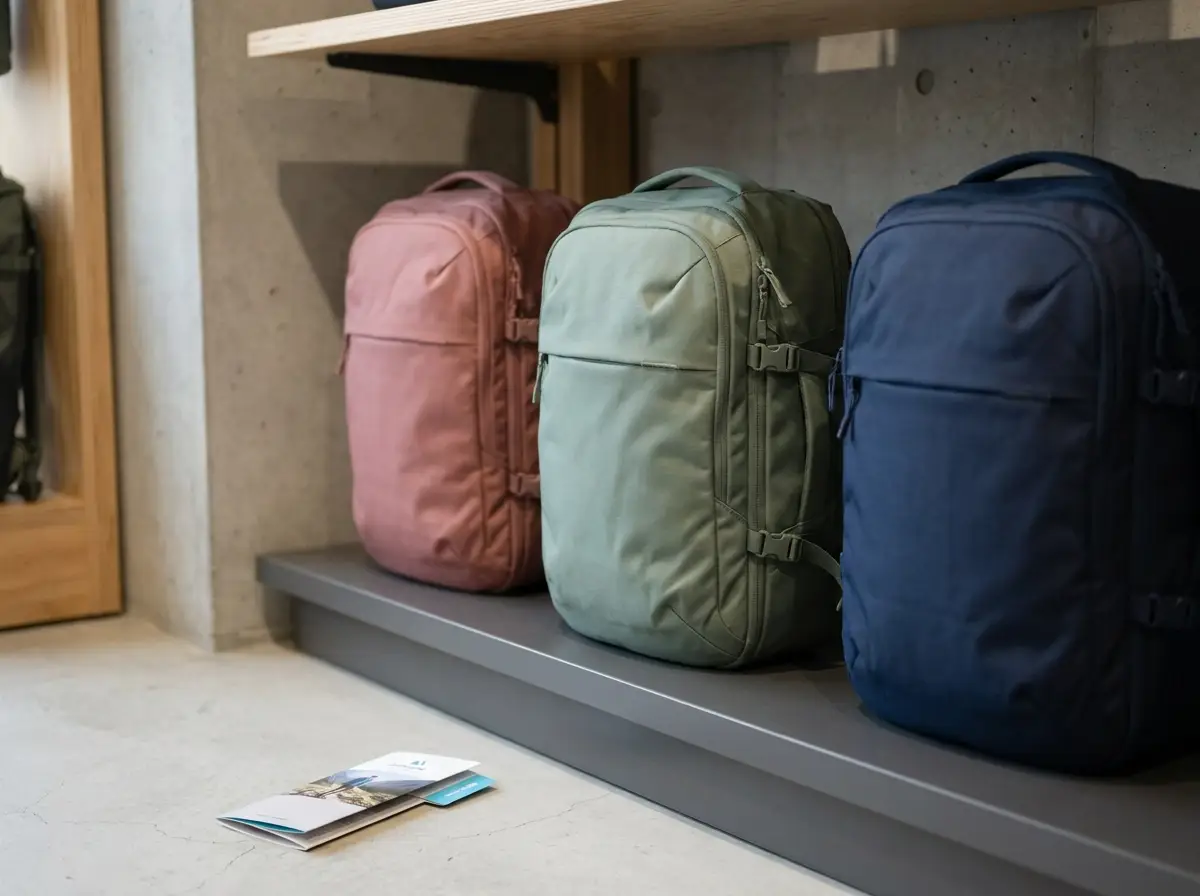
Walk into any major retailer’s women’s travel backpack section and the first variable you encounter is color. Dusty rose. Sage green. Midnight navy. The marketing assumes that female travelers select gear the way they select accent pillows, and the product pages follow: lifestyle photography of women striding through cobblestone streets, soft-focus mountain backdrops, and curated flatlay shots. Functional specifications, when they appear at all, are buried beneath aesthetic copy.
This is not a superficial complaint. The color-first approach signals a deeper structural failure: most evaluation frameworks applied to women’s travel backpacks were built for male body proportions and scaled down, not redesigned. Shoulder strap spacing, hip belt height, torso-length range, and load-transfer geometry were all standardized against male anthropometric data. What the industry calls a “women’s fit” is frequently a smaller shell in a different colorway, carrying the same frame geometry that positions the hip belt too low and concentrates load on the spine instead of the hips.
The real-world result is predictable. Female travelers purchase bags that photograph well, feel manageable empty in a store, and then create compounding problems in the field: shoulder fatigue by hour three of a transit day, security vulnerabilities from poorly positioned zippers, and organizational systems that fragment essential items across pockets that were never tested against actual travel sequences.
This guide corrects the evaluation framework from the ground up. The criteria that matter are torso-length fit, weight distribution, anti-theft zipper placement relative to female body mechanics, and organizational depth that holds up under real travel conditions. If you want a broader baseline on what separates a functional travel backpack from a marketing exercise, what to look for in a travel backpack for every trip type covers the foundational variables across bag categories.
What this piece will not do: recommend any backpack based on color, brand aesthetics, or lifestyle photography. Those variables tell you nothing about fit, load transfer, or security. The sections that follow define criteria that do.

Of all the evaluation criteria that matter for a travel backpack for women, torso length is the one most likely to be ignored and the one most likely to cause real discomfort the moment you board a flight.
Many standard backpack frames are designed around proportions that do not accommodate shorter torso lengths common among women, which means longer back panels, wider shoulder strap spacing, and hip belts sized for different iliac positioning. When a woman wears one of these bags, the hip belt typically lands below her iliac crest rather than on it, and the shoulder straps splay outward at the base. The result is that the load bypasses the hip transfer system entirely and rides on the spine and shoulders. After three hours in an airport, that is not a comfort issue; it is a structural failure.
Torso length is not your full back length. Torso length runs from the base of your neck to the top of your hip bones. Measure with a flexible tape while standing upright. Torso lengths vary considerably; knowing your own measurement is what matters. This single number should precede every backpack evaluation you do.
“Adjustable suspension” on a product listing can mean almost anything. What you need is independently adjustable torso length with multiple discrete positions, not a single compression that slides the entire back panel as one unit. A legitimate system lets you set the torso length first, then position the hip belt and shoulder straps separately. A “women’s small” label with no stated torso-length range in inches or centimeters is not a size specification; it is a color-adjacent marketing decision.
The hip belt must sit centered on the iliac crest, not floating above it or resting below it on the upper thigh. When positioned correctly and cinched firmly, hip belt engagement transfers load off the shoulder muscles, reducing fatigue across a long travel day.
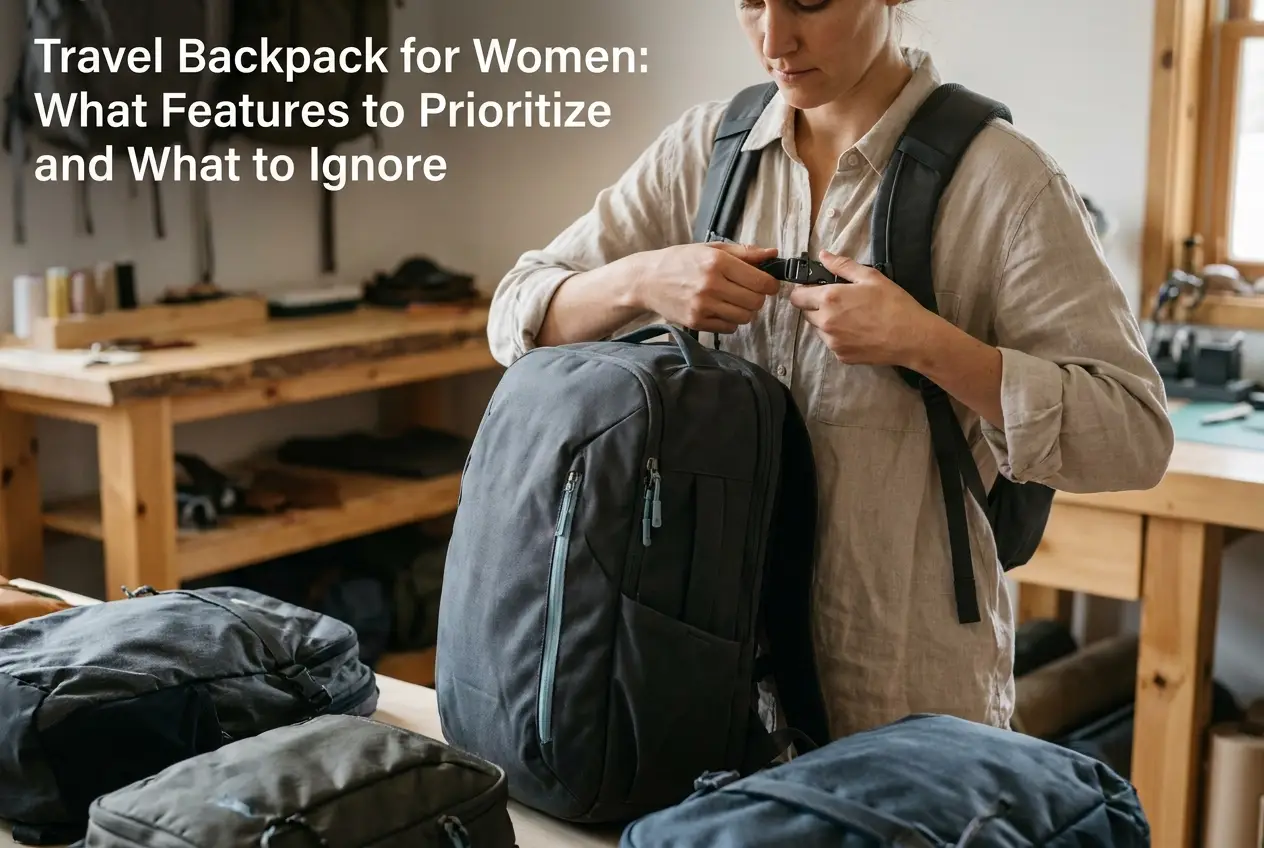
Whether you are testing in a store or on delivery, load the bag with at least 15 lbs before making any judgment. Tighten the hip belt first, before touching the shoulder straps. The hip belt should feel snug and centered on the iliac crest; verify that most of the weight is pressing down through your hips, not hanging from your shoulders. If you reach the correct hip-belt position and the shoulder straps are still floating away from your body, the torso length is wrong for your frame.
One practical note: if you are also evaluating whether your backpack meets airline size requirements, the complete 2026 guide to carry-on luggage size rules is worth reviewing before your purchase is final. A bag that fits your body but not the overhead bin creates a different problem entirely.
Any “women’s fit” label that specifies only capacity or colorway without a stated torso-length range is a red flag. Ignore it, take your measurement, and treat that number as the first filter applied to every bag you evaluate.
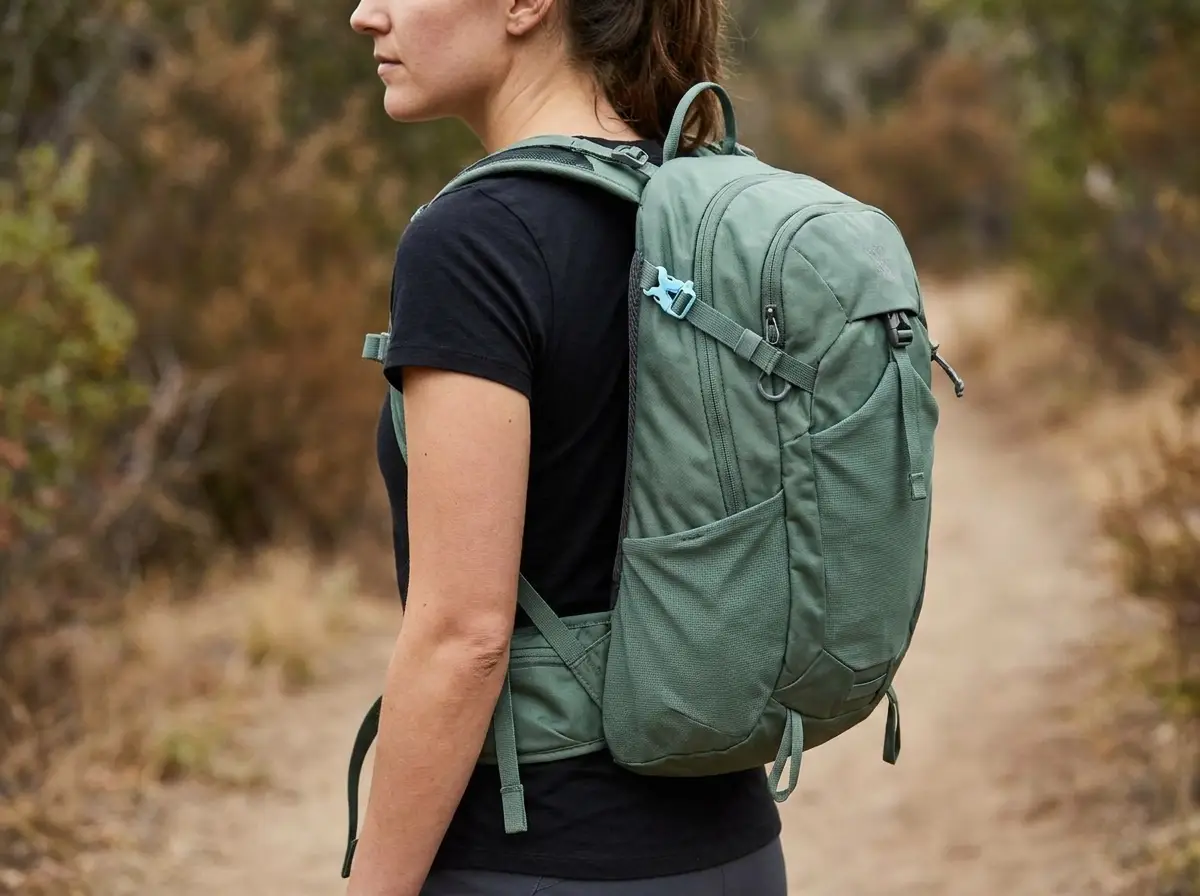
Once your hip belt is correctly positioned, the next variables that determine whether a backpack carries comfortably or punishes you are strap geometry and frame design. These components control how load travels through your body, and they are where resized male frames most visibly fail women.
The short straps connecting the top of your shoulder straps to the frame are load lifters. Load lifter straps should angle upward from the shoulder toward the frame, not run flat, a noticeable upward angle signals correct positioning. A flatter angle means the pack is riding too low on your back, shifting weight forward onto your shoulders instead of distributing it through the frame. Most travelers never adjust these; most manufacturers never explain them.
Sternum straps are equally misunderstood. The sternum strap should sit comfortably below the collarbone, high enough to stabilize the shoulder straps without compressing the chest. This is a direct consequence of bags designed around male chest geometry, where the sternum sits higher relative to shoulder strap attachment points. If your bag offers only a single fixed sternum strap height, that is a design limitation, not a fit feature.
Shoulder straps should curve inward at the base, angling toward the center of your chest rather than running straight across. Straight straps pull outward and dig into breast tissue during extended wear. Inward curvature reduces contact pressure and seats the straps more evenly across a wider range of female torso shapes.
Frame type compounds this. Luggage and pack stabilization systems both rely on the same principle: load that moves laterally or pulls away from the body creates strain. Internal frames that contour to the natural lumbar curve keep the center of gravity close to your spine. Flat-panel frames, common in bags marketed as lightweight or packable, push the load away from your back, requiring your muscles to compensate across every hour of carry.
Load the bag to your expected travel weight, then stand in front of a mirror. The pack should not pull your upper body backward. It should not create a forward lean at the neck. Either position indicates the load is sitting in the wrong place relative to your center of gravity, typically too high or too far from your back.
Then run the bounce test. Walk briskly for 30 seconds at full load. A correctly balanced pack moves with you. Lateral sway, where the bag shifts side to side with each step, signals insufficient load stabilization. On a travel day covering airport terminals, transit systems, and city blocks, that sway translates directly into hip and lower back strain.
The red flags to identify before buying: hip belts with flat, unconstructed padding; shoulder straps that run straight without inward curvature at the base; and sternum straps fixed at a single height. Each of these signals a frame that has been recolored, not redesigned.
Once your bag fits and loads correctly, the next variable is whether it stays secure while you move through the environments that matter most: metro systems, airport terminals, bus stations, and crowded streets.
Generic anti-theft advice tells you to find a bag with hidden zippers. That is incomplete guidance. The more useful question is where those zippers sit relative to your body while you are wearing the bag and moving through a crowd.
Rear-panel zippers, where the main compartment opens flush against your back, are the strongest anti-theft configuration available. A thief cannot reach a zipper that is pressed against your spine. The practical caveat: test whether you can open that panel yourself without fully removing the bag. If accessing your own main compartment requires a full unpack sequence at every stop, the security feature has created an operational problem for the owner while only marginally inconveniencing a determined thief.
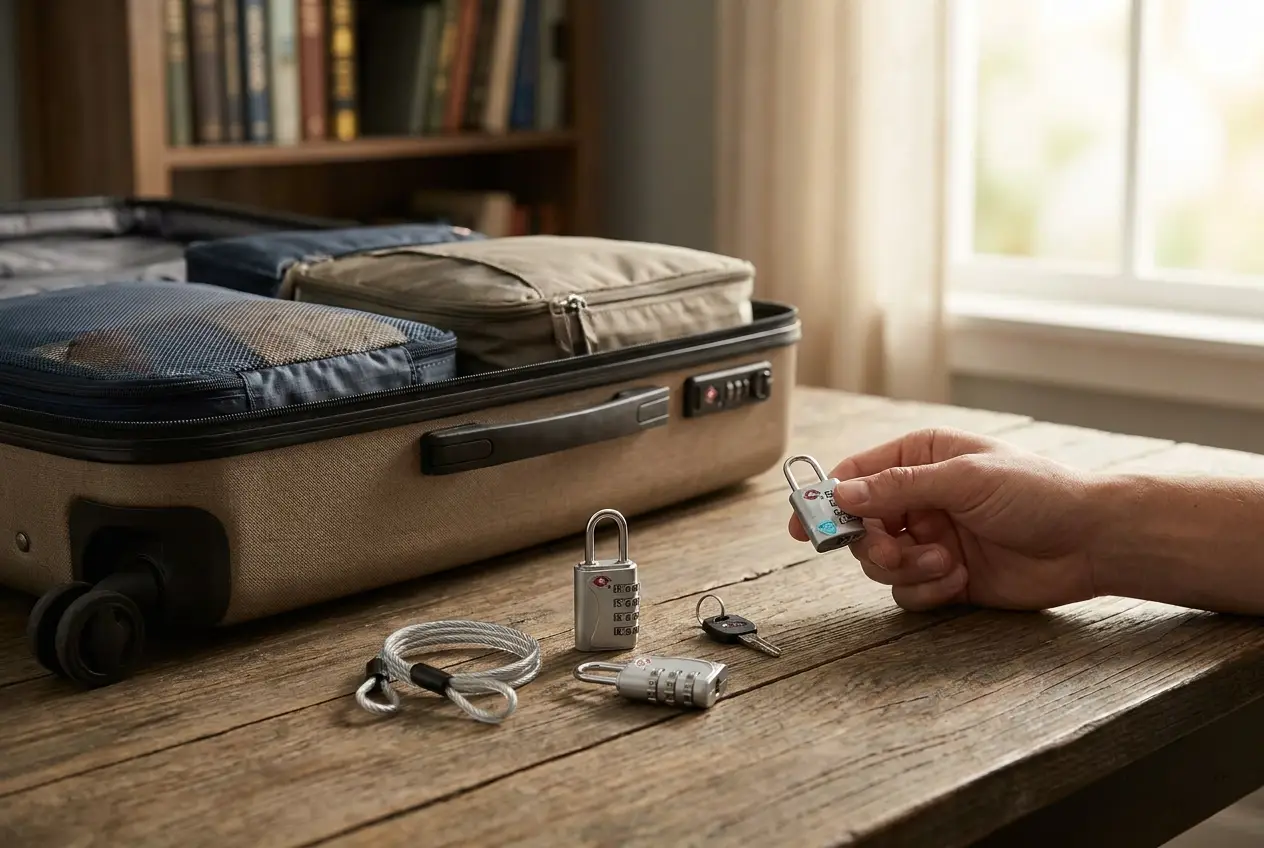
Cable locks threaded through zipper pulls add real deterrence in high-density transit environments. They do not make a bag impenetrable; they increase the time and visibility required to open it, which is enough to redirect opportunistic theft. Use them at metro turnstiles, in airport security lines, and on overnight buses.
Slash-resistant panels address a different threat: grab-and-run. Cut-resistant shoulder straps and wire-mesh-reinforced panels reduce the risk that a bag can be removed quickly by force. When evaluating these features, ask for the material specification: wire mesh gauge, cut-resistance rating, or third-party test data. “Slash-resistant” printed on packaging is a marketing claim; a material specification is a verifiable fact.
Here is the evaluation step most guides skip entirely. Put the bag on, fully loaded, and try to access the quick-access pocket on the front or side without removing the bag or visibly contorting. If you cannot reach it comfortably, neither scenario, routine access or an emergency, will go smoothly. Women’s shoulder geometry and arm-reach arc differ from the male-standard reach assumptions most backpacks are designed around. An inaccessible pocket is a useless pocket regardless of where the zipper is hidden.
RFID-blocking pockets are worth having for passport and payment card protection. Verify one detail before counting it as a feature: open the pocket and confirm it fits a US passport booklet plus two cards. Many RFID pockets are sized for a card sleeve only. A passport that does not fit inside the RFID zone is not protected by it.
In dense transit environments, wearing a backpack reversed against your chest eliminates rear access entirely and keeps contents in your line of sight. This is the highest deterrence position available without a separate anti-theft bag. Before purchasing, put the bag on your chest and evaluate whether the profile and weight distribution make this practical for 10 to 15 minutes of crowded transit. If it sits awkwardly or digs into your chest, you will not use the option when it matters.
For a parallel look at security features across bag types, the guide on how to choose a travel duffel bag covers zipper and panel construction criteria worth cross-referencing when evaluating any travel bag.
Security features tell you whether a bag can be compromised. Organization tells you whether it can be used. Both matter, but the travel backpack market oversells the second category with features that perform in a store and fail in a terminal.
A backpack with three well-positioned, easily reachable zones consistently outperforms one with twelve pockets that require partial unpacking to reach. Compartment count is a marketing number. Compartment accessibility is a functional one. When you are navigating a crowded airport, you need your items to be findable without removing the bag or rummaging.
The five-second rule applies here: your boarding pass, phone, and transit card should be retrievable while the bag is on your back, in under five seconds, without looking. Test this before purchasing. If the quick-access pocket requires a two-handed unzip or is positioned at an awkward angle relative to your shoulder, it will cost you time at every checkpoint.
Internal compression straps prevent contents from shifting during movement. That function matters for your back, not just your bag’s profile. When packed contents migrate toward the bottom or shift laterally, the bag’s center of gravity drops and destabilizes, creating the lower back strain that compounds over a long travel day. Tighten compression straps after packing, every time.
A laptop sleeve should meet three criteria: padded walls, suspended construction (the sleeve base should not rest on the bag’s base, where impact is highest), and a dedicated opening that does not require unpacking the main compartment to access. That last point is also a security feature. A sleeve accessible through a separate zipper means you can retrieve your laptop at TSA without opening your entire bag to strangers or a checkpoint camera.
Skip the following without guilt: excessive internal mesh pockets that fragment small items across six locations you will forget, mirror pouches marketed as travel-specific (a mirror is not a travel essential; it is a cosmetic bag insert), and cosmetic organizers presented as primary compartments. These features add weight and cognitive load with no transit utility.
For water bottle pockets, side-access and stretchy enough to hold a 1-liter bottle while moving are the only specifications that matter. Top-access water bottle pockets require removing the bag entirely. Test with an actual filled bottle, not an empty pouch.
Before purchasing, mentally assign each of your five most-accessed items (phone, passport, boarding pass, lip balm, earbuds) to a specific pocket. If you cannot complete that map confidently within 30 seconds, the organization system will not serve you under transit pressure.
For a deeper breakdown of which travel accessories are genuinely worth carrying, that guide covers every category by function rather than marketing claim, and pairs well with the organizational framework above.
Knowing what to evaluate gets you most of the way to a good decision. Knowing what to ignore gets you the rest of the way.
Color and aesthetic finishes are easy to communicate visually and the least relevant to your experience on the ground. As covered earlier, a colorway does not adjust to your torso length and a finish does not redistribute load to your hips. Choose color last, if you choose it at all.
Lifestyle photography is not a fit proxy. An image of a woman summiting a ridge or navigating a European market communicates brand identity, not ergonomic performance. No product photo shows hip belt placement on the iliac crest, torso-length adjustment range, or shoulder strap curvature under load. Treat lifestyle imagery as decoration and move on.
Liter capacity is a secondary metric, not a starting point. Volume tells you nothing about frame geometry or load distribution design. Confirm fit first; confirm capacity second.
Unsubstantiated “women’s fit” claims should be read as marketing language. A legitimate women’s fit specification states a torso-length range in inches or centimeters, describes gender-specific hip belt contouring, and details shoulder strap curvature geometry. If a product page uses “women’s fit” without those specifics, the claim is promotional, not functional.
Price does not signal ergonomic design. Premium price points from well-known outdoor brands frequently reflect material quality, brand positioning, and retail markup rather than female-specific frame engineering. Some of the most expensive bags on the market are standard frames with narrower shoulder straps and a different colorway. Verify the specs regardless of cost.
Influencer endorsements without technical detail are promotional content. An endorsement that does not address torso-length range, load capacity rating, or zipper security type tells you the bag photographs well and the partnership terms were met. It does not tell you whether the bag fits a 16-inch torso or distributes load correctly over eight hours of transit. Apply the same scrutiny you would to any other product claim. (Incidentally, the same principle applies when evaluating accessories: a guide on how to choose a travel toiletry bag shows how functional criteria consistently outperform aesthetic ones across travel gear categories.)
Peer reviews from women with different body proportions are directional, not definitive. A reviewer with a 19-inch torso praising a backpack’s comfort is giving you accurate information about her body and that bag, not yours. Reviews help identify recurring design flaws and durability patterns. For fit, use the measurement protocols covered earlier in this guide as your primary standard.
The pattern across all of these is the same: marketing surfaces variables that are easy to communicate visually and emotionally. Your evaluation criteria should be the ones that are harder to photograph but easier to feel after six hours in a crowded airport.
The backpacks listed below were selected against the criteria defined in this guide, not for colorways or brand recognition. Each one carries verifiable specifications for torso-length range, hip belt design, anti-theft zipper placement, and organizational structure. Use your own torso measurement and the loading tests from earlier sections to confirm fit before purchasing.
Torso-length range: adjustable via an independent suspension slider, confirm your range against the spec sheet on the product page. The contoured hip belt sits centered on the iliac crest and uses gender-specific padding at the contact points, transferring load off the shoulders as described in the fit section above. Main compartment access uses a rear-panel hidden zipper with lockable pulls; the outer quick-access pocket includes RFID-blocking lining sized for a full passport. Organizational structure: three dedicated zones with a suspended laptop sleeve, two compression straps, and a side-access water bottle pocket that accommodates a 1-liter bottle without unpacking.
Shop Now: essentialfortravel.com/wanderlust-anti-theft-travel-backpack
Torso-length range: adjustable with multiple fixed positions, confirm your range against the spec sheet on the product page. Shoulder straps are contoured with an inward base curve to reduce chest pressure, and the sternum strap is height-adjustable, sitting correctly below the collarbone at multiple torso lengths, confirm the adjustment range on the product page. Slash-resistant panels reinforce the main and secondary compartments; zipper pulls thread through a cable lock system compatible with TSA-approved locks. The internal layout maps to five primary access categories: laptop, documents, daily essentials, compression-packed clothing, and external hydration, with no filler pockets that fragment small items.
Shop Now: essentialfortravel.com/meridian-lightweight-womens-travel-pack
Torso-length range: adjustable, confirm your range against the spec sheet on the product page. Flat-panel hip belt with light contouring. Anti-theft rear zipper with dual lockable pulls. Dedicated front quick-access pocket for transit documents. Meets standard carry-on dimensions. If you want to pair this backpack with a structured carry-on for longer trips, the guide to carry-on luggage setups that work covers compatible configurations and what to prioritize when building a two-bag travel system.
Shop Now: essentialfortravel.com/nomad-carry-on-travel-backpack
These three options represent different torso-length ranges and organizational priorities. None was selected for aesthetic reasons. Cross-reference each specification against your own measurements before committing.
The sequence above, fit, load, security, organization, is the complete evaluation framework; what follows is how to apply it at the point of purchase.
The products covered in the previous section pass the framework because they were evaluated in that sequence: torso-length fit first, weight distribution second, anti-theft zipper placement third, organizational depth fourth. Colorways and brand aesthetics did not factor into the selection. That sequence is the argument of this entire guide, and it is the sequence that changes what ends up in your hands at the departure gate.
For curated options that already meet these functional criteria, discover why smart travelers build their kit around verified essentials at EssentialForTravel.com. Every product on the platform is selected for function, not aesthetics.
Shop Now: essentialfortravel.com
When fit is your filter, the options narrow quickly, and that is a good thing. A shorter list of bags that actually work beats a long list that photographs well.
#EssentialForTravel #TravelBackpackForWomen #WomenWhoTravel #TravelEssentials #BestTravelGear
Torso length is measured from the base of your neck to the top of your hip bones (not your full back length). Using a flexible tape measure, measure while standing upright. This single measurement should precede every backpack evaluation you do, as it is the most critical factor in determining whether a bag will fit your body correctly and distribute weight properly.
The hip belt must sit centered on your iliac crest (hip bone), not floating above it or resting below it on your upper thigh. When positioned correctly and cinched firmly, the hip belt transfers load off your shoulder muscles and spine, distributing weight through your hips instead. This positioning reduces fatigue significantly during long travel days and prevents the back pain that occurs when the load rides on your spine and shoulders.
Adjustable suspension should mean independently adjustable torso length with multiple discrete positions, not a single compression that slides the entire back panel as one unit. A legitimate system lets you set the torso length first, then position the hip belt and shoulder straps separately. Be cautious of bags labeled only as 'women's small' without stated torso-length range in inches or centimeters, as this is a marketing decision rather than a genuine size specification.
Load the bag with at least 15 lbs, then tighten the hip belt first before adjusting shoulder straps. Verify the hip belt feels snug and centered on your iliac crest with most weight pressing through your hips. Stand in front of a mirror—the pack should not pull your upper body backward or create a forward neck lean. Finally, walk briskly for 30 seconds at full load (the 'bounce test'). A correctly balanced pack moves with you without lateral sway.
Prioritize accessibility over compartment count—three well-positioned zones outperform twelve pockets requiring partial unpacking. Essential features include: suspended laptop sleeves with dedicated access, compression straps that prevent content shifting, and quick-access pockets reachable in under 5 seconds without removing the bag. Skip: excessive mesh pockets, mirror pouches, and cosmetic organizers. The key is whether your five most-accessed items (phone, passport, boarding pass, lip balm, earbuds) can be confidently assigned to specific pockets within 30 seconds.