
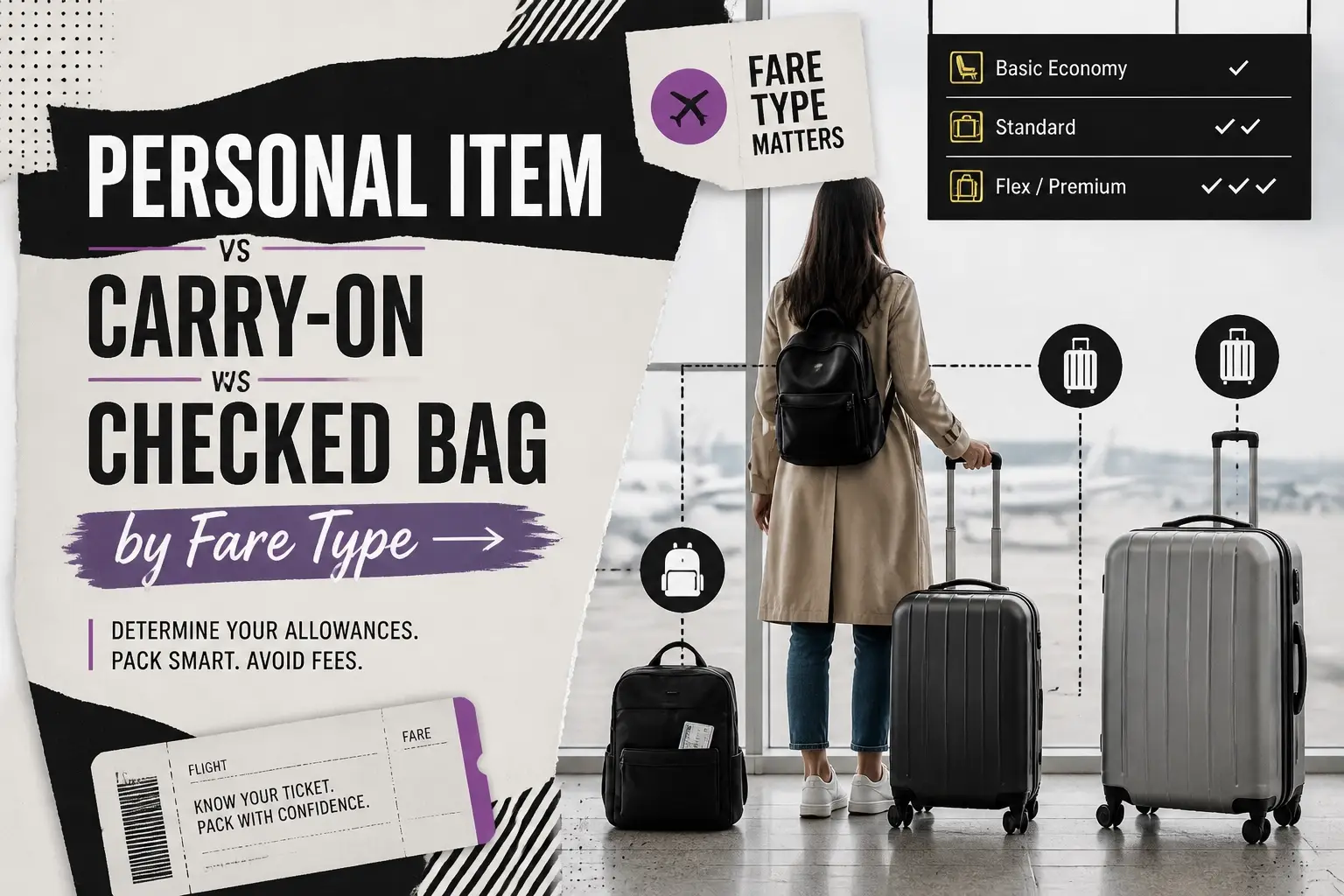
Your airline’s baggage policy and the fare you purchased determine which bags are included. Some basic-economy fares allow only a personal item without an additional bag fee, while others include a carry-on. Check the baggage allowance shown in your specific booking before packing, including the operating airline on codeshare flights. Measure the packed bag, including wheels, handles and exterior pockets; a product’s advertised capacity alone cannot establish airline compliance. For screening rules, consult the TSA What Can I Bring? guide for U.S. departures. For a short-trip bag comparison, read our duffel, weekender and gym bag guide. Airline allowances and fees may change, so verify them again before travel. This guide compares personal items, carry-on bags, and checked bags by fare type, explaining how baggage rules can differ by airline, route, and region.
Use the four-step packing method below to decide what belongs in your personal item, carry-on, or checked bag. You’ll also find a comparison table, advice on avoiding baggage fees, and tips for rail, bus, road, and cruise travel.
Quick answer: A personal item usually goes under the seat, a carry-on usually goes in the overhead bin, and a checked bag travels in the aircraft hold. Which bags are included and what they cost depend on the operating airline, route, fare and ticket benefits. Check your booking before choosing luggage.
How Your Fare Determines Your Baggage Allowance
Published by Garry Barnes · Updated November 14, 2026
Your baggage allowance depends on the airline, route, fare type, and any applicable status or ticket benefits. A personal item generally fits under the seat, a carry-on bag goes in the overhead bin, and checked baggage is handed over to the airline. Always confirm the specific size, weight, and fee rules for your booking.
One carrier can sell basic, standard and flexible fares on the same route, each with different bag terms. Check three places: the fare card at booking, the airline baggage page for your route and travel date, and your booking confirmation. Re-check within 24 hours of departure, because terms change between booking and flying.
Dimensions, weights and fees differ by carrier, route and fare, so this guide explains rules structurally. Verify every figure against a primary airline or TSA source and record the retrieval date. For U.S. flights, the U.S. Department of Transportation explains where airlines disclose baggage fees. For liquids in carry-on bags, review the official TSA travel checklist. Use the airline’s current policy as the final authority for baggage limits.
Choosing between a travel backpack and a carry-on suitcase also shifts which tier you pack into.
How Basic-Economy Baggage Allowances Affect Your Packing
On some basic-economy fares, a personal item is included while a larger carry-on costs extra or is not permitted. Always confirm your fare’s exact allowance. Plan from there, not from the carry on suitcase.
Failure mode one: you pack a full size carry on suitcase, reach the gate, and learn your fare does not include it. If you packed medication or documents in that bag, they could become inaccessible during the journey. Move essentials into the bag you retain before handing it over.
If your carry-on is gate-checked, ask where it will be returned. Depending on the airline and route, it may be delivered at the aircraft door or baggage claim.
Terms vary widely. Confirm whether your fare includes a carry on, whether it is charged, and how it affects boarding position and gate checks.
Anything you would panic without for 24 hours belongs in the personal item, no matter how short the flight.
Still choosing that bag? How to choose a lightweight travel backpack for long trips covers empty weight, real capacity, and airline sizing.
Personal Item vs. Carry-On vs. Checked Bag: Comparison
The comparison below shows structure, not limits; confirm every number on your own fare card.
| What it is | Where it goes | Typical contents | Who handles it | Main risk |
|---|---|---|---|---|
| Personal item: size set by your fare card | Under the seat | Fallback kit | You | Size limit |
| Carry on bag: size and weight set by your fare card | Overhead bin | Non-essentials | You, then crew | Gate-checked when bins fill |
| Checked bag: weight limit set by your fare card | Counter handover | Bulk items | Airline staff | Overweight fees |
The personal item is your fallback kit when everything else is delayed. Keep medication, travel documents, valuables and essential batteries in the bag you can keep with you. An overhead-bin carry-on may need to be gate-checked when cabin space is limited. Weigh the checked bag at home; the checked baggage weight limit and overweight fees are settled at the counter.
Limits change by fare and route. Screenshot the bag terms for both legs. Airlines may enforce size and weight limits at check-in or the gate, so read the carry-on size rules by airline before you pack.
Personal Item Packing List for a 3–5 Day Trip
Before choosing a bag, check the operating airline’s personal-item size, weight, and fare rules for every flight. Measure the packed bag, including its bulging pockets, handles and straps. There is no universal personal-item size that works on every airline.
- Clothing: Pack versatile outfits, underwear and socks for the trip length; use packing cubes to separate items, but do not overfill the bag.
- Toiletries: For U.S. airport security, the TSA 3-1-1 rule generally limits ordinary carry-on liquids, gels and aerosols to containers of 3.4 ounces (100 mL) or less, fitting in one quart-size bag per passenger. Medically necessary liquids have separate screening rules; verify current guidance with TSA.
- Technology: Keep your phone, travel documents, headphones, charging cables and any permitted power bank accessible. Spare lithium batteries and power banks belong in carry-on baggage, not checked bags; check FAA and airline battery limits.
- Comfort and essentials: Keep necessary medication, valuables, a light layer and items needed during a delay in the bag that stays with you.
For organizers, compare our compression packing cubes, electronics organizer, and travel toiletry containers. Check each product’s measurements and features before buying; these links do not imply airline or TSA certification.
How to Pack by Baggage Tier: Four Steps
Step 1: Sort Your Gear With the 24 Hour Rule
Once you know which bags your ticket includes, sort essentials according to how soon you may need them. The 24-hour test is a packing method, not an airline rule.
Ask one question of every item: if my bags arrive a day late, do I need this within 24 hours? Yes goes in the personal item. No moves outward, to the carry on bag or the checked bag.
Four categories almost always pass: documents and money, medication and medical devices, one change of clothes, and charging essentials.
Comfort is the wildcard. A neck pillow or a light layer earns its place if you sleep in transit or face a long layover, but only if it truly fits the personal item you own.
Run the reverse test on common mistakes: full size toiletries, spare shoes, a laptop you will not open in transit, and heavy chargers usually fail.
Before packing, measure your bag against your airline’s stated personal item dimensions. Many daypacks sold as personal items are built to carry on luggage size specs, and they will not slide under the seat.
Sort first; packing order follows from it.
Step 2: Build the Personal Item From Documents, Medication and One Change of Clothes
With the sort done, load the personal item in this order.
Start with documents: passport or ID, boarding pass, travel insurance, booking confirmations, a card that works abroad, and a printed itinerary in case your phone dies.
Second, medication. Keep it in original labeled containers and with you, never checked. Confirm current TSA and airline rules on liquids and medically necessary items before you fly, because TSA does not certify bottles; the rule concerns container size and quantity.
Third, one change of clothes: underwear, socks, a t-shirt and a light layer, rolled or compressed into a packing organizer.
Fourth, a small toiletry kit built around travel-size toiletry containers that meet current TSA liquid limits, so you never pay airport prices for replacements on arrival.
Finish with power: charging essentials and portable electronics, plus the cables and adapters your first day requires. Keep spare lithium batteries and power banks in the cabin, not checked baggage, and remove them if your carry-on is gate-checked. Read the FAA guidance on lithium batteries and power banks before flying. If you need a portable charger, compare the 20,000mAh portable power bank and verify its watt-hour rating against your airline's rules.
This is where packing organizers, travel-size toiletry containers that meet current TSA liquid limits and charging essentials from Essential For Travel do the most work; our guide to the travel accessories worth buying covers the rest.
Step 3: Build the Carry On Bag or Carry On Suitcase Around What Is Left
Everything that failed the 24 hour test but must stay in the cabin goes into the carry on bag: the rest of your clothes, spare shoes, and anything fragile or valuable. For a tighter load, see How to Pack Light Without Sacrificing Comfort on Long Trips.
Liquids ride in travel-size toiletry containers that meet current TSA liquid limits inside a clear pouch, packed near the top so you can pull them out in one motion at security instead of digging.
Pack for the overhead bin, not the floor. Packing organizers and cubes let you lift the bag down, take one item, and close it again without repacking in the aisle.
Measure your carry on suitcase against your airline’s stated size before leaving home; many carriers also weigh cabin bags at the gate, not just the counter.
Keep comfort gear such as a neck pillow in the personal item, not the bin, so you can settle in without standing up mid-flight.
Next, rebalance by weight before you leave.
Step 4: Move Weight Between Bags Without a Gate Repack
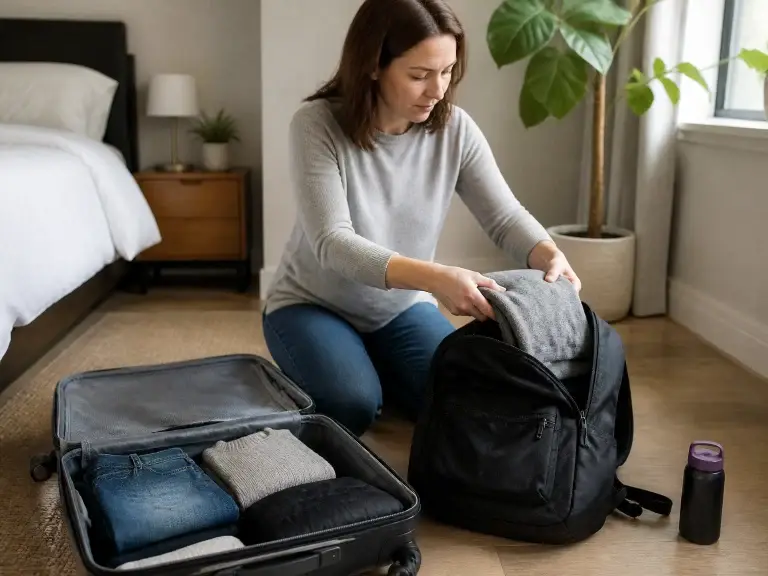
Once the carry on and the checked bag are packed, weigh both at home with a luggage scale, then write the numbers down. Checked-bag weight limits commonly apply to each bag individually. Confirm any airline-specific exceptions before moving items between bags. Shift weight before you leave, never at the boarding door: chargers, books and toiletry bags move into the personal item whenever your fare sets no weight limit on it. Wear your heaviest layer instead of packing it, and send bulky but light items to the checked bag so the carry on sheds volume rather than weight. Never move medication, documents, keys or valuables into checked baggage to make weight; buy a smaller toiletry kit or leave the extras home. Traveling with someone? Split shared gear across both bags and agree target numbers before you get in the car, so a single overweight bag rebalances in seconds. Use a luggage scale to check your packed weight at home, and compare the result with your airline’s allowance.
Checked Baggage Weight Limit: What Actually Counts
You have already weighed both bags at home. Now confirm you are reading the right number.
A checked allowance combines piece count and weight. The weight limit, not the bag’s size, is where fees and counter repacking happen. Do not assume baggage weight allowances can be pooled between bags or travelers. Some airlines offer exceptions; check the carrier’s published rules before redistributing weight.
Find your real number on the airline’s own baggage page for your route and fare, then confirm it in your booking confirmation email. Record the date you checked it.
At the airport, an over-limit bag means paying the overweight fee or repacking in front of the counter. Weigh your luggage before departure and check whether an extra tote counts toward your permitted bag allowance. For a larger luggage option, compare the five-piece spinner luggage set against your airline’s size and weight limits. Cabin bags may be weighed on some carriers too, so the checked baggage weight limit is not the only number worth knowing.
Trip by Trip: Carry On Luggage on Road, Rail, Bus and Cruise
Those counter rules soften once you leave the airport, though each mode of travel swaps the constraint.
Road trips. No formal weight limit exists, so space and access decide everything. Packing organizers keep the bag you need at the hotel from sitting under three others.
Rail. Many trains skip liquid restrictions and allow generous carry on luggage space, yet you lift your own bags at every platform. Weight matters more than rules.
Bus. Confirm whether luggage rides in the hold beneath the coach or stays with you. Medication and documents stay in the bag at your seat, never the hold.
Cruise. Delivered luggage may not reach your cabin immediately after boarding. Keep medications, documents, valuables, and anything needed during the first few hours in a small bag you carry aboard, subject to your cruise line’s rules.
Long haul flights. The 24-hour rule applies with higher stakes: a delayed bag on a two week trip hurts far more than on a weekend break.
Plan each trip around the bag that never leaves your side.
Gate Mistakes That Cost Money and How to Avoid Them
Rules tighten in the air, and that is where mistakes get expensive. Five gate errors to avoid:
- Bringing a full size carry on suitcase on a basic economy fare that excludes it. The airline may charge a gate fee, require the bag to be checked, or refuse it under the fare’s baggage rules.
- Checking your medication. A long delay, a diversion, or an unplanned overnight stop leaves it out of reach exactly when you need it.
- Overstuffing the personal item. It still has to fit under the seat. An overflowing daypack can be refused or forced into the bin, which defeats its purpose.
- Adding a shopping bag or duty free purchase. You are suddenly carrying three items when the fare allows two.
- Assuming the return matches the outbound. Codeshares and partner airlines can apply different carry on luggage rules on the very same itinerary.
Verify the terms for both legs before you fly.
Baggage Rules: Quick Answers Before You Fly
Here are direct answers to the questions that cause those gate surprises.
A personal item generally fits under the seat in front of you; a carry-on bag usually goes in the overhead bin, subject to the airline’s rules and available space. Carry on luggage sizes differ, so measure both. Your fare, not the airline’s general policy, decides which bags your ticket includes.
It depends. Some basic economy fares include a carry on bag; others charge for it or ban it. Check your fare card before booking and again before flying, because airlines change these policies between trips, routes, and fare brands.
There is no single number. The checked baggage weight limit is set per carrier, route, and fare, so read the airline’s own baggage page for your flight and note the date you checked it. Limits and fees change.
Yes, and it belongs there. Keep medication in original, labeled packaging inside your personal item, never in a checked bag, and check current TSA and airline rules for liquids and medically necessary items before you fly.
Pre-Flight Baggage Checklist
- Confirm personal-item, carry-on and checked-bag allowances for each flight and operating airline.
- Measure bags, including handles and wheels, and check any weight limits.
- Keep essential medications, documents, valuables and spare lithium batteries accessible; follow airline and security rules.
- Review liquid restrictions and any rules for medical supplies.
- Prepare for possible gate-checking by keeping essentials in a removable small bag.
- Save the current baggage policy and fee information with your booking.
How We Select Travel Gear
These gear suggestions are based on the product information available to us, including listed dimensions, capacity, organization features and intended use, alongside official airline baggage and security guidance. A product appearing here does not mean we have personally tested it or that an airline guarantees acceptance. Measure the fully packed bag and confirm the operating airline’s current rules before purchase or travel.
Compare travel organizers: compression packing cubes · electronics organizer · travel toiletry containers. Check specifications and availability on each product page.
Related Travel Guides: Plan, Pack and Compare
Use these destination and packing guides to decide what belongs in your personal item and what can stay in a larger bag. For the right bag size, always verify your airline and fare rather than relying on a single universal dimension.
- Carry-on liquid limits: TSA, EU and UK explains how security screening rules vary by departure airport.
- How many packing cubes for travel? helps organize clothing by trip length.
- Best carry-on backpack for international travel explains dimensions and fit considerations.
- Long-haul flight essentials covers items worth keeping within reach.
- Manila travel guide adds airport-arrival and destination planning advice.
- Cabo San Lucas vs. Puerto Vallarta helps plan a Mexico trip alongside your packing checklist.
- Cruise packing essentials covers gear for travelers combining flights and cruises.
Questions to Answer Before Buying Travel Luggage
Is a personal item included with every basic-economy ticket?
Rules vary by airline, route and fare. Check the baggage allowance in your actual reservation and confirm the operating carrier.
Can a backpack count as a personal item?
Often, provided its packed dimensions meet the airline’s personal-item limit and it fits where required. The word “backpack” does not determine eligibility.
Should a power bank go in checked luggage?
Spare lithium batteries and power banks generally belong in carry-on baggage, subject to airline and FAA battery rules. Check capacity limits and airline requirements before departure.
Final Packing Advice
Start with the baggage allowance for your exact ticket and operating airline. Keep travel documents, essential medication, valuables and a practical change of clothes in the cabin bag you are permitted to bring. Use any additional carry-on or checked allowance for less time-sensitive items, while observing security and hazardous-material restrictions.
Before the airport: measure bags against your airline’s stated dimensions, weigh the checked bag at home, and screenshot the terms for both legs.
Prioritize items you must keep accessible, then choose the remaining bags according to the allowance on your ticket. Packing organizers and travel-size toiletry containers can help separate essentials, but confirm current screening rules and bag dimensions before departure.
Frequently Asked Questions
What is the difference between a personal item, a carry on bag, and a checked bag?
A personal item travels under the seat in front of you, a carry on bag travels in the overhead bin, and checked baggage is handed over at the counter or gate. Allowances depend on the airline, route, fare type, and applicable ticket benefits; check your booking and the airline’s current baggage rules.
Why does the personal item matter more than the carry on on a basic economy fare?
On some basic-economy fares, a personal item is included while a larger carry-on costs extra or is not permitted. Always confirm your fare’s exact allowance. If your fare does not include a larger carry-on, the airline may require you to check that bag or pay an applicable fee; gate checking is not guaranteed. Keep medication, travel documents and other essentials in a bag you are permitted to bring into the cabin.
What is the 24 hour rule for sorting gear?
Ask of every item whether you would need it within 24 hours if your bags arrived a day late. If yes, it goes in the personal item; if no, it moves to the carry on bag or the checked bag. Documents and money, medication and medical devices, one change of clothes, and charging essentials almost always pass the test.
What should I put in my personal item?
Load documents first (passport or ID, boarding pass, travel insurance, booking confirmations, a card that works abroad, and a printed itinerary). Then add medication in original labeled containers, one change of clothes, a small toiletry kit built around travel-size toiletry containers that meet current TSA liquid limits, and charging essentials.
Where can I find my checked baggage weight limit?
The guide says there is no single number because limits are set per carrier, route, and fare. Find your real number on the airline's own baggage page for your route and fare, confirm it in your booking confirmation email, and record the date you checked it. Allowances are per bag, not pooled across travelers or bags.