Carry-On Size by Airline: The 2026 Enforcement Rules That Could Cost You $100 at the Gate

Professional header image for list-based article: Carry-On Size by Airline: The 2026 Enforcement Rules That...
Share it

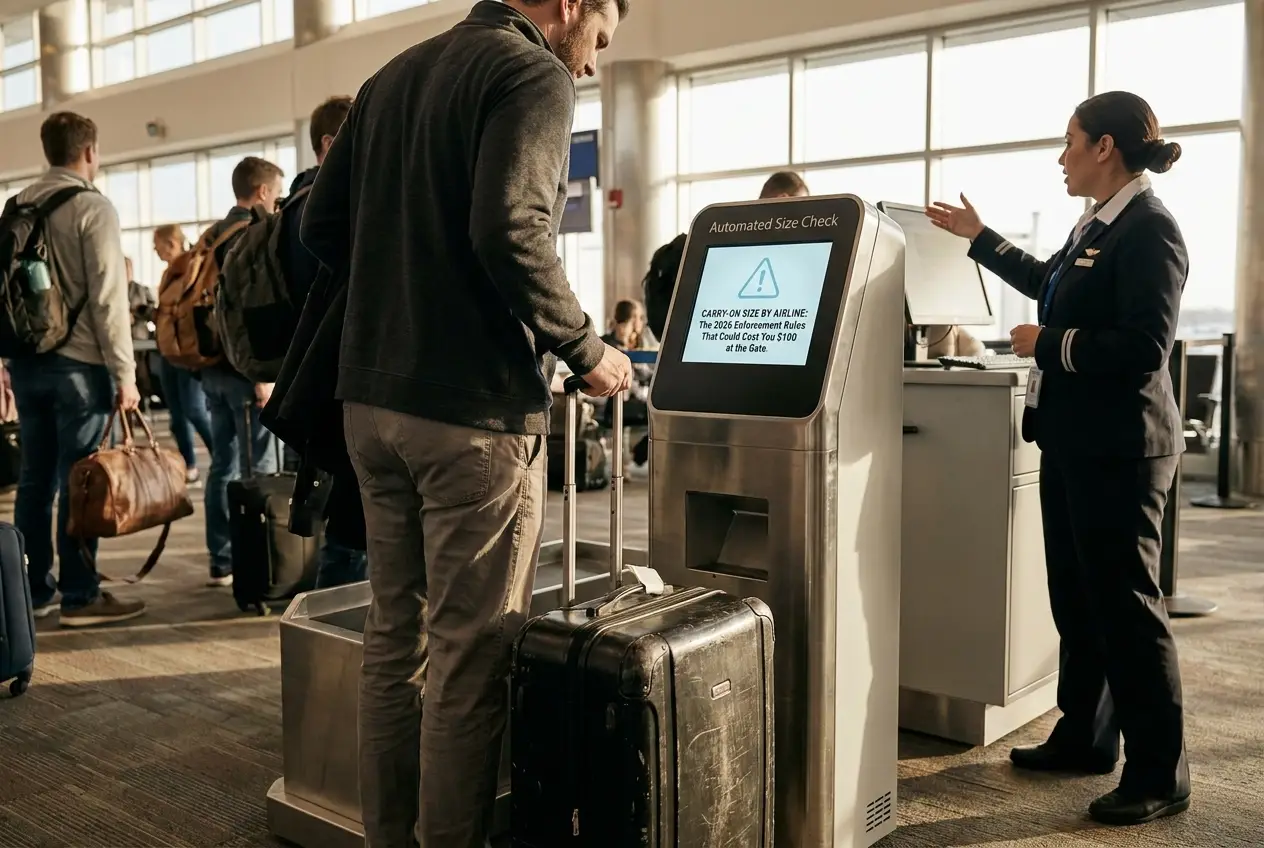
The rules changed in 2026, and the airport is no longer forgiving. Airlines have replaced the informal, agent-at-the-gate system with automated sizing frames that measure every bag with zero tolerance. Bring an oversized carry-on to the wrong airline, and you are looking at a $100 fee before you board.

Getting your carry on luggage measurements right before you buy a bag is no longer optional. The old “22x14x9” rule that circulated for years was never universal, and it certainly does not cover the stricter enforcement era we are now in. American, Delta, United, Southwest, and budget carriers like Frontier and Spirit each enforce different dimensions, and some include wheels and handles in the measurement while others account for protruding pockets as well.

This guide breaks down exactly what you need to know, carrier by carrier. You will learn how airlines measure bags, which dimensions clear each major airline, how the personal item strategy shifts when enforcement tightens, and how to avoid gate fees entirely. Read this before your next bag purchase, not after your next flight.

Why 2026 Changed Everything: Automated Scanners and No More Negotiation

Airlines across the U.S. have replaced manual gate agent discretion with automated rigid sizing frames, physical metal or sensor-based gauges that your bag either fits into or does not. There is no appeal, no compression opportunity, and no friendly agent willing to look the other way. If you want the full carrier-by-carrier breakdown before you buy, the complete 2026 airline carry-on size guide covers every major U.S. carrier in detail.

Here is what the automated enforcement shift means in practice:

  • Soft-sided bags lost their advantage. Gate agents previously allowed travelers to compress or reshape a slightly oversized soft bag to squeeze into the overhead bin. Automated frames do not accommodate compression. If the exterior dimension exceeds the limit, the bag fails, regardless of material.
  • Every protrusion counts. Measurements are total exterior, meaning wheels, telescoping handles, and any bulging external pockets are included in the dimensional check. The bag body alone is not the measurement; the outermost edge of every element is.
  • The fee structure punishes delay. Budget carriers currently charge approximately $60 for a carry-on fee paid during booking. That same fee reaches $100 if collected at the gate, a $40 penalty for not acting in advance.
  • Status offers no exemption. Frequent flyers who previously benefited from agent familiarity or elite status leniency now move through the same automated compliance process as every other traveler. The frame does not read your loyalty number.

How Airlines Measure Carry-On Luggage Dimensions (What “Including Wheels and Handles” Really Means)

Airlines measure every exterior dimension of the complete bag as it sits, including every element that protrudes beyond the main body. Internal capacity is irrelevant. A bag with a spacious interior but wide spinner wheels can fail a frame check that a slimmer, smaller-volume bag passes.

Where the inches hide:

Wheels, telescoping handle housings, and external pockets all contribute to the measured exterior, so the total height of a labeled “22-inch” bag regularly exceeds its marketed size. Always check the manufacturer’s listed exterior dimensions before purchasing. Our guide to best carry-on luggage flags tested exterior measurements for top 2026 picks.

How to self-measure any bag you already own:

  1. Lay the bag flat on a hard surface
  2. Extend all handles to their fully retracted resting position (collapsed but not removed)
  3. Measure from the outermost wheel base to the top of the handle housing for true height
  4. Measure width at the widest point, including side pockets if they bulge when packed
  5. Measure depth with any front pocket fully loaded as you would travel

An overpacked front pocket that pushes width from 13.5 inches to 14.5 inches is the difference between clearing a frame and paying a gate fee.

Carry-On Luggage Sizes by Airline: Major U.S. Carriers at a Glance

Here is how each carrier’s limits stack up side by side.

U.S. Carrier Carry-On Dimensions at a Glance

AirlineMax Exterior DimensionsCarry-On Weight LimitGate Fee (Unpaid)
American Airlines22 x 14 x 9 inNot enforced domesticallyUp to $100
Delta Air Lines22 x 14 x 9 inNot enforced domesticallyUp to $100
United Airlines22 x 14 x 9 inNot enforced domesticallyUp to $100
JetBlue22 x 14 x 9 inNot enforced domesticallyUp to $100
Alaska Airlines22 x 14 x 9 inNot enforced domesticallyUp to $100
Southwest24 x 16 x 10 inNot enforced domesticallyVaries
Frontier~18 x 14 x 8 in (free)Not enforced domesticallyUp to $100
Spirit~18 x 14 x 8 in (free)Not enforced domesticallyUp to $100

American, Delta, United, JetBlue, and Alaska all enforce the same 22 x 14 x 9 inch standard, wheels and handles included. A bag that clears this frame travels freely on any of these five carriers.

Southwest’s 24 x 16 x 10 inch allowance is the largest here. Many bags labeled “large carry-on” or “expandable” that would fail at the gate on American or Delta pass Southwest’s frame without issue.

Frontier and Spirit restrict the free allowance to a personal item of roughly 18 x 14 x 8 inches, sized for under the seat. Any traditional carry-on requires a paid add-on, approximately $60 at booking and up to $100 if flagged at the gate.

International routes add a weight dimension, covered fully in the international section below.

For travelers who need a bag that clears across multiple carrier types, this guide on what to look for in a travel backpack for every trip type helps you match the bag to both the trip and the carrier.

American Airlines Carry-On Size Rules for 2026

American Airlines enforces a 22 x 14 x 9 inch carry-on limit, total exterior including wheels and handles. If your bag exceeds any single dimension, it fails the automated frame check. No exceptions, no compression allowances.

Domestic vs. International Weight Rules

On domestic American Airlines flights, no carry-on weight limit is actively enforced. You do need to lift the bag into the overhead bin yourself, but no scale comes out. On transatlantic and transpacific itineraries, particularly on codeshare segments operated by partner carriers, weight restrictions can vary significantly by partner. Verify the specific partner’s policy before you travel, not at the gate.

Enforcement at Major Hubs

Sizing compliance checks are most commonly reported at high-traffic hubs; verify current gate procedures with the carrier before travel. If you are unsure whether your current bag clears, reviewing the TSA carry-on size limits and approved gear guide before your trip can save you a costly surprise.

Basic Economy Passengers: A Separate Rule

Basic Economy fare holders on American Airlines cannot use the overhead bin at all. A carry-on bag at any size must be checked at the gate. For Basic Economy travelers, the personal item, typically up to 18 x 14 x 8 inches, is the only free bag option.

What to Buy

A hard-sided spinner tested to the exact 22 x 14 x 9 frame is the safest choice. A rigid shell does not flex over the limit when packed, unlike soft-sided bags that expand with contents.

Shop Now: essentialfortravel.com

Delta Airlines Carry-On Size Rules for 2026

Delta matches American’s standard exactly: 22 x 14 x 9 inches total exterior dimensions, wheels and handles included. If your bag cleared American’s frame, it clears Delta’s frame too.

Basic Economy fare is the critical exception. Delta’s Basic Economy terms should be confirmed at booking; overhead bin access and personal item requirements can vary by route and fare version.

Enforcement in 2026 is most active at Delta’s highest-volume hubs. Sizing compliance checks are most commonly reported at high-traffic hubs; verify current gate procedures with the carrier before travel. Traveling through a smaller spoke airport does not guarantee a pass; it just means enforcement is less consistent.

Weight rules split by who operates your flight. Delta-metal international flights generally carry no carry-on weight limit. The risk appears when your itinerary connects to a SkyTeam partner such as Air France or KLM. Those carriers enforce their own weight policies, and Delta’s leniency does not transfer to codeshare segments. A bag that Delta boards without question can trigger a fee on the next leg.

If your trip includes a SkyTeam connection, pull up the operating carrier’s baggage policy before you pack, not at the airport. The same due diligence applies to any connecting segment not operated by Delta itself.

For travelers debating between a hard-sided spinner and a soft duffel, our guide on how to choose a travel duffel bag before you buy covers the tradeoffs in full, including which formats hold their shape through automated frame checks.

United Airlines Carry-On Size Rules for 2026

United follows the same 22 x 14 x 9 inch standard as American and Delta, with all protrusions counted. That means wheels, handles, and any external pocket that bulges beyond the bag body are included in the measurement. Enforcement rigor in 2026 now matches the stated policy.

Basic Economy on United is particularly restrictive. Passengers in that fare class are limited to one personal item only, sized at 9 x 10 x 17 inches, and it must fit under the seat. No overhead bin access. United is one of three major carriers with this hard restriction, so travelers booking on price alone need to account for it before checkout.

Sizing compliance checks are most commonly reported at high-traffic hubs; verify current gate procedures with the carrier before travel.

United’s elite-status exceptions for Basic Economy overhead bin access vary by tier; confirm your specific benefit directly with United before assuming access.

For Star Alliance itineraries booked through United, the dimension rule stays consistent, but weight limits do not. United does not enforce carry-on weight on domestic routes. Star Alliance partners like Lufthansa and Singapore Airlines enforce their own Economy carry-on weight limits, check each operating carrier’s policy independently. Weigh before you leave, not at the gate.

Southwest Airlines Carry-On Size Rules for 2026

Unlike every carrier covered so far, Southwest operates under a noticeably different set of rules, and they favor the traveler.

Southwest’s carry-on allowance is 24 x 16 x 10 inches, the largest permitted dimensions of any major U.S. domestic carrier in 2026. That is 2 inches more in length, 2 inches more in width, and 1 inch more in depth than the 22 x 14 x 9 standard enforced at American, Delta, and United. In practical terms, many bags sold as “large carry-on” or “expandable carry-on” that would fail an automated frame at other carriers will clear Southwest’s sizing requirement without issue.

Southwest also allows two free checked bags per ticketed customer, which removes the financial pressure many travelers feel to push carry-on capacity to its limit. That said, free checked baggage does not suspend the carry-on size rule at the gate. The dimensional limit still applies.

Southwest’s published policy does not list a domestic carry-on weight limit; confirm via Southwest’s official baggage page before travel. Combined with the larger dimensional allowance, that makes Southwest the most carry-on-friendly major U.S. domestic carrier in 2026 by both size and weight criteria.

The critical caveat for multi-carrier travelers: if your itinerary includes any flights on American, Delta, United, or other major carriers, do not buy a bag optimized for Southwest’s larger frame. A bag built to 24 x 16 x 10 inches will fail the 22 x 14 x 9 automated frames at other hubs and trigger a gate fee. Travelers who split trips across carriers should own a bag that clears the stricter standard and simply enjoy the extra overhead space on Southwest flights.

JetBlue and Alaska Airlines Carry-On Rules for 2026

Both JetBlue and Alaska Airlines enforce the same 22 x 14 x 9 inch carry-on limit as the other major carriers covered above, wheels and handles included. If your bag clears American or Delta’s sizing frame, it clears these two as well.

JetBlue: Same Dimensions, High-Priority Enforcement Hubs

Sizing compliance checks are most commonly reported at high-traffic hubs; verify current gate procedures with the carrier before travel.

The fare-class detail that catches travelers off guard is JetBlue’s Blue Basic tier. As of September 2024, JetBlue extended one free carry-on to all fare classes including Blue Basic, a meaningful improvement over its prior policy. Blue Basic passengers may still face other restrictions; confirm current fare terms before booking. Both JetBlue and Alaska set personal item limits at approximately 17 x 13 x 8 inches, and that under-seat measurement is what travelers must plan around when the carry-on slot is unavailable.

Alaska Airlines: Consistent Enforcement

Alaska Airlines enforces 22 x 14 x 9 inches. Sizing compliance checks are most commonly reported at high-traffic hubs; verify current gate procedures with the carrier before travel.

On domestic routes, Alaska does not enforce a carry-on weight limit. However, international itineraries to Mexico or Canada that include a connecting segment on a partner carrier may trigger that partner’s own weight restrictions. Confirm the partner’s policy independently before packing for any cross-border connection.

Both carriers allow one personal item in addition to the carry-on, required to fit under the seat in front of you.

Budget Carriers Frontier and Spirit: Stricter Carry-On Dimension Rules and $100 Gate Fees

Budget carriers operate under a completely different rulebook than JetBlue or Alaska. Where major carriers give you 22 x 14 x 9 inches free, Frontier and Spirit shrink that allowance dramatically.

The free tier on both carriers is approximately 18 x 14 x 8 inches. That is a personal item designed to slide under the seat, not a carry-on for the overhead bin. The standard 22 x 14 x 9 inch bag that clears every major carrier does not qualify here. Bringing one without paying first is where travelers get hurt.

What You Pay and When It Hurts

If you need overhead bin space, you must purchase a carry-on add-on. Bought during booking, that fee runs approximately $60. Wait until the gate, and the same bag costs $100. That is not a nuanced enforcement call; it is an automated flag with a fixed penalty. In 2026, no agent discretion softens it.

The $100 gate fee is the single most expensive per-bag mistake available to a U.S. traveler this year.

The Right Compliance Strategy

Your approach depends on how you fly:

  • Frontier or Spirit only: Own a dedicated personal item bag at 18 x 14 x 8 inches. You bring it, you board, you pay nothing.
  • Mix of budget and major carriers: Either carry two bags (a 22 x 14 x 9 hard-sided carry-on for major carriers plus an 18 x 14 x 8 personal item bag for budget legs), or prepay the carry-on fee at booking when flying Frontier or Spirit. Never let it reach the gate.

The $40 difference between a prepaid fee and a gate fee is decided days before you travel.

Shop Now: essentialfortravel.com

International Flights and Carry-On Weight Limits U.S. Travelers Frequently Miss

The fee risk on budget carriers is dimensional. On international routes, the risk is weight, and American travelers are uniquely unprepared for it.

European and Asian carriers in the 15–22 pound range actively enforce carry-on weight limits, consult the specific operating carrier’s baggage policy page before your trip, as limits vary.

The enforcement tool differs from the automated frames used for dimensions. Gate agents use portable scales or fixed weigh points, and the process takes seconds. The fees, however, are comparable to domestic gate bag penalties.

The dimension problem and the weight problem collide in a specific way: a fully packed carry-on can easily approach or exceed the strictest international weight ceilings. That bag clears every dimensional frame on a major U.S. carrier without issue, then fails the weight check at a European or Asian gate before you even reach the jetway. Compliant dimensions do not guarantee compliant weight. Travelers on international routes must manage both.

Choosing a lightweight bag gives you more packing capacity before hitting international weight thresholds, check manufacturer empty-weight specs before buying. It also helps to pack heavier items, such as liquids and TSA-compliant toiletry bags, into your personal item to reduce carry-on weight at the gate.

Shop Now: essentialfortravel.com

Personal Item Strategy: Maximizing Your Second Bag as Enforcement Tightens

Weight limits are the international traveler’s ambush. The personal item slot is every traveler’s insurance policy.

Every U.S. airline permits one personal item alongside your carry-on, and that item must fit under the seat in front of you. Check your specific carrier’s baggage page, as allowances range roughly from 17 x 13 x 8 inches to 18 x 14 x 8 inches. That range is narrow, but the volume it unlocks is not.

Why the Personal Item Matters More in 2026

A well-organized personal item carries a laptop, one day’s clothing, medications, documents, and valuables that should never travel in checked luggage. It is your fallback when the carry-on gets flagged.

Budget Carrier Travelers: Flip the Strategy

On Frontier and Spirit, as covered above, the only free allowance is the personal item slot, so treat it as your primary bag. If your trip fits into 18 x 14 x 8 inches, you pay nothing. Budget carrier travelers should pack the personal item first and treat it as the primary bag, not an accessory.

Choose the Right Format

Structured backpacks, slim tote bags, and laptop bags are the top personal item formats. A structured backpack within the 18 x 14 x 8 inch range fits under-seat on most U.S. carriers, though regional aircraft under-seat space can be tighter.

Avoid rigid-framed bags that cannot compress slightly. Under-seat space varies between wide-body jets and regional aircraft. Soft structure gives you that critical margin.

Soft-Sided vs. Hard-Sided Carry-Ons: Which Bag Types Fail the 2026 Automated Frames

Your carry-on choice determines whether you clear the gate frame at all, and in 2026, the bag material you choose matters more than ever.

Automated sizing frames have no judgment. If any exterior dimension exceeds the limit, the frame rejects the bag, and previously, a soft-sided bag running slightly large could be squeezed or tilted into the overhead at an agent’s judgment. That grace period ended.

The Expandable Bag Problem

Expandable soft-sided carry-ons are the highest-risk category this year. When the expansion zipper is used, total exterior dimensions can exceed the carrier’s limit, measure the bag fully expanded before every trip. Most travelers expand the zipper while packing at home, then forget the bag is now oversized before reaching the gate.

Why Hard-Sided Bags Win in 2026

A hard-sided shell does not flex, bulge, or expand with contents. The exterior dimension you measure before a trip is the dimension the frame scans. The bag either complies or it does not, and you know before leaving home.

Non-expandable soft-sided bags with minimal external pockets can still pass, but only if you measure the fully packed exterior, not the empty manufacturer spec on the product page. An overstuffed front pocket alone can push a compliant bag over the limit.

For frequent flyers, the practical answer is a hard-sided spinner tested to 22 x 14 x 9 inches including wheels and handles, paired with a slim personal item. A well-chosen travel toiletry bag keeps your personal item efficient and security lines moving.

Gate Fee Avoidance: A Simple Decision Guide Before Your Next Flight

Knowing your bag type determines everything. Apply these five steps before you book, not before you board.

Step 1: Identify your carrier. Confirm your carrier’s limit, Southwest allows 24 x 16 x 10 inches; most major carriers enforce 22 x 14 x 9 inches; budget carriers’ free tier is ~18 x 14 x 8 inches, then proceed to Step 2.

Step 2: Measure your bag fully packed. Wheels down, handles retracted to resting position, all pockets filled as they would be at the gate. If any single dimension exceeds your carrier’s limit, you have two options: buy a compliant bag, or prepay the carry-on fee at booking (approximately $60).

Step 3: Run the cost math. A compliant carry-on from Shop Now: essentialfortravel.com amortized across 10 or more trips costs a fraction of repeated $100 gate fees. One gate penalty often exceeds half the cost of a properly sized bag. For frequent travelers, the one-time purchase wins on the first round trip.

Step 4: Prepay on budget carriers. If your bag does not clear the 18 x 14 x 8 free personal item threshold on Frontier or Spirit, declare it during online check-in. The $40 difference between a $60 prepaid fee and a $100 gate fee is recovered in minutes of planning.

Step 5: Weigh before international departures. Weigh your luggage before leaving home and redistribute non-essentials to your personal item. International carriers enforce weight limits at the gate with no negotiation.

The Bottom Line: Buy the Right Bag Before You Reach the Gate

All the planning in previous sections leads to one decision made before you pack. The 2026 enforcement shift is not a policy update travelers can negotiate through; it is a mechanical reality. A sizing frame either accepts your bag or it does not, and no gate agent overrides the result.

Three facts to carry with you:

  • Carrier dimensions are not interchangeable, see the carrier sections above for specifics.
  • Generic “22 x 14 x 9” advice is incomplete protection. That standard applies to major carriers only. Budget carrier free allowances are narrower, and international weight limits add a second compliance layer that dimensions alone do not address.
  • One purchase solves most of the problem. A hard-sided carry-on tested to 22 x 14 x 9 inches, paired with a structured personal item bag sized for under-seat storage, covers the overwhelming majority of U.S. domestic routes and major-carrier international itineraries. The hard shell guarantees dimensional compliance that soft-sided bags no longer reliably provide.

The $100 gate fee is avoidable. The right bag, bought once, costs less than two gate penalties and travels indefinitely.

Shop Now: essentialfortravel.com

#EssentialForTravel #CarryOnLuggage #TravelTips #AirlineRules #PackSmart

Conclusion

The 2026 carry-on enforcement shift removes human judgment from the equation. Automated sizing frames decide instantly, and gate fees follow just as fast.

Two points that protect your wallet:

  • Carrier dimensions are not interchangeable, what clears Delta may fail Spirit, and the carrier sections above detail the specifics.
  • Hard-sided bags guarantee dimensional compliance that soft-sided bags can no longer reliably deliver.

The planning only works if you act before you pack. Review your upcoming carriers, confirm your bag meets their specific requirements, and upgrade if it does not. A compliant carry-on is not an expense; it is a one-time investment that pays for itself on the very first trip it saves you from a $100 surprise.

Visit essentialfortravel.com to find the right bag before your next flight.

Frequently Asked Questions

What changed in 2026 that makes carry-on sizing so important?

In 2026, airlines replaced manual gate agent discretion with automated sizing frames that have zero tolerance for oversized bags. These rigid metal or sensor-based gauges no longer allow agents to compress soft-sided bags or make exceptions. If your bag doesn't fit the frame, it fails automatically, and you face a gate fee of up to $100. There is no negotiation, no appeal, and no special treatment for frequent flyers.

How exactly do airlines measure carry-on bags now?

Airlines measure every exterior dimension of your bag as it sits packed, including all protrusions. This means wheels, telescoping handles, external pockets that bulge, and any other protruding element are included in the measurement. To self-measure, lay your bag flat, extend handles to their collapsed resting position, and measure height (from wheel base to handle top), width (at widest point including side pockets), and depth (with front pockets fully loaded as you'd travel). A single dimension exceeding the limit causes the bag to fail the frame check.

Do all U.S. airlines have the same carry-on size limits?

No. American Airlines, Delta, United, JetBlue, and Alaska Airlines all enforce 22 x 14 x 9 inches. Southwest is more generous at 24 x 16 x 10 inches, allowing bags that would fail at other carriers. Budget carriers Frontier and Spirit are much stricter—their free allowance is only approximately 18 x 14 x 8 inches for a personal item, and any traditional carry-on requires a paid add-on fee. Always verify your specific carrier's dimensions before purchasing a bag.

What is the difference between a prepaid carry-on fee and a gate fee?

If you need to pay for a carry-on on budget carriers like Frontier or Spirit, prepaying during online check-in costs approximately $60. However, if you wait until the gate and your bag is flagged by the automated frame, the same fee jumps to $100—a $40 penalty for not planning ahead. For travelers flying budget carriers, prepaying during booking is a smart strategy to avoid the higher gate fee and guarantee overhead bin access.

How do international carry-on weight limits affect U.S. travelers?

International carriers, particularly European and Asian airlines, actively enforce carry-on weight limits in the 15–22 pound range, which most U.S. travelers are unprepared for. A fully packed carry-on can easily exceed these international weight ceilings, even if it passes all dimensional frame checks. Gate agents use portable scales to verify weight at international departure gates with no negotiation. To avoid fees, choose a lightweight bag to maximize packing capacity, and consider packing heavier items like liquids and toiletries in your personal item instead to reduce carry-on weight before the gate.