By Garry Barnes. Publisher: Essential For Travel.
Most leaked toiletry bags have nothing to do with a faulty cap.
Here is the uncomfortable truth about travel bottles for toiletries: the mechanism usually fails first, well before the seal gives out. A fine fragrance dribbles out of a squeeze tube. Thick conditioner refuses to leave a narrow mist nozzle. A silicone neck splits at the seam after a few trips, and the bottle you trusted becomes the reason your clothes smell like shampoo.
This guide is for beginners who want to buy once and pack confidently. You will learn why bottle sets fail, what the checkpoint actually requires at security, and how the four main dispensing mechanisms work: spray, pump, squeeze and silicone. From there, we match each mechanism to what you fill it with, covering fragrance and fine mist, shampoo and thick conditioner, lotion and cream, plus toner and astringent.
You will also get four practical tests every travel bottle set should pass before you buy: seal design, honest capacity markings, how easily it cleans out, and why silicone necks split at the seam. Quick selection guidance and a pre-flight checklist close it out.
Why Travel Bottle Sets Fail and It Is Rarely the Cap
Most toiletry bottles do not fail because the cap is defective. They fail because the dispensing mechanism does not match the liquid inside, which is why a set of refillable travel bottles needs to be chosen against what you actually carry. A pump squirts lotion sideways in a moving bag. A spray spits fragrance in droplets instead of mist. A narrow neck refuses to release thick conditioner, and a soft silicone bottle weeps where the neck meets the body.
Meeting a checkpoint volume rule and surviving a squeezed bag are different tests. For choosing a bag with room for toiletries, see our duffel, weekender and gym bag comparison. Decide what you fill, then choose the bottle that dispenses it properly; size, color and bundle count come later. Check the rules for your departure airport, not just your destination.
The Compliance Frame: What the Checkpoint Actually Requires
Do not pack from memory. The TSA governs US checkpoints, and its Liquids, Aerosols, and Gels Rule page and FAQ are where the current per-container limit and bag size are published. Confirm both before you fly; the 3-1-1 label is still how TSA markets the rule, but the numbers live on those pages.
Other countries publish their own limits. TSA pages say nothing about UK, EU, or other checkpoints, so check the authority for your departure airport.
One caution: meeting a volume limit says nothing about whether a bottle survives a squeezed bag. Compliance and seal quality are separate tests. For the baggage side of the rule, see our TSA approved carry on luggage guide.
Four Mechanisms and What Each One Actually Does
Compliance is only half the test; the mechanism decides whether your travel bottle works.
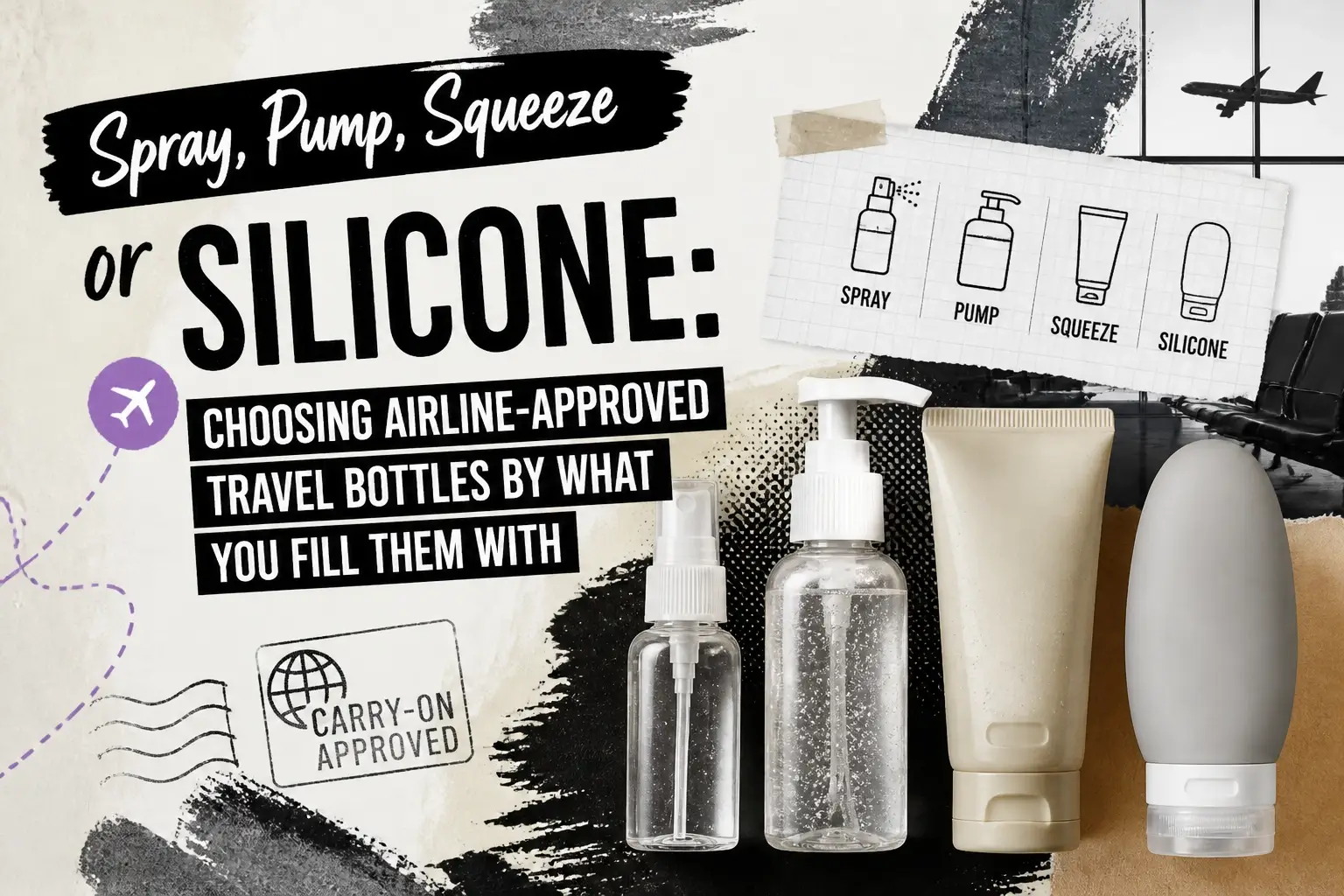
Spray. Atomizers push liquid through a fine nozzle. Thin liquids mist well; thicker ones tend to clog or dribble. Best for fragrance and toner.
Pump. A spring-loaded piston meters the dose. Good for hotel-sink lotion, awkward for anything you shake out fast, and a pump that is not fully locked down can keep releasing product once pressure builds in the bag. Best for countertop lotion.
Squeeze tube. Hand pressure moves product, so the opening decides what fits. A wide mouth passes conditioner and gel with ease; a narrow neck is a struggle. Best for shampoo and body wash.
Silicone. Soft walls survive squeezing, but the join where silicone meets the rigid collar tends to go first. Best for crush resistance.
No set does all four well. Match mechanism first, then read our guide to TSA-compliant travel bottles.
Match the Mechanism to What You Fill It With
| Product | Mechanism | Opening or nozzle | Failure if mismatched |
|---|---|---|---|
| Fragrance | Fine mist spray | Fine nozzle, gasketed collar | Droplets; weeping threads |
| Shampoo | Squeeze tube | Wide mouth, flip top | Clogged neck |
| Thick conditioner | Squeeze tube | Wide mouth | Stalled flow |
| Lotion | Pump or tube | Metered dose or wide mouth | Weeping pump in a packed bag |
| Toner | Flip top or spray | Fine nozzle, firm collar | Drips; alcohol seal failure |
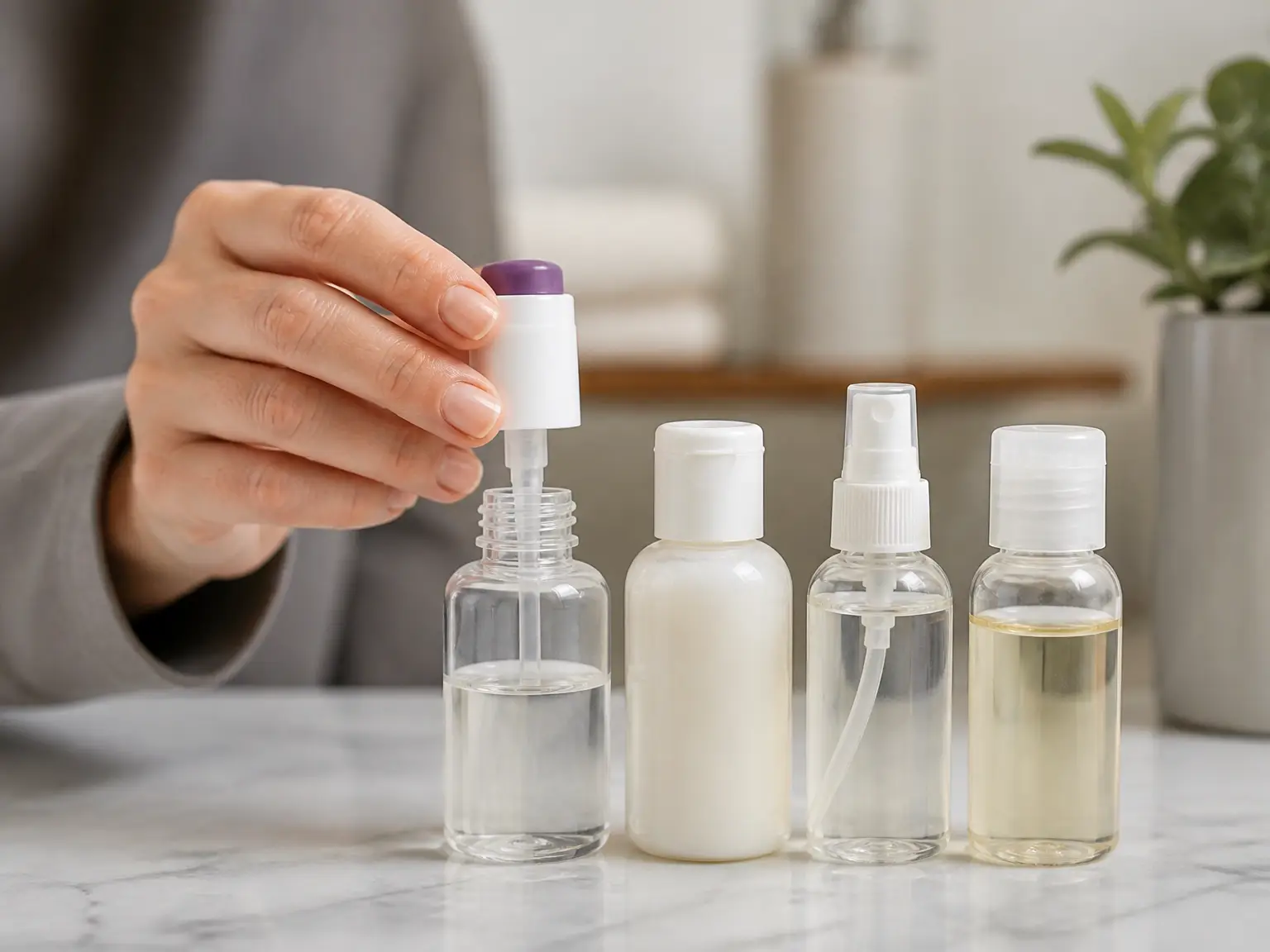
Choose the mechanism first, then the set. A set built around one mechanism will let you down on at least two of your four products. The logic holds for travel size bottles in any format, so read the table as a shop-aisle checklist. Cross-check each pairing against manufacturer nozzle or viscosity specs; otherwise, treat it as author-tested. Compare the 3- or 11-piece travel toiletry container set and the 4-in-1 refillable travel bottle dispenser to check their available formats.
Fragrance and Fine Mist: A Fine Spray Plus a Sealed Collar
The fragrance pairing is the easy one: alcohol-based and thin, it mists readily. The seal is the hard part, because alcohol evaporates, creeps into weak threads, and escapes. Look for a travel spray bottle with a fine mist nozzle, an internal gasket, and a collar that closes firmly through several turns. Plastic meeting plastic will weep across a long flight.
Test at home: fill with water, invert, squeeze gently, then stand it on a paper towel overnight. A damp ring indicts the collar, not the nozzle.
A small atomizer beats a full-size bottle for a weekend, but decanted fragrance does not hold its character forever, so mix only what you will use.
Rinse the nozzle with warm water between refills; dried residue turns a mist into a squirt. Seal quality decides other gear too, including a water filter bottle for travel.
Shampoo and Thick Conditioner: Wide Mouth Squeeze Tubes
Unlike fragrance, thick conditioner needs an opening it can actually pass, so look for a mouth wide enough to admit a small funnel or a fingertip.
The pairing is the point: soft walls to drive product out, plus a wide mouth to fill and empty. A wide mouth on a stiff bottle stays miserable in a hotel shower.
Judge the closure honestly: flip tops are quick with wet hands but rely on a thin hinge; screw caps tend to seal more reliably but open slower.
For shampoo and conditioner, a multi-bottle set with two cap types beats a matched set: shampoo wants a flip top, toner wants something else. Essential For Travel’s TSA-compliant bottles follow that format. See the 4-in-1 portable leakproof travel bottle dispenser set page for current formats.
Lotion and Cream: Pump or Squeeze?
Lotion splits the two mechanisms. A pump earns its place at a hotel sink: one press delivers a metered dose and the rim stays clean. It travels badly. In a squeezed rucksack, a partly depressed pump, pressed by tight compression packing cubes, can keep releasing product into the pouch. Lock it fully down or pack a tube instead.
Thickness decides the pairing. Runny body lotion pumps fine; dense cream needs a wide-mouth squeeze tube; a gritty exfoliant belongs in a tube you can force it out of. The capacity trap: a pump hides its remaining level, so you may arrive with less than you assumed, while a squeezable tube lets you judge by feel and top up before leaving. A pump also grows sluggish within a few refills, so flush the mechanism with warm water between products.
Toner and Astringent: Spray Bottles and Flip Tops
Toner is the thin counterpart to lotion. It mists as readily as fragrance, but most people apply it with a cotton pad, so a flip top suits shelf use. If you use toner as a face mist, a travel spray bottle with a fine nozzle works well, provided the nozzle does not drip on the way to your face, where watery products show drips instantly.
Alcohol content decides the seal. High alcohol toners need the same gasket and firm collar as fragrance; non alcoholic formulas are forgiving. Keep toner in its own bottle, since thin liquids pick up whatever trace was left behind and a reused shampoo bottle leaves a smell you will notice every morning. Do not refill one bottle with whatever is left on the shelf. See our travel essentials list.
Travel Bottles: Four Tests Every Set Should Pass
Whatever you just put in that toner bottle, four checks decide whether any travel bottle set earns its place. Judge seal design, honest capacity markings, ease of cleaning, and survival in a squeezed, packed bag.
Those four beat the leak proof claim on packaging. A marketing promise cannot be verified in a store. The four tests take one afternoon at home. Fill and invert overnight for the seal. Measure stated capacity against a kitchen measuring cup. Rinse with warm water for cleaning. Load a daypack for the squeeze test.
Apply them to any set, and they work as a return or exchange test after one trip. Fail two of four, and it is wrong for how you pack.
Seal Design: Gaskets, Collars and Threads
That overnight inverted test exposes the weakest link: a seal is a stack of cap or nozzle, gasket, collar, and the thread cut into the bottle. Any layer fails and the whole bottle weeps, which is why a fresh cap on a worn collar seldom cures it.
Look for replaceable silicone or rubber gaskets and collars that engage several full turns. Quarter-turn closures loosen as soon as something presses against them in a bag.
In interchangeable sets, watch for thread mismatch: a cap that feels loose on one bottle can seal perfectly on its twin. Match and label them.
Gaskets vanish down hotel sinks. Buy a set with spares, or carry two in the pouch.
Hard-shelled cases and rigid pouches help, since much of what people call a leak is product pushed upward through the cap by pressure, not liquid escaping a closed bottle. Next: honest capacity markings.
Honest Capacity Markings
A tight seal keeps product in; honest markings tell you how much of it you actually have. Capacity numbers serve two jobs: meeting the checkpoint volume rule, and showing how much shampoo remains on night three.
Look for printed or molded markings that survive repeated washing, since soft-bottle markings are often the first thing to fade.
Verify stated capacity with a measuring cup at home. Some sets overstate usable volume because the neck, shoulder and pump mechanism occupy space you cannot fill.
Once you know how much product covers your usual trip, tape your fill line onto the bottle. Refilling before a flight becomes a glance instead of a guess.
How Easily It Cleans Out
Markings only help if the bottle comes clean. Residue is where a mismatched mechanism shows up. Conditioner left in a narrow neck hardens into a clog, and old lotion leaves a pump sluggish within a few refills.
Prefer wide mouths and removable collars so a small brush reaches the inside wall. No brush access means no way to get the old product out.
Routine: warm water, dish soap, a shake, a rinse, then air dry fully open. Sealing a damp bottle grows mildew and taints whatever goes in next.
Silicone tends to hold scent more than rigid plastic does. Do not move fragrance and conditioner between the same silicone bottle without a full clean and dry.
Swap rule: assign each bottle to one product family and label it. A bottle that has only held shampoo cleans faster and never smells of anything else.
Why Silicone Necks Split at the Seam
Cleaning leads to durability, and silicone is where that trade-off bites.
In my own use, the failure point is never the cap: it is the seam where flexible silicone walls meet the rigid collar. That join absorbs every squeeze and every flattening in a packed bag. Treat this as hands-on experience and an observed pattern, not a tested fact.
Silicone still earns its place. Soft walls empty almost completely when a thick product runs low, shrug off crushing better than rigid plastic, and sit gently against the rest of your bag.
The practical compromise: a silicone body with a screw-on rigid cap and a wide mouth, with a spare on hand for long trips. Silicone is a consumable, not a lifetime purchase, so price it that way against rigid bottles that may outlast it.
If You Mostly Pack X, Choose Y
Silicone is a consumable, not a lifetime purchase, so let your products pick the set, not the bundle count.
- Fragrance only: one small fine mist atomizer with a gasket seal, not a whole set.
- Shampoo and conditioner: a wide-mouth squeeze tube pair with flip tops, sized to the length of your typical trip.
- Lotion, cream, toner: a pump for hotel-sink lotion, a flip top or fine spray for toner, and a separate pouch so a pump leak never reaches your clothes.
- Mixed kit, checked bag: a squeeze-first set with wide mouths, plus one spray bottle if you need fragrance or a toner mist.
Mark every bottle, keep the pouch zipped, and re-run the four tests once a year instead of replacing a set that still passes.
What to Do Before Your Next Flight
Whatever you pack, three pre-flight checks remain. Buy the mechanism first, the set second. Then run the overnight inverted test before trusting the bottles in a bag you care about. Replace silicone bodies once the seam softens. Carry a spare gasket. Label every bottle, so you never guess at security or in a hotel shower.
Confirm your departure airport’s current rule rather than an old number, and treat compliance as separate from leak performance.
Now pack with confidence.
Conclusion
Choose the mechanism before the bundle, run the four tests, especially the overnight inverted test, and label every bottle. Replace silicone bodies once seams soften. Because airport rules vary by location, verify your departure airport’s current guidance instead of trusting an old number. For a practical starting point, visit essentialfortravel.com for travel bottle sets and match them to what you actually pack. Then zip your pouch and fly with confidence.
By Garry Barnes, Essential For Travel.
Frequently Asked Questions
Why do travel toiletry bottles usually leak?
Most travel bottles fail because the dispensing mechanism does not match the liquid inside, not because the cap is defective. A pump can squirt lotion sideways, a spray can spit fragrance in droplets, a narrow neck can refuse thick conditioner, and a soft silicone bottle can weep where the neck meets the body.
Which dispensing mechanism should I choose for my products?
Choose the mechanism first, then the set. Fine spray suits fragrance and toner, pumps suit hotel-sink lotion, wide-mouth squeeze tubes suit shampoo, body wash and thick conditioner, and silicone bottles offer crush resistance. No single set does all four well.
Where do I find the current checkpoint liquid rules?
For US checkpoints, check the TSA's Liquids, Aerosols, and Gels Rule page and FAQ, which publish the current per-container limit and bag size. The post notes that TSA pages do not cover UK, EU, or other checkpoints, so verify the rules for your departure airport. Meeting a volume limit does not mean a bottle will survive a squeezed bag.
How can I test whether a travel bottle will leak before I fly?
Run four tests: seal design, honest capacity markings, ease of cleaning, and survival in a squeezed, packed bag. For the seal, fill the bottle with water, invert it, squeeze gently, and stand it on a paper towel overnight; a damp ring points to the collar rather than the nozzle. To check capacity, measure the stated volume with a kitchen measuring cup. To test cleaning, rinse with warm water. For the squeeze test, load a daypack. A set that fails two of the four tests is wrong for how you pack.
Why do silicone travel bottles split, and should I still use them?
In the author's own use, silicone bottles most often fail at the seam where the flexible silicone walls meet the rigid collar, which absorbs every squeeze and flattening in a packed bag. The author describes this as an observed pattern, not a tested fact. Silicone still has advantages: soft walls empty almost completely, resist crushing better than rigid plastic, and fit gently against other items. The author suggests a silicone body with a screw-on rigid cap and a wide mouth, with a spare for long trips, and treats silicone as a consumable.