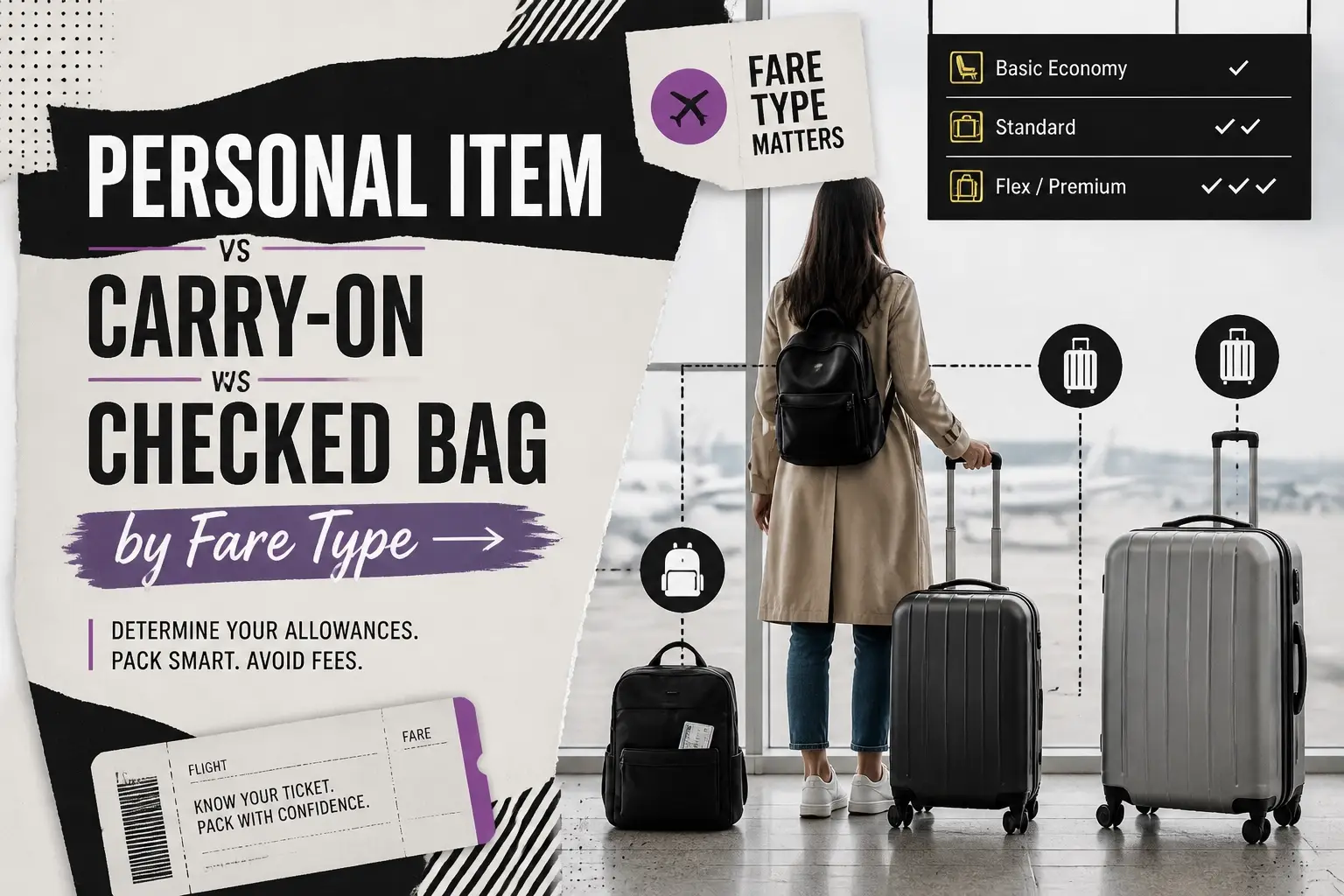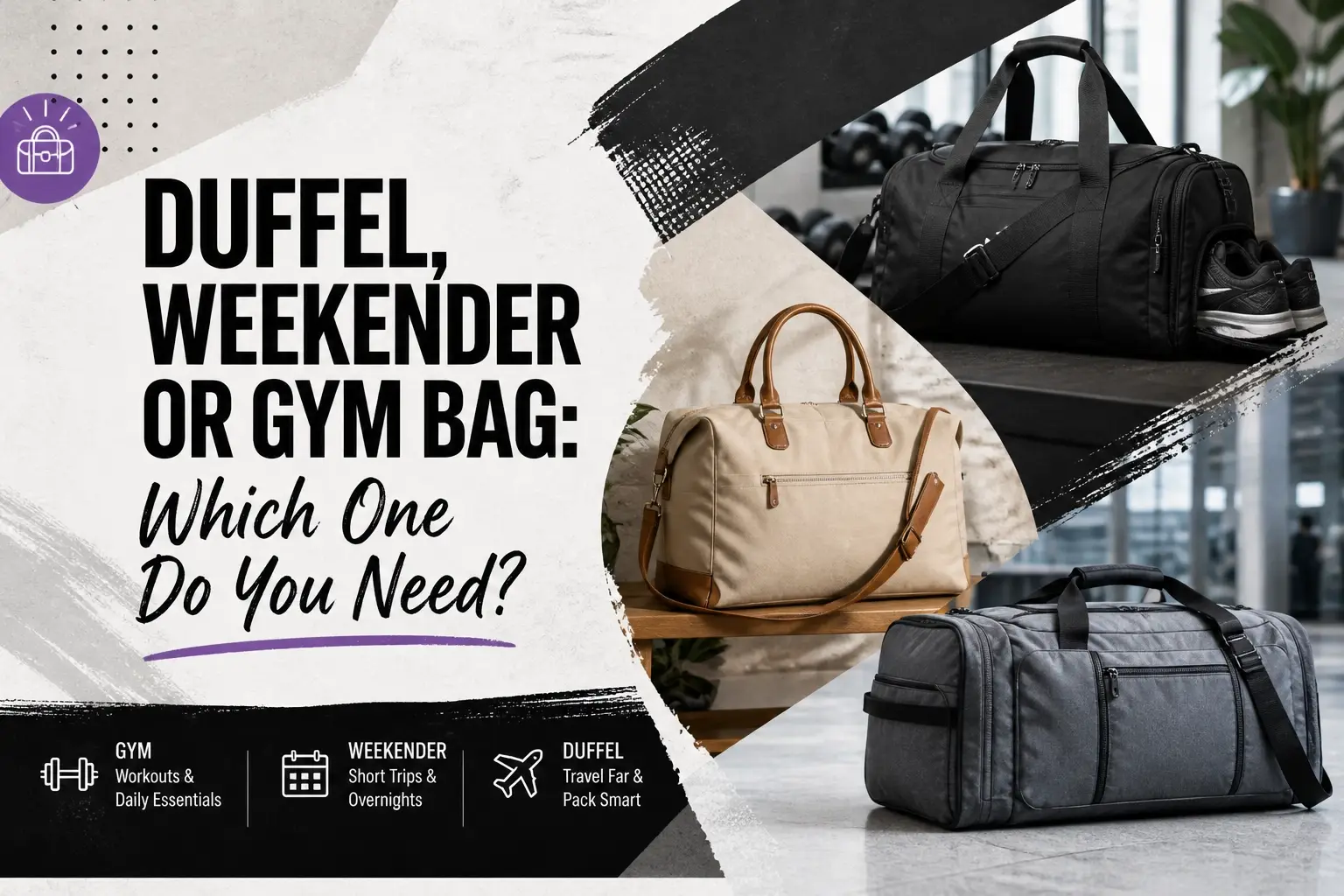
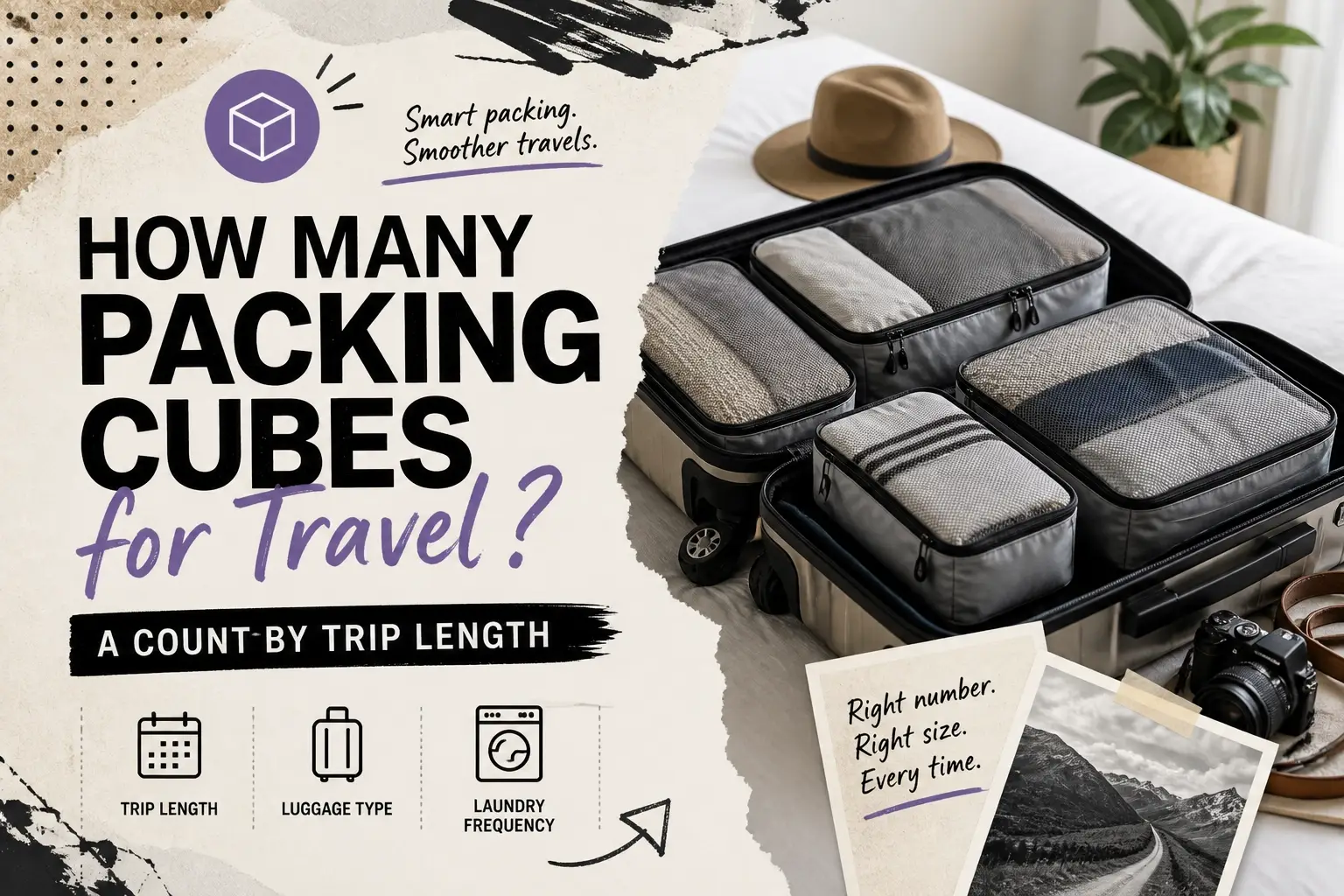
Most travelers can start with three to five packing cubes for a weeklong trip. A weekend may need two or three; longer trips often work with four to six. The right count depends on clothing bulk, luggage dimensions, and laundry access. Pack by clothing category, not by day: a cube for tops, one for bottoms, and a smaller one for underwear and socks. Add cubes only for a specific need. Compression cubes can reduce clothing bulk, but not weight. For a bag-by-bag checklist, see our personal item and carry-on packing guide, including what to keep accessible during a flight. Before buying, test filled cubes inside your actual bag, leaving room for shoes, toiletries, and the suitcase’s internal rails. These counts are planning estimates, not tested capacity limits. For equipment options, compare the 7-, 8- or 9-piece packing cube organizer set or browse the Essential For Travel shop; for airport screening questions about what belongs in your bags, check the official TSA What Can I Bring? guide. Published November 6, 2026 by Garry Barnes. Publisher: Essential For Travel. Updated November 9, 2026.
How Many Packing Cubes Do You Need? Start With the Bag, Not the Set
A large set asks you to choose a piece count before knowing what actually fits. The honest answer comes from trip length, laundry access and bag style, not the number on the box.
Small cubes are fine for socks, underwear and cables, but a stack of them eats the flat, full-width floor of a suitcase. If you are choosing between bag styles, see our duffel versus weekender versus gym bag guide.
Reframe the question around categories, not outfits. Grouping like garments keeps the count low and the bag readable, which is the entire point of packing cubes for travel.
Here is the structure: the working rule (one cube per garment category per laundry cycle plus a dirty-laundry container), a piece-count table by trip length, bag-style counts, and fit math against real airline dimensions. Not sure which type to buy? Our guide to packing cubes versus compression cubes covers what each one does.
The Working Rule: One Cube Per Useful Clothing Category
Here is that rule, and label it a rule of thumb, not a manufacturer spec: one cube holds one garment category for one laundry cycle, plus one container for dirty laundry.
Pack by category the way you actually fold: tops, bottoms, underwear and socks, sleepwear, workout gear, swimwear, and a hard-goods cube for cables and toiletry bottles sized to the TSA liquids rule.
Your multiplier is laundry, not days. A 4-day trip with no laundry is one cycle. For a 14-day trip with laundry every five days, pack enough clothes for about five days between washes and reuse the same cubes after each wash. You do not need a fresh set of cubes for every laundry cycle. That scales with laundry access and bag capacity, so the same rule covers a road trip and a long-haul flight.
The piece most sets get wrong is the dirty-laundry container. A lined or breathable bag keeps soiled items off your clean cubes and removes the urge to pack spare tops. For a ready-made start, consider Essential For Travel’s 6-set compression packing cubes for suitcase.
How Many Packing Cubes for Travel by Trip Length: Weekend, One Week, Two Weeks
Trip length offers a starting range; laundry access, clothing categories, and luggage size determine the final count.
Days to Cubes
| Trip length | Suggested cubes |
|---|---|
| 2–3 days | 2–3 |
| 4–7 days | 3–5 |
| 8–14 days | 4–6 |
| 15+ days | 4–7 |
These are starting ranges, not guarantees. Count the dirty-laundry bag separately; reduce clothing volume when you have laundry access.
For longer trips, pack for the longest interval between laundry days rather than bringing a separate cube for each cycle.
2 to 3 days: one medium tops cube, one medium bottoms cube, one small cube for underwear and socks, plus a slim dirty-laundry bag.
5 to 7 days: 4 to 5 cubes, with medium tops and bottoms, a small underwear and socks cube, a hard-goods or toiletry cube, and the laundry bag.
8 to 14 days: 5 to 6 cubes. Reuse the same cubes after each laundry cycle; add a cube only when another clothing category needs its own space. Beyond that, a checked bag beats another organizer. Pair the count with The Complete Travel Essentials List so nothing extra sneaks in.
Piece Count by Bag Style: Carry-On, Checked and Personal-Item Only
Trip length sets your range; bag style sets the ceiling.
Carry-On: Start With 3 to 5 Cubes
Size matters more than count here, since medium cubes laid in a single layer use the flat footprint of the case.
Checked Bag: 6 to 8 Cubes
In a 24 to 26 inch case, the extra volume lets you keep categories separate instead of compressing them into shared space.
Personal-Item Only: 2 to 3 Cubes
Personal-item dimensions differ by airline and can change, so check your operating carrier’s current rules. For a compact personal-item bag, a small tops cube, a small bottoms cube and a slim laundry bag come close to filling that envelope.
Cruisers and Rail Travelers
The same rule applies, but soft-sided duffels, train racks and cabin lockers reward a flatter mix. Favor medium over large, and keep one cube for day-bag duty.
Garment Folders and Hybrids
A folder replaces your tops and bottoms cubes, removing about two pieces from every count in this guide. Consider this before buying another set. Compare the six-piece compression packing cube set with the space available in your bag.
Size Math: Will Your Cubes Fit a Carry-On Envelope?
Counts only work if the cubes fit the frame you’re measured against. Carry-on size limits vary by airline, aircraft, fare, and route. A commonly used U.S. limit is 22 x 14 x 9 inches, but it is not universal; check your operating carrier’s published dimensions before choosing a bag (carry-on luggage size guide). Those figures are total exterior size, not usable interior capacity, so your cubes plus the air between them must fit the frame, not the listing’s number.
Airline size checks and oversized-bag fees vary by carrier, fare, and route. Check the operating airline’s current published baggage rules before departure. Some international routes also cap carry-on weight. U.S. allowances are the baseline here; other regions differ, so check your route.
Fit example: test two medium cubes and one small cube inside your actual suitcase. A bag advertised as 22 x 14 x 9 inches has smaller usable interior dimensions, so this arrangement may not fit every model.
Five-Minute Packing Cube Fit Test Before You Buy
- Measure the flat interior packing area between the suitcase rails, wheel housings and handle channels. Do not use the exterior suitcase dimensions as available space.
- Fill the cubes with the clothes you will actually take. Empty-cube dimensions can understate how much a packed cube bulges.
- Lay the filled cubes in the case without forcing the lid closed. Leave space for shoes, a separate liquids bag and items you need during transit.
- Close the case normally and check for pressure on the zipper or shell. If the lid bows, remove an organizer or clothing item rather than relying on compression to hide overpacking.
- Weigh the packed bag against your operating airline’s allowance, where applicable. Packing cubes organize contents; they do not reduce their weight.
For a backpack or personal-item bag, repeat the test with the bag upright and worn. A cube arrangement that fits on the floor may still create an uncomfortable lump against your back or block access to a laptop sleeve. If you already own two or three useful cubes, test them before buying a larger set.
When Medium Cubes Work Better Than Small Ones
Small cubes look efficient, which is why oversized sets are stuffed with them. Four small cubes mean four zippers, four sets of walls, and four fixed footprints competing for the same floor area.
Medium cubes can be a useful starting point for folded shirts and trousers, but the best size depends on your luggage’s usable interior and the garments you pack. Compare the filled dimensions of one medium cube with two smaller cubes in your own bag before deciding.
Small cubes still earn a slot, just not four. Keep one or two per trip for underwear and socks, cables and chargers, and toiletries in travel bottles that meet TSA’s 3-1-1 limits.
Large cubes belong in checked bags, holding jackets and shoes. Inside a carry-on they push soft goods outward, and that bulge is what gate measurement punishes.
Already own a set? Repurpose the extras as gym kit, a cable organizer, or a beach bag. If volume, not count, is your squeeze, our vacuum compression bag guide covers that trade-off.
The Oversized Set Problem: What the Extra Pieces Really Add
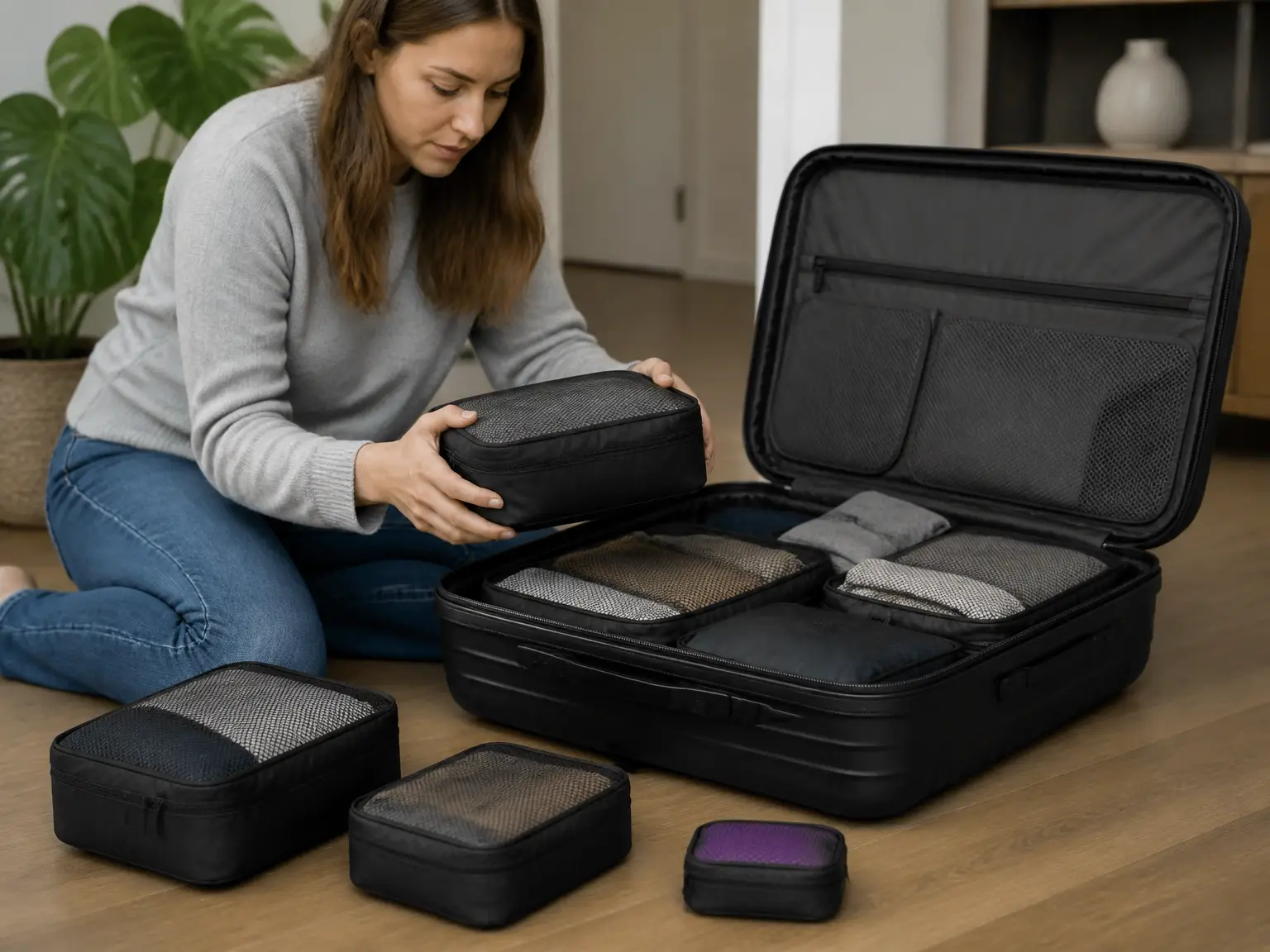
Those spare small cubes usually come from one purchase: the oversized set. In our view, the extra pieces in 8- and 9-piece sets mostly add zipper weight and closed seams, not capacity. We’ll be honest: public testing data doesn’t support per-piece weight figures for cubes, so skip the gram claims. Weigh your own set at home and compare the total against your carrier’s weight cap.
Every cube brings its own walls, zipper tape and handle, so extra organizers add bulk faster than capacity.
Test it before you buy: count the pieces you’d genuinely use on your next three trips. For most travelers, that lands between 4 and 6.
Buy sizes individually or in smaller packs, then fill the gaps with a laundry bag, a TSA-compliant travel bottle set and a neck pillow. A mini clear zipper travel pouch covers small essentials better than three more organizers.
Compression Packing Cubes: When They Earn a Slot
One specific cube type still might earn its slot, though. Compression cubes solve volume, not count, so they pay off when a carry-on-only winter trip or a strict gate frame is the real constraint, which is where searches for the best compression packing cubes usually start.
The trade-off: compression adds weight and stiffness and does not reduce what a garment weighs, so it does nothing for a weight-capped international carry-on.
Our rule of thumb: one compression cube for bulky soft goods such as fleece, knitwear or swimwear, with every other category in standard medium cubes. Before you commit, see what each tool ruins in Vacuum vs Compression Bags vs Packing Cubes: What Each Ruins.
Skip long-term compression for down and quilted items. Measure your case interior and your existing stack before adding one, since compression cubes tend to run deeper than standard cubes.
Four Trip Scenarios: Packing Cube Counts and Examples
Compression aside, the counts fall out like this.
Weekend, carry-on, no laundry: 3 cubes plus a laundry bag (medium tops, medium bottoms, small underwear and socks). Chargers and toiletries go in a pouch, not a fourth cube.
Ten days international, carry-on, laundry twice: 4 cubes. One for tops, one for bottoms, one small cube for underwear and socks, and an optional fourth for workout or sleepwear. Reuse the same cubes after washing and carry a separate laundry bag.
Two weeks, checked bag: 5 to 6 cubes. Split swimwear, sleepwear and workout gear into their own cubes instead of doubling tops and bottoms, since a checked case rewards separation over compression.
Personal-item only, three days: 2 small cubes plus a laundry bag. Fold tops flat in one, roll bottoms in the other, and wear your bulkiest layer on the plane to stay inside the budget carrier footprint.
Two levers adjust every count: add a cube for shoes or gear, and drop one if you wear your heaviest layer in transit. Those two variables account for most of the variation in counts you’ll see online.
Next Steps: Build Your Cube Set Around Your Bag, Not the Box
You now have the method: start with trip length and your laundry cadence, write down your garment categories, then convert categories to cubes. Buy to that number, not to a set size.
Size your organizers to your case interior first. Essential For Travel carries packing organizers, luggage, and travel bags that pair cleanly with a category-per-cube setup. Our packing checklists and luggage comparison guides let you confirm bag dimensions before you buy, and the packing organizers category page shows current options.
Then round out the kit: a travel bottle set sized to TSA’s 3-1-1 limits, a laundry bag for the dirty cycle, and comfort gear such as a neck pillow on long-haul routes. Build around your bag, not the box count.
Next, the FAQ covers the edge cases.
More packing-cube questions answered
Are compression packing cubes worth buying for air travel?
They can reduce the bulk of soft clothing but do not reduce luggage weight. Check your airline weight allowance and avoid overpacking.
What are the best packing cubes for organizing a suitcase?
Choose lightweight cubes with durable seams and zippers in sizes that match your suitcase. A few useful sizes are usually better than an oversized set.
Which packing cubes fit best in carry-on luggage?
Measure the usable inside dimensions of your bag, allowing for wheel housings and handle rails. Two or three medium cubes plus one small cube can be a practical starting point.
How do I choose durable packing cubes with useful sizes?
Compare zipper quality, seam reinforcement, fabric weight and dimensions when filled. Choose sizes based on the clothing categories you pack.
What packing cube set is best for a two-week trip?
Four to six cubes can work for many travelers, but the right count depends on laundry access, clothing bulk and luggage size. Try packing your existing bag before buying more.
FAQ: Packing Cubes for Travel
Quick answers before you buy:
How many packing cubes should I buy first? Start with three packing cubes: two medium and one small. Add a separate laundry bag if needed; reuse the same cubes after washing.
Do I need compression packing cubes? They solve volume, not weight, so they rarely help on a weight-limited international route.
How many cubes fit a personal item? Usually one to three compact cubes, depending on the actual bag dimensions. Check your operating airline’s current personal-item limits.
Are packing cubes worth it for a checked bag? Yes, mostly for order and faster unpacking. A checked bag may hold more cubes, but choose the number based on useful clothing categories and available space.
How many packing cubes for a two-week trip? Start with four to six cubes for an 8–14-day trip. Laundry access can reduce clothing volume; add a cube only for another useful category.
Conclusion: Your Count, Your Bag, Your Trip
The whole guide in one line: start with one cube per useful clothing category, reuse the cubes after laundry, and keep dirty clothes separately.
Skip the 8- and 9-piece sets unless you can name a real use for every piece this year. Put the difference toward a laundry bag and a better toiletry kit.
Written by Garry Barnes for Essential For Travel. Updated November 2026. Confirm your carrier’s current size and weight rules before you fly; limits vary by route and region.