
By Garry Barnes | Published
Editorially reviewed . Check the linked official sources for current travel requirements.
Read a U.S. State Department travel advisory by checking the overall level, the full destination guidance, location-specific warnings, risk indicators, and issue date. Compare those details with every part of your itinerary. Regional guidance adds detail; it does not automatically cancel out the overall advisory.
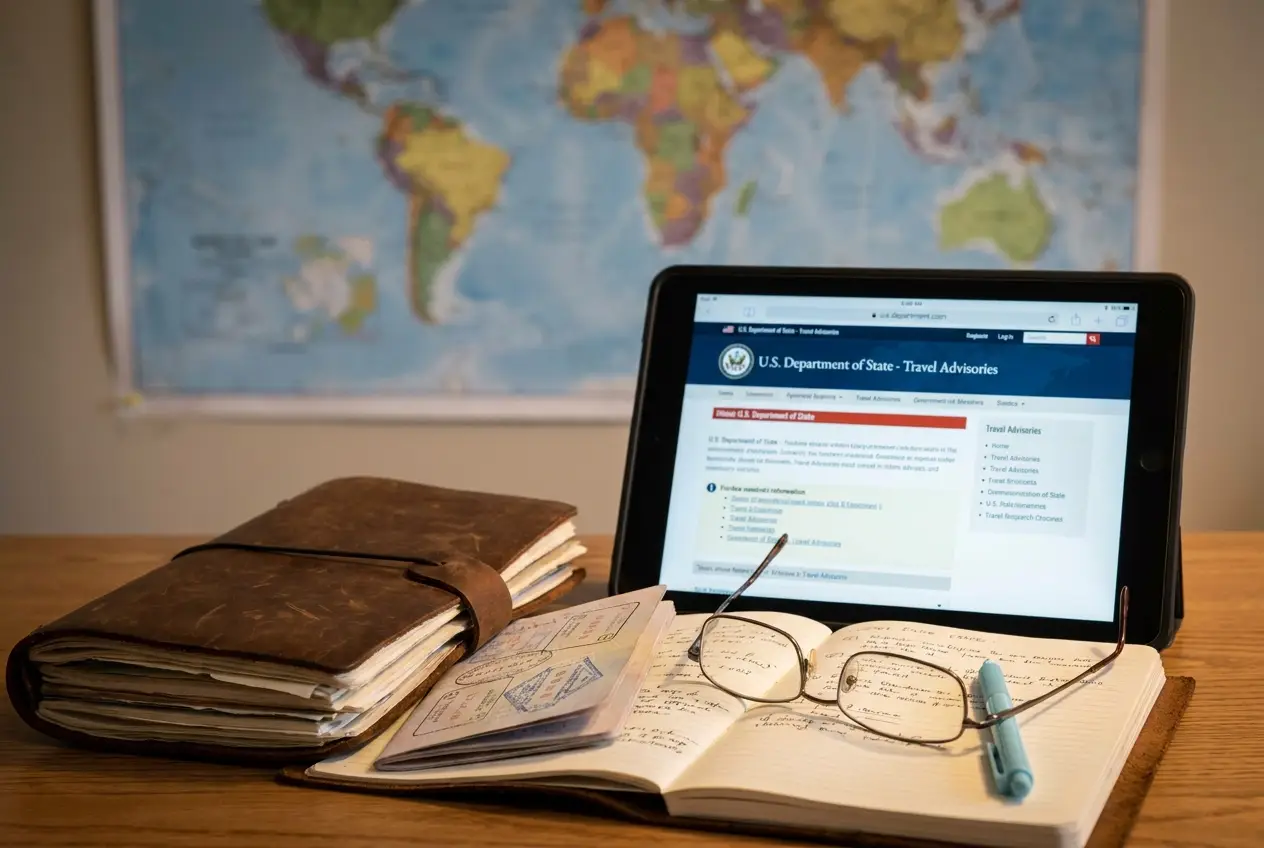
Start with the official Travel Advisories page. This guide explains how to read the information; it does not replace the current destination advisory.

| Level | Current official label | How to use it |
|---|---|---|
| 1 | Exercise normal precautions | Read the destination guidance; the lowest level does not mean no risk |
| 2 | Exercise increased caution | Review the specific risks and recommended precautions |
| 3 | Reconsider travel | Take the serious risks into account when reassessing the trip |
| 4 | Do not travel | Follow the warning; government assistance may be very limited or unavailable |
The State Department directs U.S. citizens at Level 4 destinations to avoid travel there or leave as soon as it is safe to do so. Read the current destination instructions rather than improvising a departure plan from the label alone.

Record the country-level guidance first, then read every named region, road, border area, and other location-specific warning. Include transfers and day trips, not just your hotel’s location.
Do not infer that an area outside a named warning is Level 1 or otherwise safe. If the official text gives different guidance for specific places, record it exactly alongside the overall advisory. A resort, cruise, or escorted tour does not override the warning.
Start with your government’s advice, then check the guidance for every city, transfer, and border crossing on your route. U.S. State Department advisories address U.S. citizens. Read the full destination guidance: a country-level summary may leave out details that affect your plans.
State Department destination-planning checklist.
The State Department identifies risks such as crime, terrorism, unrest, health, natural disasters, time-limited events, kidnapping or hostage-taking, wrongful detention, and other concerns. Read the explanations and destination text. A short summary elsewhere may omit an indicator or an important qualification.
Use the categories to form practical questions: Does the itinerary involve a named road? Can you reach appropriate medical care? Are transfers or local services affected? Seek the relevant official information rather than translating a category into a personal probability of harm.

| Trip segment | Record from official guidance | Follow-up |
|---|---|---|
| Arrival and hotel transfer | Overall advisory plus any airport, road, or area warnings | Confirm the route and transport arrangements |
| Accommodation and activities | Named areas and applicable instructions | Reassess reservations and alternatives |
| Day trips and onward travel | Warnings affecting crossings and transit points | Check each segment separately |
Check your insurer’s terms, airline change conditions, and any employer or tour-operator requirements directly. Do not assume an advisory creates automatic cancellation coverage or a refund. Save the relevant confirmations and contact details.
| Official guidance | Your itinerary | Your action |
|---|---|---|
| Named area to avoid | Hotel, airport transfer, or excursion crosses that area | Change the route, activity, or booking and confirm the replacement plan. |
| Health or medical-care concern | Trip includes remote travel or limited access to care | Review medical access, insurance terms, medication supply, and evacuation options. |
| Unrest, crime, or transport disruption | You depend on late-night transfers or specific transit links | Adjust timing, transport, or accommodation location and keep alternatives available. |
Suppose the country is Level 2, but the advisory warns against travel near one border region. If your hotel and airport are elsewhere, do not stop at the country-level label. Check whether any day trip, rail route, rental-car segment, or transfer passes through the warned area. If it does, change that part of the itinerary and recheck the official text before departure.
Travel advisories help you evaluate destination risks. Travel accessories address smaller, everyday needs. A passport holder keeps documents organized, while a portable door lock may add privacy in a compatible room. Neither product can make an unsafe destination safe or replace official travel advice.
| Comparison | RFID Family Passport Holder | Portable Travel Door Lock |
|---|---|---|
| Primary purpose | Organize passports, boarding passes, and other travel documents | Provide an additional physical barrier on some compatible inward-opening doors |
| Best use | Family check-in, transfers, and keeping essential paperwork together | Additional room-door security where installation is permitted and compatible |
| Important limitation | Does not replace passport copies, entry documents, or secure document storage | May not fit every door and must not obstruct emergency evacuation |
| Before buying | Check capacity, dimensions, and the documents you need to carry | Check door compatibility, local rules, and whether it allows a safe exit |
Which product should you choose? Choose the RFID Family Passport Holder if your main concern is keeping family travel documents together. Consider the Portable Interior Door Lock for Travel if you want an extra privacy measure and have confirmed the door is compatible. These products solve different problems; you may need neither. Follow accommodation rules and make sure you can exit quickly in an emergency.
The U.S. Department of State says it reviews Level 1 and Level 2 advisories every 12 months and Level 3 and Level 4 advisories at least every six months. Advisories can also be updated when conditions change substantially, so a scheduled review cycle is not a reason to wait before checking your destination. Read the latest issue date and full advisory on the official Travel Advisories page.
The free Smart Traveler Enrollment Program (STEP) provides email alerts from U.S. embassies and consulates, including security, demonstration, health, weather, and Travel Advisory updates. Register your travel information or choose the available subscription option, and update your details when plans change. Alerts supplement rather than replace checking the official advisory.
Use the State Department’s International Travel Checklist to verify passport validity, entry requirements, emergency contacts, and document copies. Review travel medical and evacuation coverage directly with your insurer: the U.S. government generally does not pay travelers’ medical bills or unexpected travel costs abroad. Keep one set of document copies separate from originals and share another with a trusted contact.
Practical example: If a new warning affects the road between your airport and hotel, do not assume the hotel itself is the only location that matters. Compare the route with the advisory, ask your transport provider about alternatives, and reconsider the transfer or itinerary as appropriate.
Before departure, save emergency contacts and copies of important documents somewhere you can access offline. Review the State Department travel checklist and consider STEP enrollment for embassy updates.
If you are coordinating passports and boarding documents for a family, our RFID Passport Holder for Family Travel is an optional organizer to compare with your document needs. Keep backup copies separately. An organizer helps with access; it does not change destination risks or replace official travel guidance.
For packing and departure tasks, read our international packing list and travel preparation checklist.
No. Read the overall advisory and all location-specific guidance together. Do not assign a lower rating to an unmentioned region unless official guidance explicitly supports it.
No. It is the lowest advisory level, but it does not mean there is no risk. Read the full destination guidance and review your route.
Follow the State Department’s Do Not Travel guidance. If you are already there, follow current official instructions about leaving as soon as it is safe to do so.
No. Accommodation style and tour arrangements do not override official warnings. Check the full guidance for the destination and every transfer.
Check during planning, before departure, and whenever conditions or your itinerary change. Review embassy alerts alongside the advisory.