
You packed like a pro for your last domestic trip. Carry-on only, no checked bag fees, everything fit perfectly. Then you booked your first international flight and suddenly the rules changed on you.
Here’s the thing most generic packing guides won’t tell you: building a solid international travel packing list is a genuinely different task than packing for a flight from Chicago to Miami. International travel brings stricter carry-on weight limits from carriers in Europe and Asia, voltage requirements that can fry your devices, documentation you’ve never needed before, and climate swings that a standard checklist completely ignores.
This guide is built specifically around those differences. You’ll learn why your domestic carry-on might get gate-checked on a foreign carrier, which adapters and locks actually matter by region, what documentation accessories deserve dedicated space in your bag, and how to pack with customs in mind before you even leave home. By the end, you’ll have a complete, modular checklist that accounts for where you are actually going, not just where you are leaving from. Let’s get into it.
Most packing lists are built around one assumption: you’re flying domestic. That means TSA rules, U.S. outlets, and carry-on policies that nobody enforces at the gate anyway. Cross an international border and every one of those assumptions breaks down simultaneously.
The rule system doesn’t just change; it multiplies. TSA governs your departure checkpoint, but your airline’s specific weight and size limits apply at check-in, foreign customs laws determine what can legally enter the destination country, and a connecting airport may add another security screening layer entirely. Getting any one of these wrong has consequences that are genuinely harder to resolve abroad. A gate-checked bag fee at Tokyo Narita or a confiscated adapter at Frankfurt Airport isn’t a minor inconvenience you can sort out in five minutes. It costs time, money, and sometimes the item itself.
This guide is structured as a modular international travel packing checklist, organized by category so you can work through the sections that apply to your specific trip rather than skimming a wall of generic bullet points. Each section targets a real difference between domestic and international travel, not basics you already know. For a broader look at what seasoned travelers pack in 2026, the Ultimate International Travel Packing Guide is a useful companion resource.
The six areas where packing genuinely changes when you leave the U.S. are:
Let’s start with the numbers, because they matter more than most travelers realize.
U.S. domestic carry-on rules allow up to 22 x 14 x 9 inches, and weight is rarely the reason a domestic bag gets flagged. International flights operate under different terms entirely.
The international standard tightens to 21.5 x 15.5 x 9 inches, a small reduction on paper, but enough to matter if you’re traveling with a maxed-out domestic carry-on. More importantly, many Asian and European carriers enforce carry-on weight limits of 15 to 22 lbs. That threshold is easier to blow past than it sounds. A 13-inch laptop, a travel pillow, a full water bottle, and a weekend’s worth of clothes can push a bag past 15 lbs before you’ve added shoes or a toiletries kit.
Non-compliance at the gate can result in your bag being checked at the airline’s discretion, check your carrier’s policy in advance.
There is no single global rule covering carry-on weight and size. Policies vary by carrier, route, and even cabin class. Before any international trip, check your specific airline’s baggage page directly. Our complete 2026 airline carry-on size guide breaks down what enforcement actually looks like across major carriers right now, which is worth reviewing before you pack.
Two tools make international carry-on compliance significantly less stressful:
Shop Now: essentialfortravel.com
The goal is simple: know your airline’s limits, weigh your bag before you leave, and fly without surprises.
Once you have your bag weight dialed in, the next thing that can quietly wreck your trip is electricity. Not dramatically, just a fried laptop charger at midnight in a hotel room in Bangkok.
Here is what you actually need to know.
The voltage gap is real. The U.S. runs on 110V/60Hz. Most of Europe, Asia, Africa, and South America run on 220-240V/50Hz. Plug the wrong device into that higher voltage without protection and you will damage it, sometimes permanently.
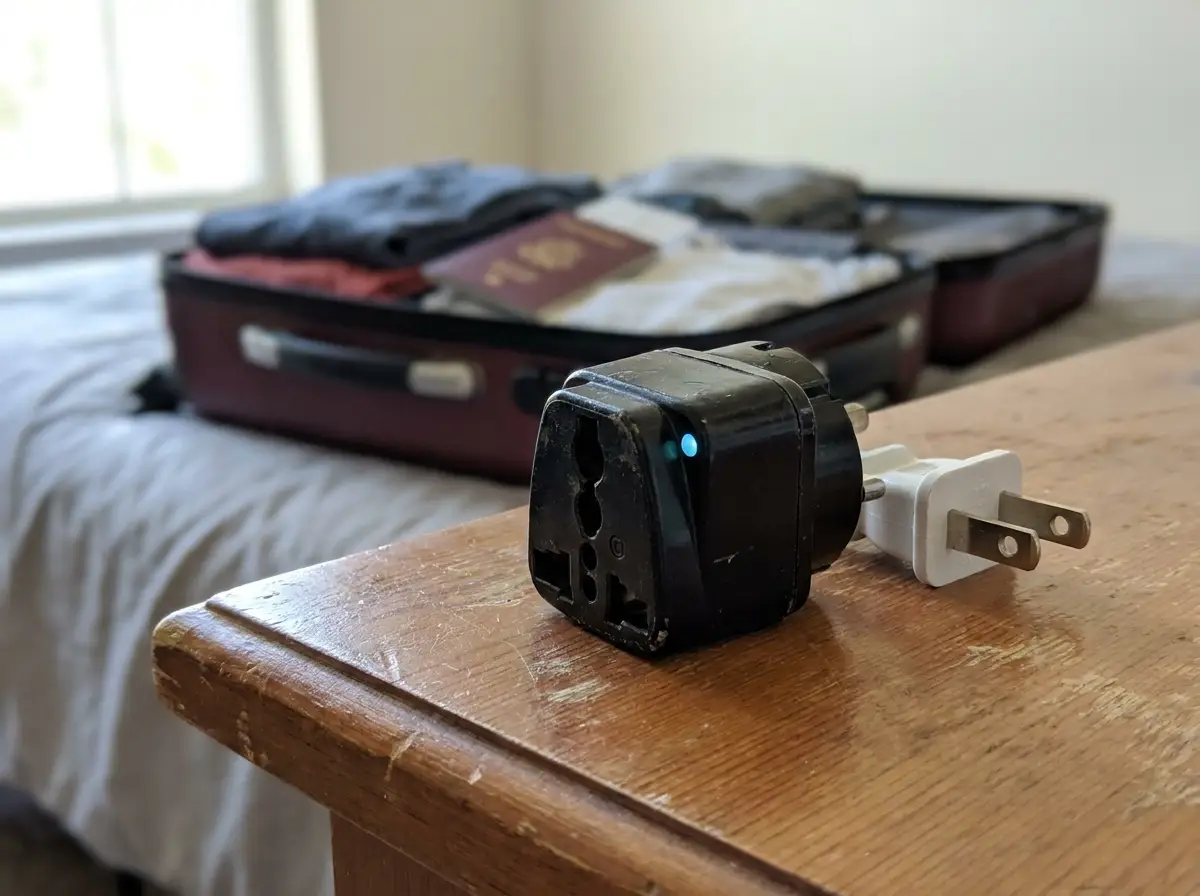
But most of your devices are probably fine without a converter. Check the label on your laptop brick, phone charger, or camera charger. If it reads “Input: 100-240V,” it is dual-voltage and handles both systems automatically. You only need a physical adapter to match the plug shape, not a voltage converter. Converters are bulky, heavy, and mostly unnecessary for modern electronics.
Adapter type matters more than most travelers expect. A Type C adapter works across most of continental Europe, but the UK uses Type G, South Africa and India also use Type G variants, and Japan uses Type A. If your itinerary crosses multiple regions, a single-country adapter will leave you short. A universal travel adapter covers all major plug types in one compact unit. For multi-destination trips, it is the only practical choice. Universal Travel Adapter, Shop Now: essentialfortravel.com
USB-C power delivery hubs have simplified things considerably. Carry one USB-C hub and you can charge a phone, tablet, and earbuds simultaneously from a single wall outlet. The catch: you still need the right adapter for that wall outlet. The hub does not eliminate the need for regional compatibility. For a full breakdown, the Charge Anywhere in the World guide covers this in detail.
The most common and costly mistake: packing a standard U.S. hair dryer or straightener. Most are single-voltage and will burn out immediately on 220V, even with an adapter. Leave them home. If you need one, pack a dual-voltage travel version rated for 100-240V.
#EssentialForTravel #InternationalTravelEssentials #TravelPackingList #TravelEssentials #PackSmarter
Once you’ve sorted your adapters, the next category most packing lists completely ignore is documentation, and internationally, this is where disorganization genuinely costs you time, money, and sometimes entry.
What you’re carrying is fundamentally different from any domestic trip. A domestic flight requires an ID. An international trip requires a passport, possibly a visa, vaccination records, a travel insurance certificate, customs declaration forms, and potentially an international SIM card. That’s a stack of critical documents you’ll present repeatedly at check-in, immigration, and customs, sometimes across multiple countries on a single trip.
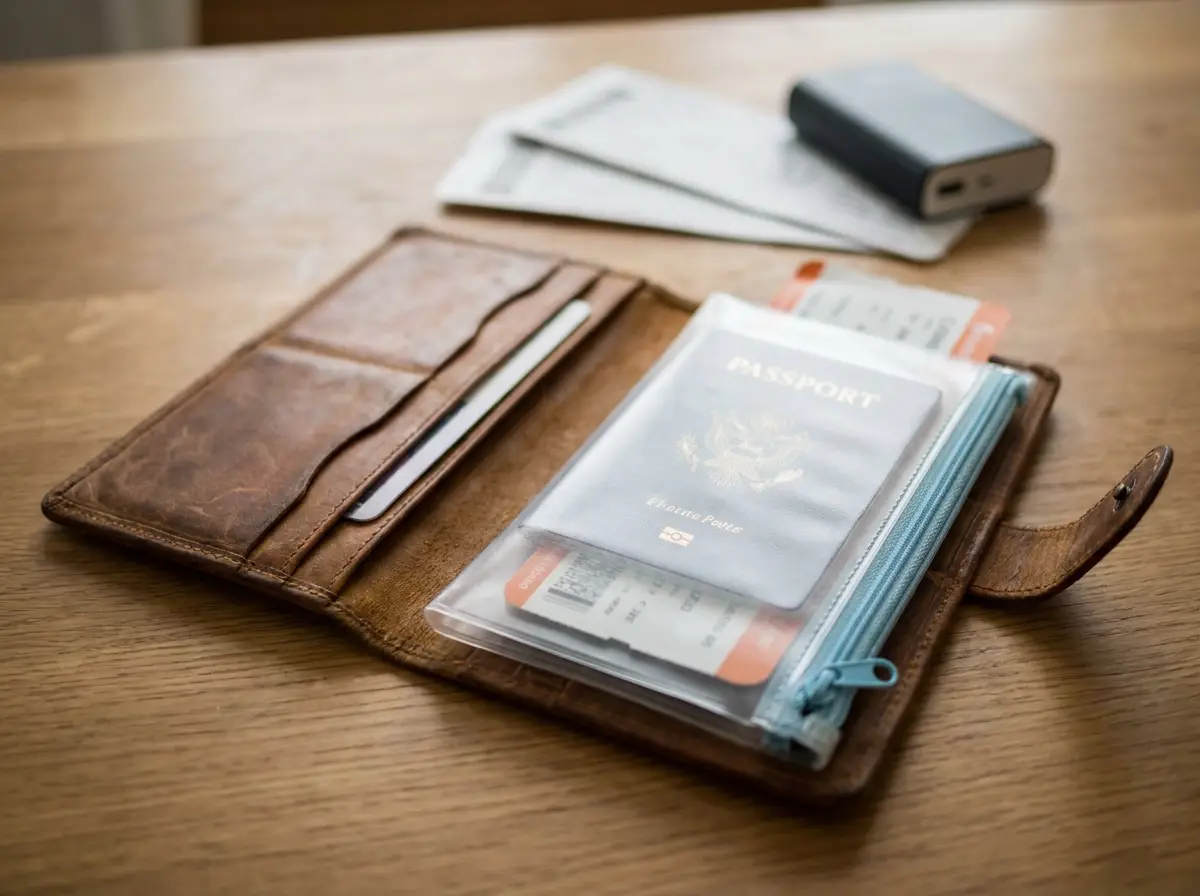
Your passport gets handled at every single checkpoint. Without protection, the cover wears and the chip can get damaged. A quality RFID-Blocking Passport Holder keeps your document clean, protected from wear, and shielded against electronic access. It’s a small item that solves multiple problems at once.
Digging through your bag at immigration is stressful and slow. A Travel Document Organizer that holds your passport, boarding passes, foreign currency, and copies of key credentials means everything is in one place before you even reach the counter. Learning how to keep important documents safe is part of building a reliable international travel system.
If you’re traveling to certain destinations in sub-Saharan Africa or South America, yellow fever vaccination certificates may be required for entry, confirm requirements for your specific destination at travel.state.gov before you depart. Border agents will not accept a screenshot. Entry requirement printouts, visa approvals, and vaccination records need to be physically accessible, not buried in an email inbox with no Wi-Fi to open it.
Shop Now: essentialfortravel.com
Pro tip: Print two copies of your passport photo page and visa. Keep one in your carry-on and one in your checked bag. If your passport is lost or stolen abroad, that copy is what the U.S. embassy uses to help you.
Getting your documents in order is step one. Knowing what you can actually carry through multiple security systems is step two, and it trips up even experienced travelers.
TSA controls what clears U.S. departure security. Once you land, IATA guidelines and destination-country customs laws take over, and those rule sets don’t always agree with each other.
The 3-1-1 Rule Has a Second Layer Abroad
The 3.4 oz / 100ml liquid limit applies at U.S. departure. Schengen border security also enforces a 100ml liquid limit. Check your connecting airport’s screening policy before assuming your quart bag is compliant end-to-end. When in doubt, go under. For a full breakdown of how the 3-1-1 rule works and what bag requirements actually apply, this guide on what makes a toiletry bag TSA approved and how to pack one right covers every detail.
Food, Plants, and Produce
TSA doesn’t care about an apple in your bag. Foreign customs does. Fresh produce, soil, and plant products that pass U.S. security without a second glance can be confiscated at international arrivals. Commercially sealed, dried, and packaged items are the safest option if you want to bring food across borders.
Medications Are Not Universally Legal
Certain medications that are OTC in the U.S. may require documentation or be restricted at your destination. Check with the U.S. Embassy website for your destination country and consult your physician before traveling with any prescription or controlled substance.
Duty-Free and Battery Restrictions
Duty-free liquids purchased post-security in a sealed tamper-evident bag are exempt from the 3-1-1 rule, but if your itinerary includes a connecting flight, check whether your connecting airport requires re-screening of duty-free purchases, as policies vary.
For power banks and lithium batteries, portable power banks face watt-hour restrictions on international carriers; check your specific airline’s policy and IATA guidelines before packing. Aerosols and lighters face additional international restrictions beyond TSA standards.
Restricted items cover what security takes from you. Locks and security gear cover what thieves and inspectors do to your bag once it leaves your hands, and that calculus changes significantly the moment you fly international.
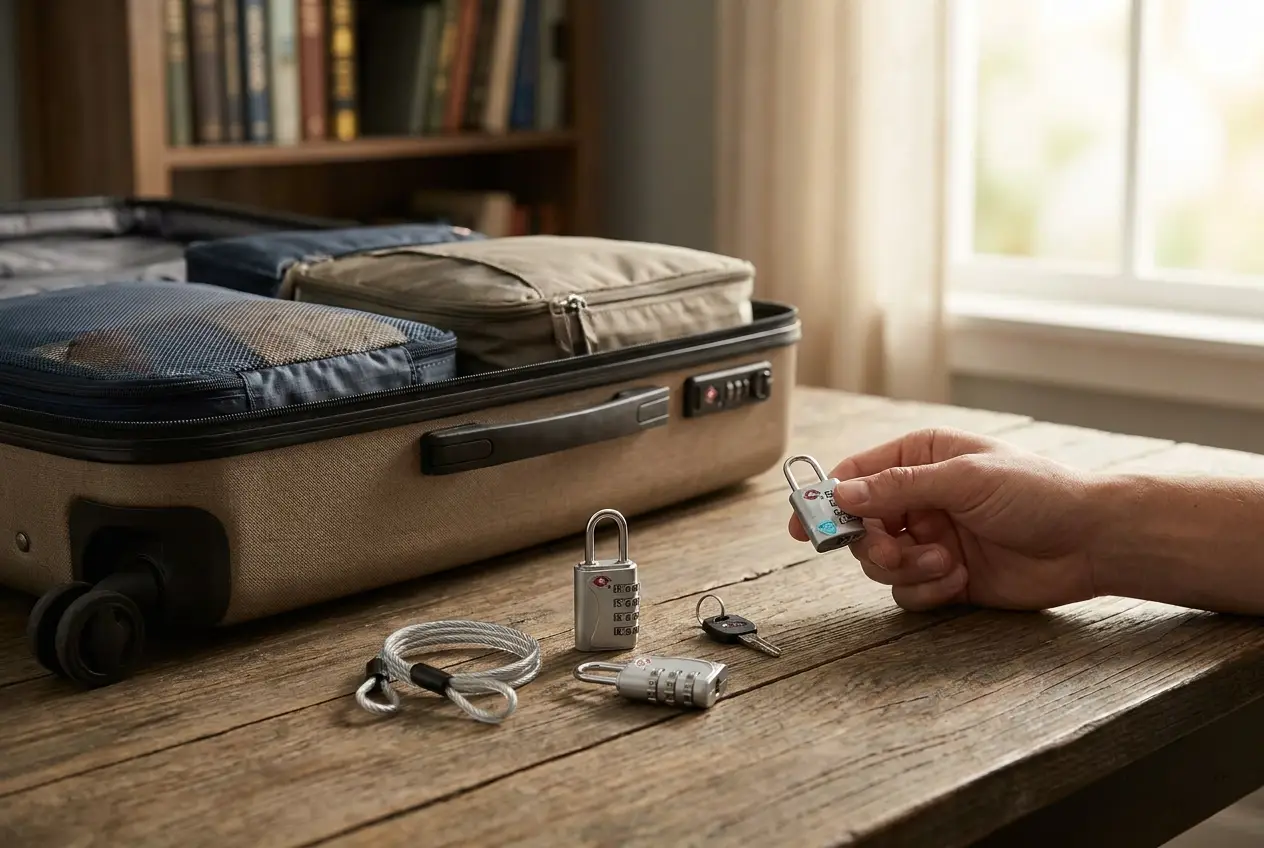
TSA-approved locks use a master key system that lets U.S. Transportation Security Administration agents unlock and re-lock your bag during inspection. That system works smoothly on departure from any U.S. airport. Outside the U.S., security agencies operate under their own protocols and may not use TSA master keys. Use a TSA-approved lock for U.S. departure; accept that checked bag inspection procedures abroad are outside your control.
A TSA-Approved Luggage Lock is still the right call for international checked bags. Your bag clears U.S. departure security under TSA jurisdiction, and that process protects the lock. The more important rule remains: keep anything irreplaceable in your carry-on, not your checked bag. No lock substitutes for that.
For the interior of your checked bag, packing cubes with zipper pulls add a minor but useful layer of organization and deterrence. They do not provide real security, but they slow opportunistic access and keep your contents from shifting if a bag is opened and repacked.
Pickpocketing at international transit hubs and tourist sites is a documented concern that most U.S. domestic travelers rarely need to think about. An anti-theft backpack with hidden zippers, slash-resistant panels, and a locking strap is genuinely useful gear for international travel in a way it simply is not for a domestic airport run.
Before your next international trip, it also helps to review TSA carry-on rules and checkpoint procedures so U.S. departure security holds no surprises, leaving your focus on what comes after the gate.
Shop Now: essentialfortravel.com

Security sorted, now comes the variable that no lock or luggage rule can fully prepare you for: the weather at your destination.
Domestic trips rarely throw you a curveball. International ones absolutely will. Bangkok in August means relentless humidity and daily downpours. A spring trip to Rome or Edinburgh can swing from 60°F afternoons to 40°F evenings in the same day. Trekking in the Andes or heading to the highlands of East Africa means altitude-driven temperature drops that have nothing to do with the season on the calendar.
The fix is not packing more. It is packing a system.
Three layers replace five single-purpose pieces: a moisture-wicking base layer, an insulating mid layer (a packable fleece or light down jacket), and a waterproof outer shell. Mix and match for any condition, and nothing in your bag has only one job.
Skip the umbrella. A lightweight rain poncho packs to the size of a fist and handles monsoon-level rain without fighting the wind. Prioritize quick-dry, moisture-wicking fabrics for everything, including casual shirts. Cotton holds sweat and takes hours to dry in high humidity.
These are the most deceptive windows for packing. A packable down jacket, a waterproof layer that fits over it, and one pair of walking shoes that handles cobblestones and a sit-down dinner covers roughly 90% of scenarios. Resist overpacking “just in case” separates.
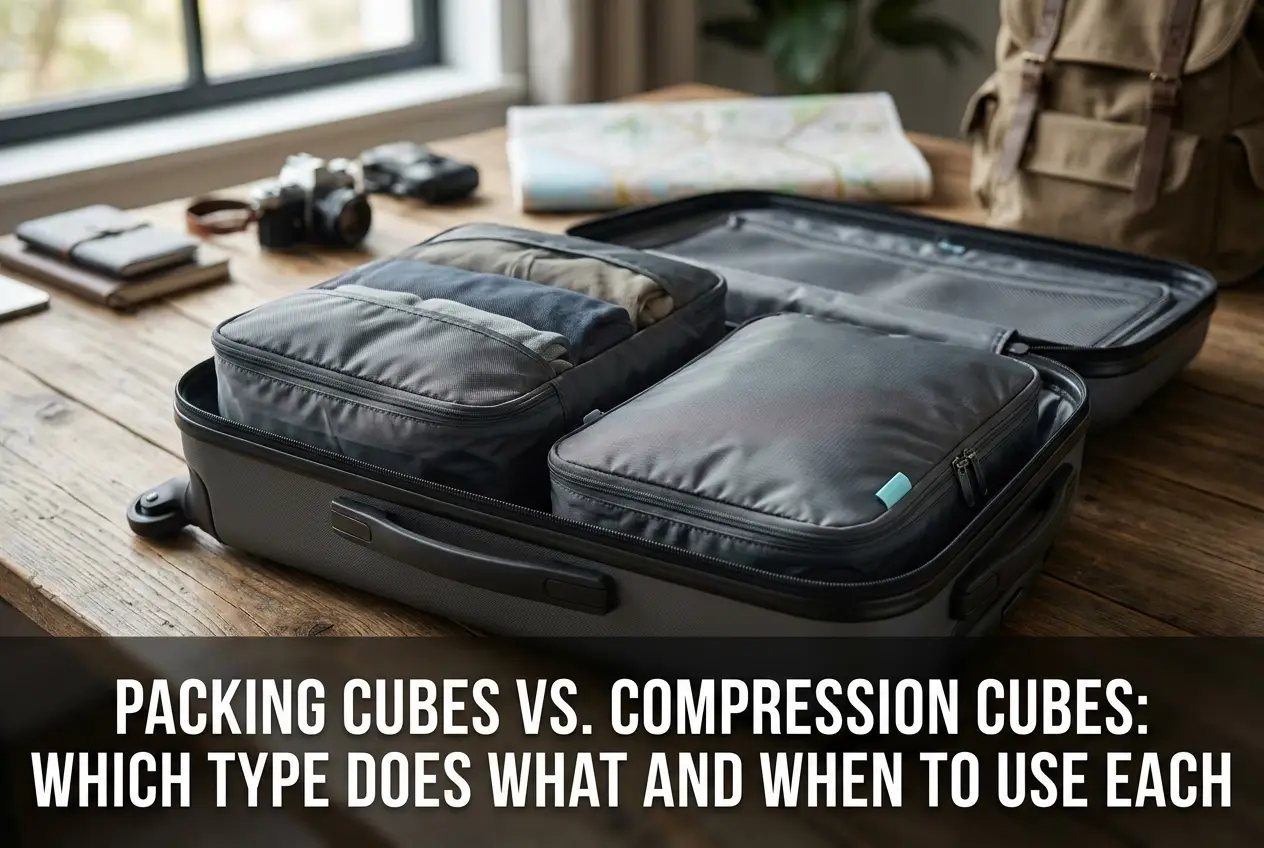
Climate-variable packing creates an organization problem inside the bag. Warm layers in one cube, lightweight pieces in another. Compression lets you squeeze a fleece down to half its normal volume, which matters when you are already working within a 15 to 22 lb international carry-on limit.
Compression Packing Cubes are the structural backbone of this kind of system. If you want a broader look at what else earns a spot in an international bag, The Complete Travel Essentials List: Everything Worth Packing is a practical starting point.
Shop Now: essentialfortravel.com
Most travelers obsess over what goes in the bag before departure. The smarter move is to think about what comes back.
Know your duty-free ceiling. U.S. Customs provides a duty-free personal exemption per traveler; confirm the current threshold at cbp.gov before your trip. Exemptions apply per traveler, so a traveling couple should consult cbp.gov for guidance on combined declarations.
Build in return-trip space. If you plan to shop, leave room in your checked bag before you leave home. A better strategy: pack a lightweight, foldable duffel that collapses to nothing on the way out and becomes your overflow bag on the way back. It adds minimal weight to your outbound load and saves you from paying overweight fees or cramming souvenirs into a carry-on. The Foldable Travel Duffel Bag is a smart pick here. Not sure which style fits your trip? This guide on how to choose a travel duffel bag breaks down size, materials, and features before you buy. Shop Now: essentialfortravel.com
Keep your receipts. Customs declaration forms ask for itemized lists of purchased goods with values. Stuffing receipts into your travel document holder as you shop abroad takes seconds and saves real time at re-entry. Agents process organized travelers faster.
Know what cannot come back at all. Certain items are prohibited from U.S. re-entry regardless of their value or where you bought them. These may include certain animal products, agricultural items, and other regulated goods, consult cbp.gov for the full prohibited-items list before you shop.
Plan your duty-free alcohol purchases carefully. Airport duty-free stores are tempting, but U.S. Customs imposes a duty-free limit on alcohol; check cbp.gov for the current allowance before purchasing at airport duty-free. Additional bottles can be declared and taxed, but they also take up checked bag space you may have already committed to other purchases. Factor that into your packing before you hit the terminal shop.
With customs prep covered, here’s everything else pulled into one scannable reference you can check before every international departure.
1. Documentation
2. Carry-On Compliance
See Carry-On Weight and Size Rules section for carrier-specific enforcement detail.
3. Electronics and Power
4. Security
5. Clothing System
6. Customs and Return Prep
Shop Now: essentialfortravel.com
The checklist above gives you every category. Now here is the mindset that makes it work every time you use it.
International packing is not about hauling more stuff. It is about operating inside a completely different rule system at every stage, from the departure gate in the U.S. to the customs hall at your destination. Getting that shift wrong costs you money, time, or both.
Four things to do before you zip that bag:
The travelers who breeze through international travel are not packing more carefully. They are packing more deliberately, with the destination’s rules already loaded before they touch a single item.
Ready to gear up for your next trip? Explore travel essentials curated specifically for international travel. Shop Now at essentialfortravel.com
#EssentialForTravel #InternationalTravelEssentials #TravelPackingList #TravelEssentials #PackSmarter
International travel does not punish unprepared packers. It simply does not wait for them. The difference between a smooth departure and a stressful one almost always traces back to decisions made before you leave the house.
The sections above cover every variable, run through them before each departure and adjust only for destination-specific rules.
This checklist is built to travel with you, not just help you pack once. Run through it before every international departure, adjust for your destination, and you will move through airports and borders with the confidence of someone who has done the work in advance.
Your next trip deserves that level of preparation. Start building your kit today at essentialfortravel.com.
Domestic packing assumes TSA rules, U.S. outlets, and lenient carry-on policies. International travel multiplies the rules: TSA governs U.S. departure, your airline's specific weight/size limits apply at check-in, foreign customs laws determine what enters the destination country, and connecting airports add additional security layers. Getting any of these wrong has serious consequences abroad—like gate-checked bag fees in Tokyo or confiscated items at Frankfurt Airport.
U.S. domestic carry-on allows 22 x 14 x 9 inches with rarely-enforced weight limits. International standard tightens to 21.5 x 15.5 x 9 inches, and many Asian and European carriers enforce strict 15-22 lb weight limits. Items like a laptop, travel pillow, water bottle, and weekend clothes can easily push a bag past 15 lbs. Always check your specific airline's baggage policy in advance and use a digital luggage scale to weigh your bag at home.
Not necessarily. Most modern devices (laptops, phone chargers, camera chargers) are dual-voltage and automatically handle both 110V (U.S.) and 220-240V (international) systems. Check your device's label for "Input: 100-240V." If it says this, you only need a physical adapter to match the plug shape, not a converter. The biggest mistake is packing single-voltage devices like standard hair dryers or straighteners, which will burn out immediately. Always verify dual-voltage compatibility before packing.
International trips require: a valid passport (6+ months beyond travel dates), visa printouts or approval letters, vaccination records (including yellow fever certificate if applicable), travel insurance certificate, and two printed copies of your passport photo page (one in carry-on, one in checked bag). Keep everything organized in an RFID-blocking passport holder and travel document organizer. Print physical copies—border agents will not accept screenshots of critical documents.
Build a layering system instead of packing individual items. Use three key pieces: a moisture-wicking base layer, an insulating mid-layer (packable fleece or light down jacket), and a waterproof outer shell. This mix-and-match approach handles most weather scenarios without overpacking. For tropical destinations, skip umbrellas and use lightweight rain ponchos; prioritize quick-dry fabrics. For European shoulder seasons, add a packable down jacket and waterproof layer. Use compression packing cubes to organize layers by climate type while maximizing limited carry-on space.