
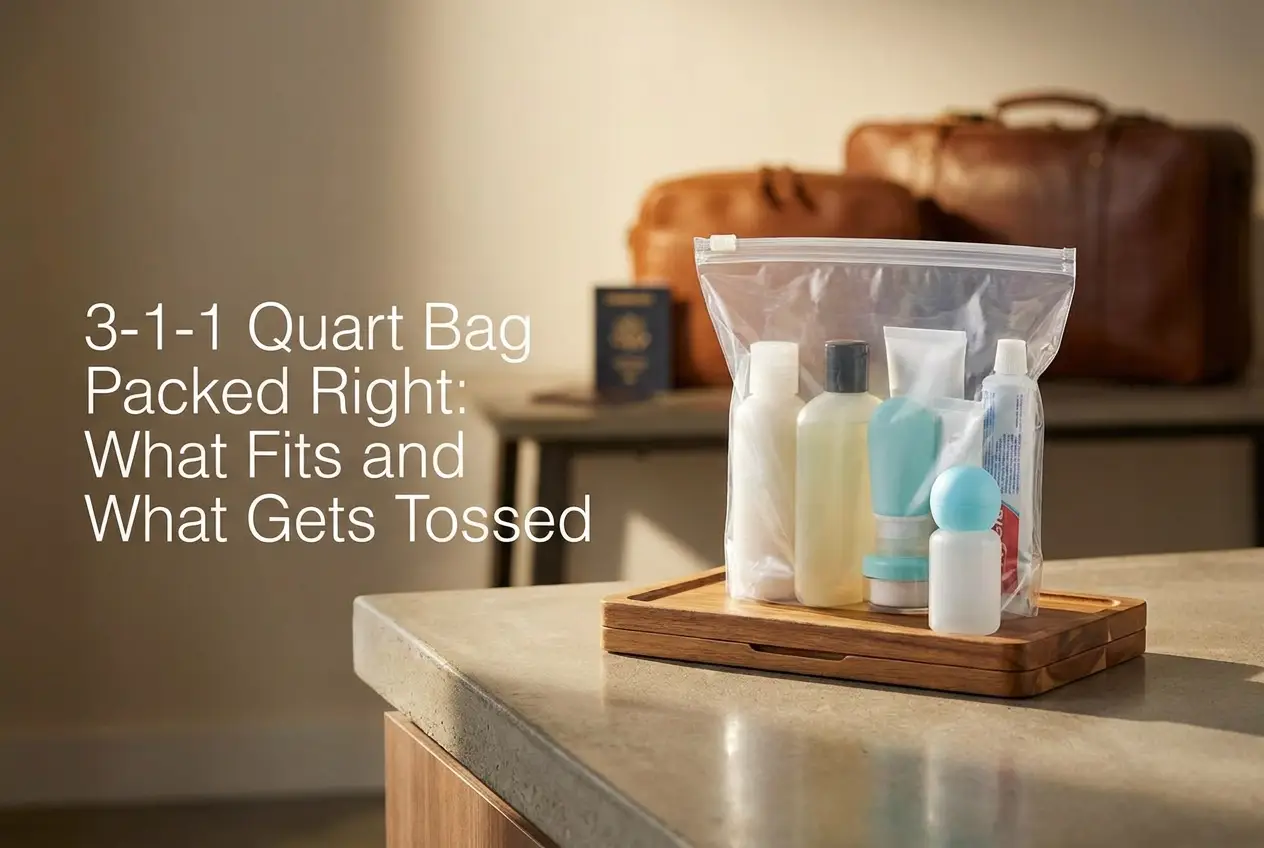
Most travelers do not fail the 3-1-1 liquids rule because they packed too much shampoo. They fail because one container is slightly oversized, the quart sized bag is overstuffed and will not seal, or a non-liquid item triggers a secondary search. The rule is not a volume test alone. It is a container test, and the container has hard limits.
This guide gives you a practical method for packing the quart sized bag correctly. You will learn why travelers fail 3-1-1 when it is almost never volume, what the rule actually says, and how to run a container-size reality check. We will answer whether the bag has to be clear, whether it has to be quart size, and what TSA’s official guidance says. Then we will cover a packing method for fitting a week into one quart sized bag, what screeners most often pull from the bin and why, and the habits that keep your bag from being emptied at the checkpoint. The takeaway is simple: pack the container, not the contents.

The quart bag is a capacity problem on paper. In practice, almost nobody is stopped for carrying too much liquid.
You are stopped for how that liquid is contained. Three failure modes account for nearly all of it: an oversized container (4 oz in a 3.4 oz world), an overstuffed bag that will not seal flat, and a non-liquid item that triggers a secondary search on the X-ray.
Watch the bin: bags bulge, get opened, get re-run. Then a screener pulls yours aside.
The cost asymmetry is brutal. A two-ounce overage can cost you a $40 serum you cannot replace before a meeting, plus five to ten minutes of your buffer. The fix costs nothing, and it usually starts with TSA-compliant travel bottles printed at the limit instead of near it.
TSA has published checkpoint volume data continuously since 2019, with a 2025 page live, so the screening line is a high-volume environment where small errors get amplified.
What follows: one packing method, one container reality check, and the habits that keep your bag from being emptied at the checkpoint.
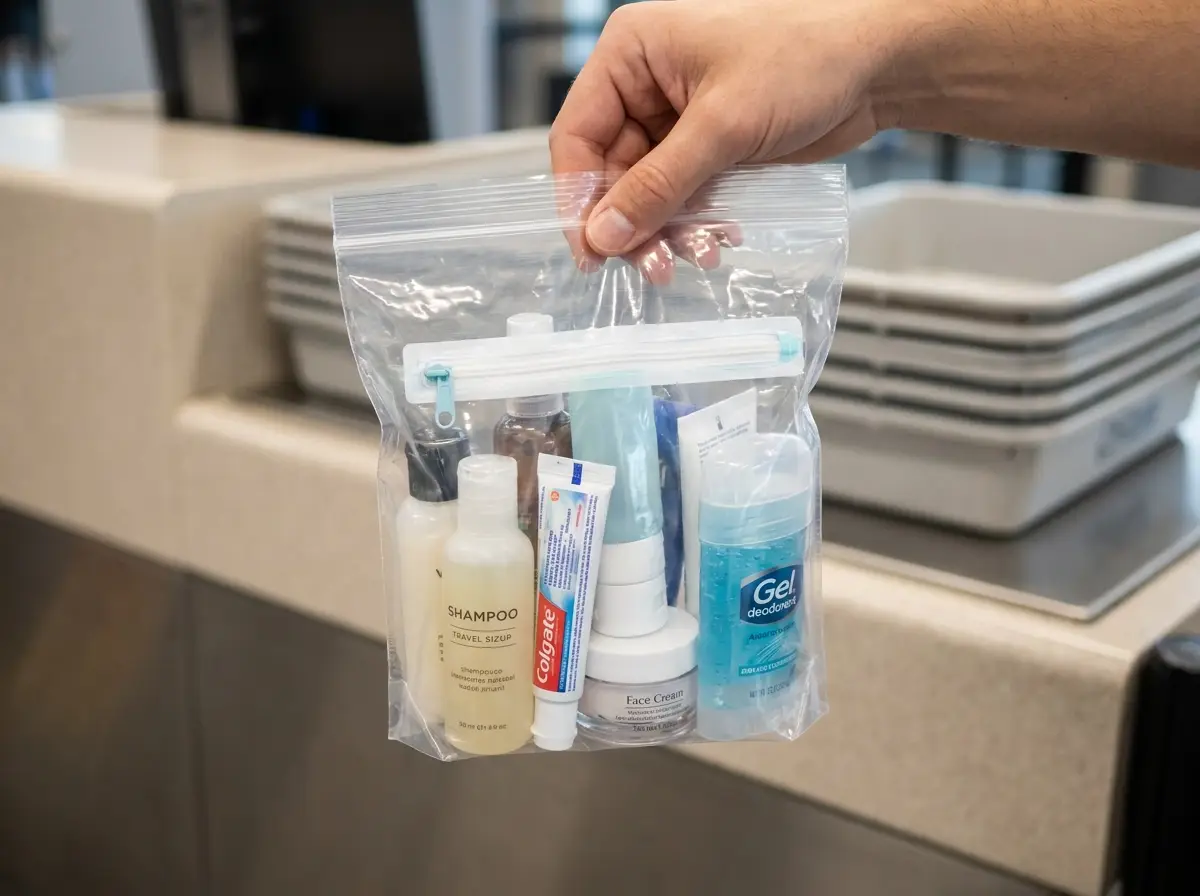
The name is the rule. Break 3-1-1 apart and you get three parts: 3.4 ounces or 100 milliliters per container, one quart-sized bag, and one bag per passenger. That is it.
The rule applies to liquids, aerosols, gels, creams, and pastes, which is why peanut butter, toothpaste, and gel deodorant land in the same category as shampoo. For the rule itself, cite the canonical source: the TSA Liquids, Aerosols, and Gels Rule page.
What the rule does not say matters just as much. TSA publishes no fixed inch or centimeter dimension for the bag, and the clear-bag and quart-size questions belong on the TSA liquids FAQ page, not the main rule page. For a deeper look at bag requirements, see our guide to what makes a toiletry bag TSA approved.
If you are unsure whether an item counts as a liquid, gel, aerosol, cream, or paste, check TSA’s current What Can I Bring? guidance before packing rather than relying on an older summary.
The rule sits inside TSA’s broader Security Screening section, so item-specific answers route through What Can I Bring? rather than guesswork. With the rule stated plainly, the next question is whether your containers actually comply.
The rule applies per container, not per total volume. Three 3.4 oz (100 ml) bottles pass. One 6 oz bottle does not, even if it holds two ounces. The label governs, and screeners read the label rather than weighing the contents.
A bottle printed 4 oz or 120 ml is oversized on its face. Decanting half of it into the same bottle does not rescue it; the printed capacity is the violation. Hotel amenities are the worst offenders: complimentary shampoo is often unmarked or stamped above 100 ml, so a nearly empty bottle becomes an easy discard.
The familiar loopholes fail too. “It’s mostly solid” still counts if it spreads to fill its container, which is why peanut butter and gel deodorant land with shampoo. “It’s medical” opens a separate screening process through TSA Cares, not an exemption. “It’s sealed” changes nothing.
Verify before you pack. A kitchen scale, a marked measuring cup, or a container printed at or under 100 ml settles it in seconds.
One last trap: frozen liquids thaw into liquids, and ice packs and gel packs screen as liquids unless frozen solid at screening.
TSA’s current travel checklist specifies one quart-size, clear, plastic, zip-top bag for carry-on liquids, gels, and aerosols. Each passenger is limited to one 3-1-1 bag, and every liquid container inside it must be 3.4 ounces (100 ml) or less. Check the current TSA liquids guidance before departure because screening procedures can change.
A clear bag also makes the contents easy to inspect and keeps the packing system simple at the checkpoint.
Quart-sized is not the same as roughly quart-sized. If the bag will not lie flat or cannot close, its effective capacity is smaller than its label. A zip-top closure is what keeps it from being treated as an open container; a torn or stretched zip defeats the purpose.
A quart bag is also not a packing cube or a dopp kit. You can pack a larger toiletry bag, but the liquids inside must still be consolidated into the one quart bag you present. Packing lighter reduces what competes for that space; see How to Pack Light Without Sacrificing Comfort on Long Trips.
A clear, flat-bottomed quart bag is the single most useful upgrade. The Essential For Travel Clear Quart Bag Set keeps spares in your carry-on for the return leg. Shop Now: essentialfortravel.com
With the right bag chosen, the packing method itself comes down to three moves in fixed order: audit and downsize, load so the bag still seals, then position it for one-motion retrieval.
Lay every candidate container on the counter. Check each printed capacity and remove anything over 100 ml no matter how little is inside.
Bar shampoo, solid deodorant, toothpaste tablets, and powder sunscreen leave the quart bag entirely and free real capacity.
A five-day trip does not require five days of product volume. A 30 ml bottle of serum covers a week for most people.
Stand bottles upright in the flat-bottomed bag, tallest at the back, shortest at the front, so the zip closes on a flat seam rather than a bulge.
5. Stop at roughly two-thirds capacity. The remaining third lets the bag flatten and seal. Overstuffing is a leading cause of bag failure at the checkpoint.
6. Position it for retrieval. Place the sealed bag in an outside pocket or the top of your personal item so you never dig for it. Retrieval time is the difference between a smooth line and a secondary search. If your current travel toiletry bag makes that awkward, that is the piece to replace next.
7. Add an absorbent pad. A small absorbent pad or folded paper towel inside the bag catches the slow leak from a poorly sealed cap and keeps the outside dry.
8. Double-bag the riskiest item. A liquid liner, tinted moisturizer, or anything with a pump. Pumps can leak with cabin pressure changes, and a zip-top snack bag around the bottle is cheap insurance.
Containers built for this method do most of the work. The Essential For Travel Leak-Proof Silicone Travel Bottles use a wide-mouth fill and a sealing cap designed to hold through pressurization, removing the most common cause of a wet quart bag. Shop Now: essentialfortravel.com
On the return leg, repack before you leave the hotel, not at the airport. That is where bags get overstuffed and zips get forced.
Your bag sealed at two-thirds capacity. Then the screener spots something on the monitor, and the method stops mattering.
TSA’s Advanced Technology X-ray is the primary system for screening carry-on items, using two-dimensional imaging to flag explosives and prohibited items. The operator reads density and shape. That is why a fully legal 3.4 oz container can still pull your bag: it looks wrong on screen.
Liquid flags to expect:
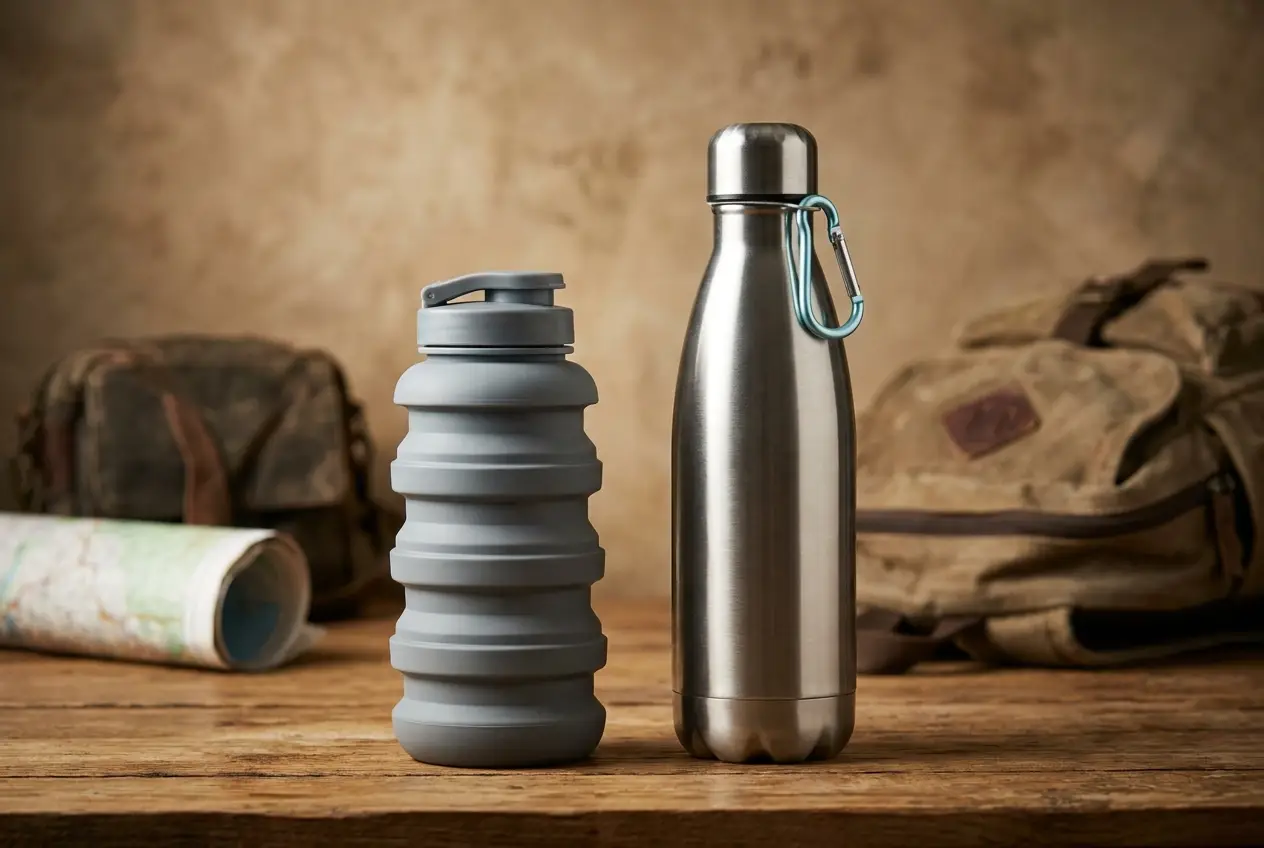
Dense powders, a battery pack riding next to a toiletry kit, a metal nail file, a corkscrew, and a full water bottle all earn a second look even though none is a liquid. Empty the bottle before the bin; our guide to travel water bottles that clear security shows which ones hold up.
A bag that will not close invites a hand check, because the screener cannot confirm its contents visually. Anything pulled for a secondary search also gets re-run, spending the minutes you saved by packing light.
When a container is over the limit, there is no negotiation. Your practical options are checking the bag, mailing it, or leaving it. TSA does not publish secondary-search or abandonment rates, so distrust any percentage you read.
Worth knowing: TSA’s current public-facing investment is identity verification, including Digital ID and Touchless ID, not new liquid rules. The liquids process itself has been stable.
You now know what draws a hand check. These habits are what keep one from happening in the first place.
Make the routine automatic with the Essential For Travel Quart Bag and Container Kit, which keeps compliant containers, a clear bag, and spares together so the system never resets.
Shop Now: essentialfortravel.com

The 3-1-1 rule is a container rule. Nearly every failure at the checkpoint traces back to an oversized container, an unsealed bag, or a non-liquid decoy, not to volume.
Three actions before your next flight:
Verify the current rule text on TSA’s canonical liquids page before relying on any summary, including this one. For the rest of your carry-on setup, use our TSA toiletry bag guide, travel bottle guide, and international travel packing list.
A quart bag that seals and presents cleanly is the difference between walking through the line and standing at the end of it repacking under pressure. The Essential For Travel Quart Bag and Container Kit keeps compliant containers and spares together so the routine never resets.
Shop Now: essentialfortravel.com
#essentialfortravel #TSA311 #QuartBag #TravelPacking #PackingTips
The 3-1-1 rule is not about squeezing more liquid into a bag. It is about container size, a proper seal, and quick presentation. Check every printed capacity, pack your quart bag to about two-thirds, and keep it in an outside pocket so security is a thirty-second habit, not a repacking project. That small routine protects your trip and your peace of mind. Before you fly, verify the current TSA guidance and review international restrictions. Then make the system automatic with the Essential For Travel Quart Bag and Container Kit, which keeps compliant containers, a clear bag, and spares together. Pack the container, not the contents, and walk through the checkpoint with confidence. Shop Now: essentialfortravel.com
The name is the rule. It breaks into three parts: 3.4 ounces (100 ml) per container, one quart-sized bag, and one bag per passenger. It applies to liquids, aerosols, gels, creams, and pastes — which is why peanut butter, toothpaste, and gel deodorant fall into the same category as shampoo. Note that the limit applies per container, not to your total volume: three 3.4 oz bottles pass, but one 6 oz bottle does not, even if it's only half full.
TSA's current guidance specifies one quart-size, clear, plastic, zip-top bag per passenger for carry-on liquids, gels, and aerosols. Each container inside must be 3.4 ounces (100 ml) or less. Use a bag that closes fully without forcing the zipper, and check TSA's current liquids guidance before departure because procedures can change.
Nearly every failure comes down to how the liquid is contained, not how much you're carrying. Three failure modes account for almost all of it: an oversized container (like a 4 oz bottle in a 3.4 oz world), an overstuffed bag that will not seal flat, and a non-liquid item that triggers a secondary search on the X-ray. The label governs — screeners read the printed capacity rather than weighing the contents, so a bottle printed 4 oz or 120 ml is oversized on its face, even if you only filled it halfway.
TSA's Advanced Technology X-ray flags items by density and shape, so a fully legal 3.4 oz container can still get your bag pulled if it looks wrong on screen. Expect flags for oversized containers with legible volume labels, aerosol cans, pump bottles that read as solid cylinders, and metal or opaque containers. Non-liquid decoys earn a second look too — dense powders, battery packs, metal nail files, corkscrews, and full water bottles. To lower your odds: load the bag to about two-thirds so it seals flat, keep it in a separate pocket from your electronics, and make it easy to retrieve in one motion.
Audit and downsize first — lay out every container and remove anything printed over 100 ml no matter how little is inside. Then convert to solids: bar shampoo, solid deodorant, toothpaste tablets, and powder sunscreen leave the bag entirely and free real capacity. Decant only what the trip needs (a 30 ml bottle of serum covers a week for most people), load bottom-up with bottles upright so the zip closes on a flat seam, and stop at roughly two-thirds capacity so the bag can flatten and seal. Position it in an outside pocket for one-motion retrieval, add an absorbent pad for slow leaks, and double-bag your riskiest item, like anything with a pump.