For ordinary liquids at US TSA checkpoints, use containers of 3.4 ounces (100 mL) or less in one quart-size bag. EU guidance uses 100 mL containers in a one-litre bag, while UK allowances can vary by airport. Check your departure, transfer and return airports before packing, including the rules for any exemptions.
Liquids packing check before each flight
- List every liquid, gel, cream and aerosol you intend to carry in the cabin.
- Check each container’s labeled capacity, not how much product remains inside it.
- Review the official screening rules for each departure and connecting airport; do not assume a newer scanner means restrictions are waived.
- Keep medically necessary liquids and infant feeding items accessible and check the applicable exception procedures.
- Pack larger nonessential containers in checked luggage only when the airline and security rules permit them.
Check the official TSA liquids rule for U.S. departures, and read our carry-on toiletry bag guide for packing tips. Airport-specific rules may differ. For choosing containers that fit these limits, read our travel bottles by dispenser type guide. To compare available options, see our travel-size refillable containers. Check each container’s marked capacity against the rules for your airports; buying a travel-size set does not guarantee screening approval.
Quick answer: how much liquid can you take in a carry-on?
For ordinary liquids at US TSA checkpoints, use containers of 3.4 ounces (100 ml) or less in one quart-size bag. EU and UK rules and exemptions can differ by airport and screening equipment. Confirm your departure and connecting airports’ current policies. Last reviewed: November 11, 2026.
Related Carry-On Packing Guides
After checking your liquid allowance, use our 3-1-1 quart bag packing guide for a practical packing example. Our refillable travel bottle guide explains how to choose containers, while the international carry-on backpack guide covers the bag around them.
Frequently Asked Questions About Carry-On Liquid Limits
Does a half-empty 200 ml bottle count?
Yes. Restrictions generally apply to container capacity, not the amount left inside.
Are medicines treated differently?
Essential medicines may qualify for exemptions; declare them when required and follow the airport’s guidance.
Standard 100 ml / 3.4 oz limits and airport exceptions
In the United States, the TSA generally limits ordinary carry-on liquids to containers of 3.4 ounces (100 ml) or less. EU rules generally use the 100 ml limit, while UK requirements can vary by airport and screening equipment. Check the rules for every airport on your itinerary. The container is what counts, not what is inside it: a 200 ml bottle with 50 ml left in it is still over the limit.
Where the regions differ
- United States (the 3-1-1 rule): ordinary liquids in containers of 3.4 oz (100 ml) or less, fitting in one quart-size bag per passenger. Follow checkpoint officers’ instructions about whether to remove the bag for screening.
- European Union: the standard rule generally limits ordinary liquids to 100 ml containers in one transparent, resealable bag of up to 1 litre per passenger. Check the departure airport’s current screening instructions and applicable exemptions.
- United Kingdom: liquid container-size limits and requirements for separate clear bags vary by airport as security scanners are upgraded. Some airports permit containers larger than 100 ml. Check the current rules for every UK departure or connecting airport before you fly.
A US quart is about 0.95 litre, but bag rules are not interchangeable everywhere. Check each airport’s required capacity, dimensions and whether the bag must be transparent and resealable.
What counts as a liquid
Airport liquid-screening rules generally cover liquids, gels, aerosols, creams and pastes, including shampoo, toothpaste, lotion, mascara, peanut butter and jam. Some unusual items, such as snow globes, may also be restricted depending on their contents and size. Powders are screened under separate rules and may require additional inspection; check the security authority’s guidance for your itinerary.
Scanners are changing what the lane asks for
Airports in the US, the UK and Europe have been installing CT scanners that can show a laptop and liquids without unpacking them. Where a lane has one in service, officers may let you leave those items in the bag. Plan for the rule on the sign at your lane, not for the scanner you read about: equipment is taken in and out of service, and the published limits still apply.
Build a kit that actually works
- Decant into refillable bottles sized for the rule — 100 ml or smaller, in silicone or squeezable PE, and label each one. Choose leak-resistant travel bottles with a labeled capacity of 100 ml (3.4 oz) or less. TSA does not approve individual toiletry-bottle brands; containers still must meet the screening rules at your airport.
- Leave some headspace. Tighten caps securely and follow the bottle manufacturer’s filling instructions. Place leak-prone toiletries in a sealed pouch to protect the rest of your bag.
- Group by category — skincare, hair, dental — so a secondary check takes seconds rather than emptying the bag.
- Keep the clear pouch at the top of the pack, not in the bottom of a stuffed duffel.
- Double-bag the risky items. A zip-top bag inside a small travel organizer bag contains a leak before it reaches your clothes.
- Carry the kit in a hanging toiletry bag that unrolls on a hook, so you are not rebuilding it on a hotel counter.
Exemptions and edge cases
- Medically necessary liquids. TSA permits medically necessary liquids in reasonable quantities exceeding 3.4 oz (100 ml), subject to additional screening. Inform the officer at the start of screening. Original labels can help with identification but are not generally required by TSA; check destination-country medicine rules separately.
- Formula, breast milk and toddler drinks. TSA allows these in quantities greater than 3.4 oz (100 ml) in carry-on baggage, subject to additional screening. Tell the officer at the start of screening and check TSA’s current guidance for related items and exceptions.
- Duty-free purchases. Larger liquids purchased after security may be allowed through connecting checkpoints when packaged in an approved tamper-evident bag with proof of purchase, but transfer rules vary by country and airport. Keep the bag sealed and check your connection airport’s requirements before buying.
- Spare lithium batteries and power banks. Carry these in cabin baggage, not checked baggage. If your carry-on is gate-checked, remove spare batteries and power banks first. Check airline watt-hour limits and protect exposed battery terminals from short circuits. Keep electronics separate from the liquids pouch.
Do You Need to Repack Liquids When Connecting Through Another Airport?
Possibly. A connection that requires another security screening may apply different container-size limits, clear-bag requirements or rules for duty-free purchases. Check the official guidance for each airport where you will be screened, including your return journey. Keep your liquids accessible and do not assume that a screening exemption at one airport applies at the next.
The ten-minute pre-flight check
- Open your airline’s baggage page and your departure airport’s security page for the current limits.
- Bag your liquids the night before and photograph the layout, so you can repack it in the same order after security.
- Check the permitted bag capacity and dimensions for each airport. A bag that zips closed is not automatically compliant; use a quart-size bag where TSA requires one, or the specified transparent resealable bag at other checkpoints.
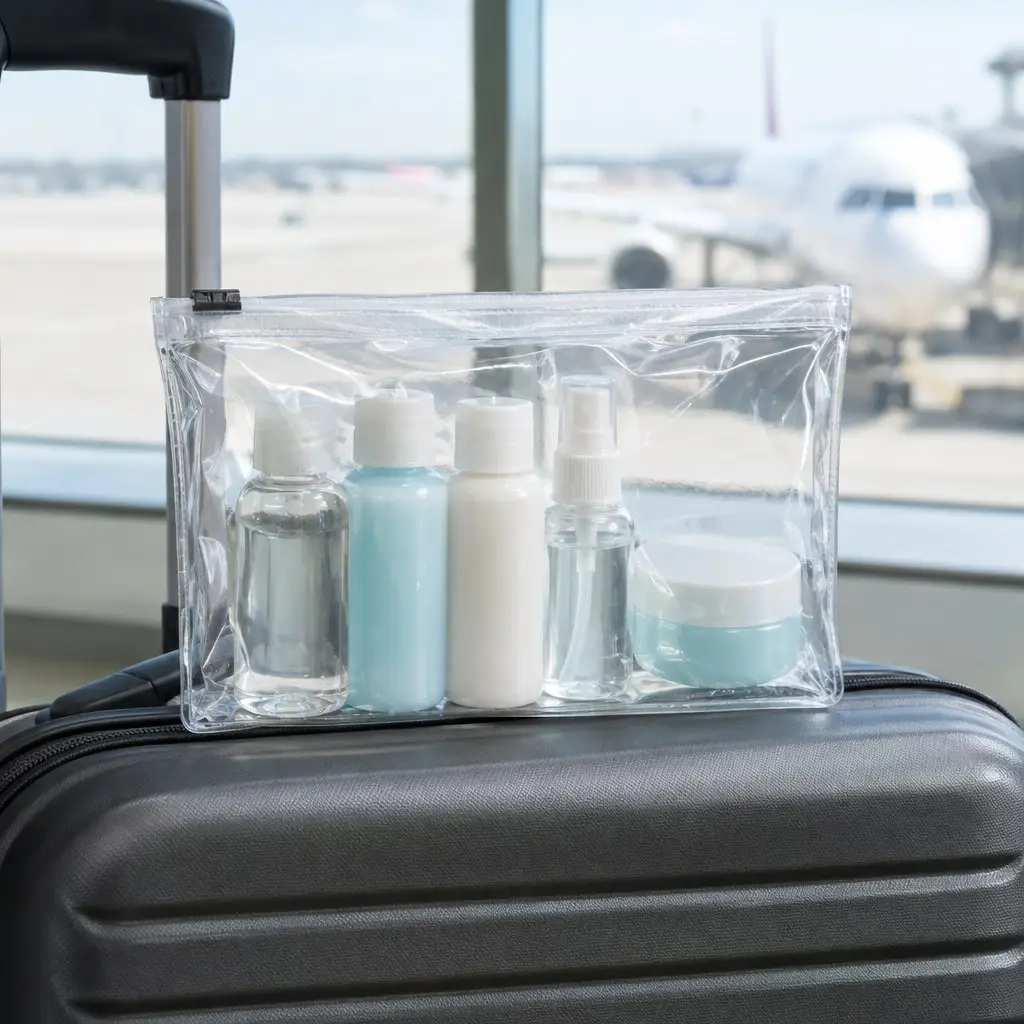
For small toiletries, a mini clear zipper travel pouch can keep containers together. Check its actual dimensions against your departure airport’s liquids-bag rules before relying on it for security screening.
Our refillable travel bottle guide explains how to prevent leaks, while the carry-on toiletry bag guide covers organization for security screening.
Before you leave: Check the official security page for each airport where you will be screened, including connections and the return flight. Set aside any medicines or infant-feeding liquids that may need separate screening, confirm the required liquids-bag size, and move oversized nonessential containers to checked baggage only when permitted. Recheck airport guidance shortly before departure because screening procedures can change.
More guides and travel organizers
Learn how to pack a 3-1-1 liquids bag and what TSA-approved luggage really means. For reusable containers, see our travel liquid bottle set. Verify US checkpoint requirements with the TSA travel tips; rules at other airports may differ.
EU Liquid Exemptions Travelers Should Know
European Commission guidance permits ordinary liquids, aerosols and gels in individual containers no larger than 100 ml when packed in one transparent, resealable one-liter bag. Important exceptions include liquids needed during the trip for medical purposes or special dietary requirements, including baby food. Certain duty-free liquids may also travel in hand luggage when they remain properly sealed with proof of purchase in the required security bag.
The EU also treats gels, pastes, lotions, sprays and liquid-solid mixtures as liquids for screening purposes. That means items such as toothpaste, perfume and shaving foam belong in your liquids calculation, not just drinks and shampoo.
Why the UK airport matters more than a blanket UK rule
UK liquid limits depend on the airport and its screening equipment. Government guidance says most airports still limit ordinary liquids to containers of 100 ml or less, but some allow larger containers, and the requirement for a separate transparent bag also varies. Travelers should check departure, transfer and return airports individually. The European Commission’s general guidance describes 100 ml containers in a transparent one-liter resealable bag, with exemptions for essential medicines, baby food and certain sealed duty-free purchases. Check current UK airport liquids guidance and European Commission liquids guidance before traveling.