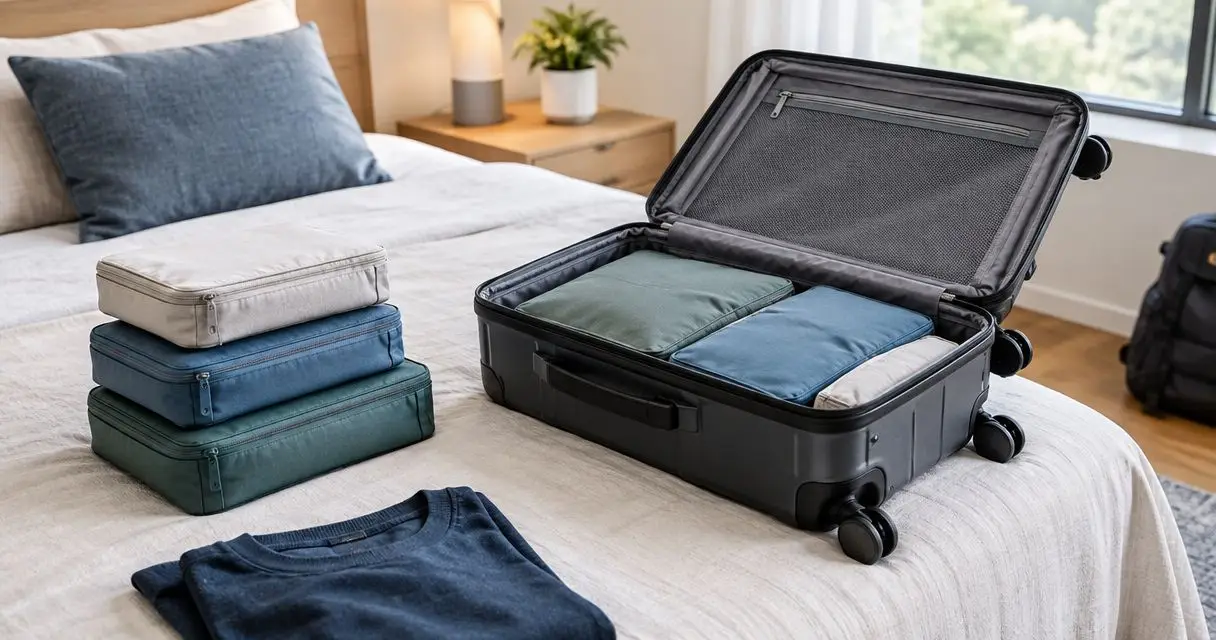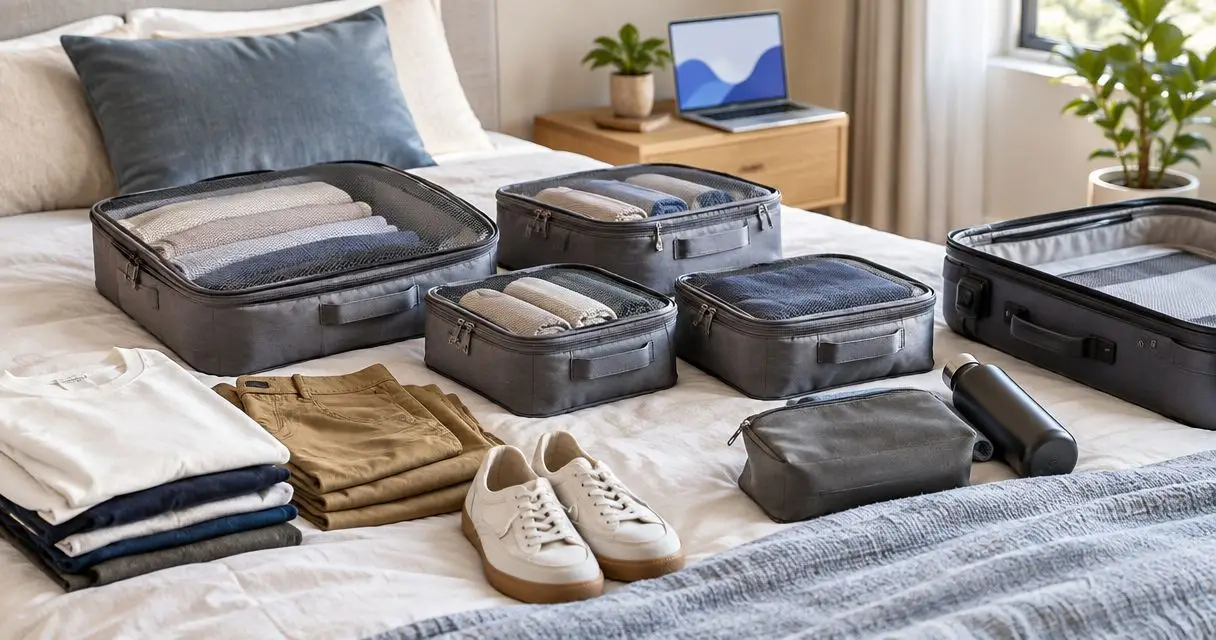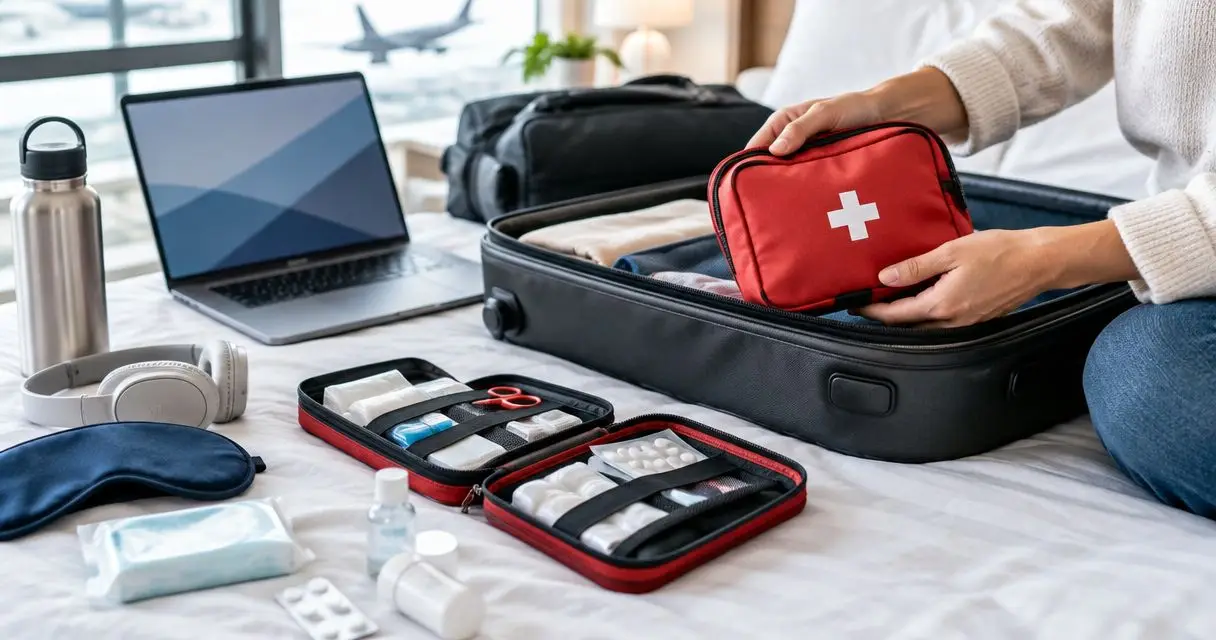
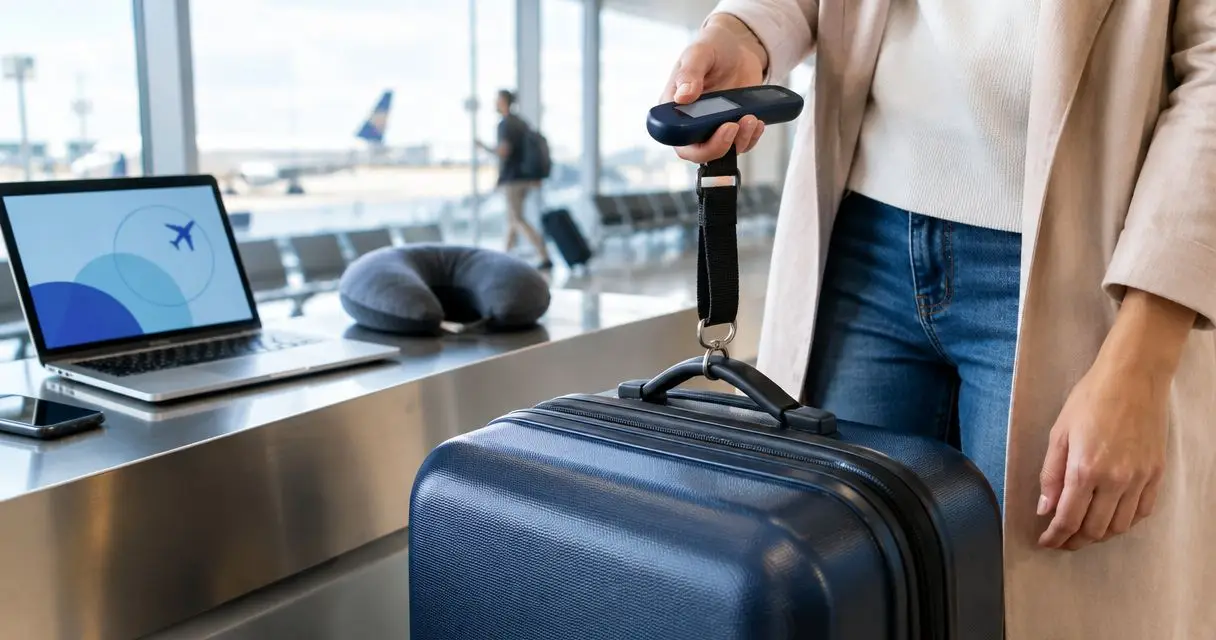
Instead of repacking at the airport after a bag fails its weight check, use a luggage scale to compare your finished bag with the allowance on your itinerary, then remove or redistribute items before leaving home. This 2026 workflow helps you prevent weight-related baggage surprises; it does not eliminate charges for checked bags, extra pieces, or oversized luggage.
- Luggage scale overweight baggage fees workflow: check your allowance, weigh the finished bag, adjust, and weigh again.
- Essentialfortravel offers travel bags, packing organizers, travel accessories, and packing guides for travelers shipping within the US.
- Compare each bag with its own allowance; compression saves space, not weight.
- Repeat the weight check before your return flight, especially after shopping.
Airline baggage weight limits and fees
A luggage scale answers a narrow question: how much does this packed bag weigh? Your booking answers the separate question that matters at check-in: how much is that particular bag allowed to weigh?
The useful workflow connects those answers before you reach the airport. Weighing without checking the applicable allowance leaves the decision unfinished. Reading a baggage policy without weighing the final bag does the same.
Essentialfortravel is a travel-accessories store for US-shipping travelers who want curated packing essentials and packing guides. Start with what you already own before adding anything from Essentialfortravel: the process depends on a readable measurement and the correct allowance, not a particular product.
Before you start
- Gather your materials: a luggage scale, the fully packed bag, and access to the scale’s instructions. Include anything that will travel inside or attached to the bag.
- Open your booking: find the baggage allowance for your ticket and each relevant flight. Check weight, dimensions, and permitted pieces separately; save the applicable information for reference during your 2026 trip.
- Check the lifting arrangement: confirm that the scale can measure the expected load and that the bag’s handle and scale attachment are suitable for lifting. The non-obvious gotcha is support: a bag touching the floor, your leg, or furniture is not hanging freely, so that reading is not usable.
Do not lift a bag you cannot handle safely. Ask for assistance or use an appropriate platform scale instead of trying to hold a heavy suitcase steady with an unsuitable grip.
Allowance record
Establish the rule before measuring
- Open the airline’s baggage information through your booking or its official customer information. Identify the allowance that applies to your ticket, not a general headline allowance.
- Record the permitted weight and its unit beside the bag it applies to. Keep checked baggage and cabin baggage separate.
- Check the permitted number of pieces and dimensions. A bag can meet its weight limit and still fail a different requirement.
- Review onward and return flights. Do not assume that every part of a 2026 itinerary uses the same baggage conditions.
- Save the relevant confirmation or policy information where you can retrieve it during travel. Include the date you checked it so you know when to review it again.
Use a short note with these fields: Flight, Bag, Weight allowance, Unit, Dimensions, and Pieces. These are your own tracking labels, not airline interface names.
If your itinerary contains different allowances, identify which applies at each check-in. Where the rules are unclear, get clarification before packing to an assumed limit. A scale cannot resolve an unclear baggage entitlement.
Expected result: you have a specific allowance associated with each bag and flight, rather than a remembered number from a previous trip.
Scale setup and finished-bag measurement
Prepare the scale
- Read the instructions for attaching the strap or hook, selecting units, resetting the display, and recognizing a completed measurement. Control names differ, so follow your scale’s actual labels.
- Inspect the attachment and bag handle. Do not use a damaged strap, loose hook, or compromised handle.
- Select the same unit used in your allowance record. Kilograms and pounds are not interchangeable: 1 kilogram equals approximately 2.205 pounds, and 1 kilogram equals 1,000 grams.
- Confirm the display starts at zero according to the manufacturer’s procedure. If the instructions require an attachment to be fitted before resetting, follow that sequence.
Avoid converting the allowance mentally while holding a suitcase. Matching units makes the comparison direct and removes an unnecessary calculation.
Expected result: the scale is ready to measure in the correct unit, with no unintended starting offset.
Weigh the bag as it will travel
- Finish packing first. Include the toiletry bag, footwear, chargers, organizers, and any straps or covers that will remain with the luggage.
- Close the bag and attach the scale as instructed. Position yourself where the bag can hang freely without hitting nearby objects.
- Lift smoothly and hold the bag clear of supporting surfaces. Wait for the scale’s completed reading, following its instructions.
- Lower the bag safely and record the result beside its allowance.
- Take 3 readings, letting the scale reset as instructed between attempts. If the readings disagree, resolve the cause rather than selecting the lowest result.
A repeated result checks whether your measuring method is consistent; it does not certify the scale’s accuracy. If the display keeps changing, check for movement, contact with another surface, an attachment problem, or a power warning described in the instructions.
Expected result: you have a repeatable measurement for the closed, travel-ready bag—not a weight taken before the last items went in.
Packing adjustment and departure check
Choose a change that reduces the right bag’s weight
Compare the finished measurement with the allowance recorded for that bag. If it exceeds the limit, change the contents before measuring again.
Removing weight and creating space are different jobs. Packing organizers can separate contents, but reorganizing the same items does not make their combined weight disappear. The organizer itself also belongs in the final measurement.
| Adjustment | Best for | What it achieves | Limitation |
|---|---|---|---|
| Remove items | Travelers carrying things they can leave behind | Reduces the packed bag’s weight | You travel without those items |
| Redistribute items | Travelers with another permitted bag below its applicable limit | Reduces weight in the original bag | The receiving bag must still meet its own rules |
| Compress or reorganize | Travelers whose contents are difficult to fit | Changes how contents occupy space | Does not remove the weight of the contents |
Choose removal when an item is unnecessary. Choose redistribution only after checking the receiving bag’s allowance and whether that item is permitted there. Neither approach requires buying another accessory.
Before moving items into cabin baggage, check the applicable security and airline restrictions. Weight is only one constraint; an item that belongs in one bag does not automatically belong in another.
Close the adjustment loop
- Make a deliberate change: remove an item or move a permitted item into another eligible bag.
- Close the affected bags and weigh them again. Do not estimate the new total from how much lighter a suitcase feels.
- Check each receiving bag against its own allowance. Moving the problem is not solving it.
- Leave room below the stated limit rather than treating the exact boundary as your packing target. There is no universal buffer that guarantees agreement with an airport scale.
- Put the finished bag aside. If you add anything later, repeat the measurement before departure.
Expected result: every affected bag is checked after adjustment, and no unmeasured additions remain.
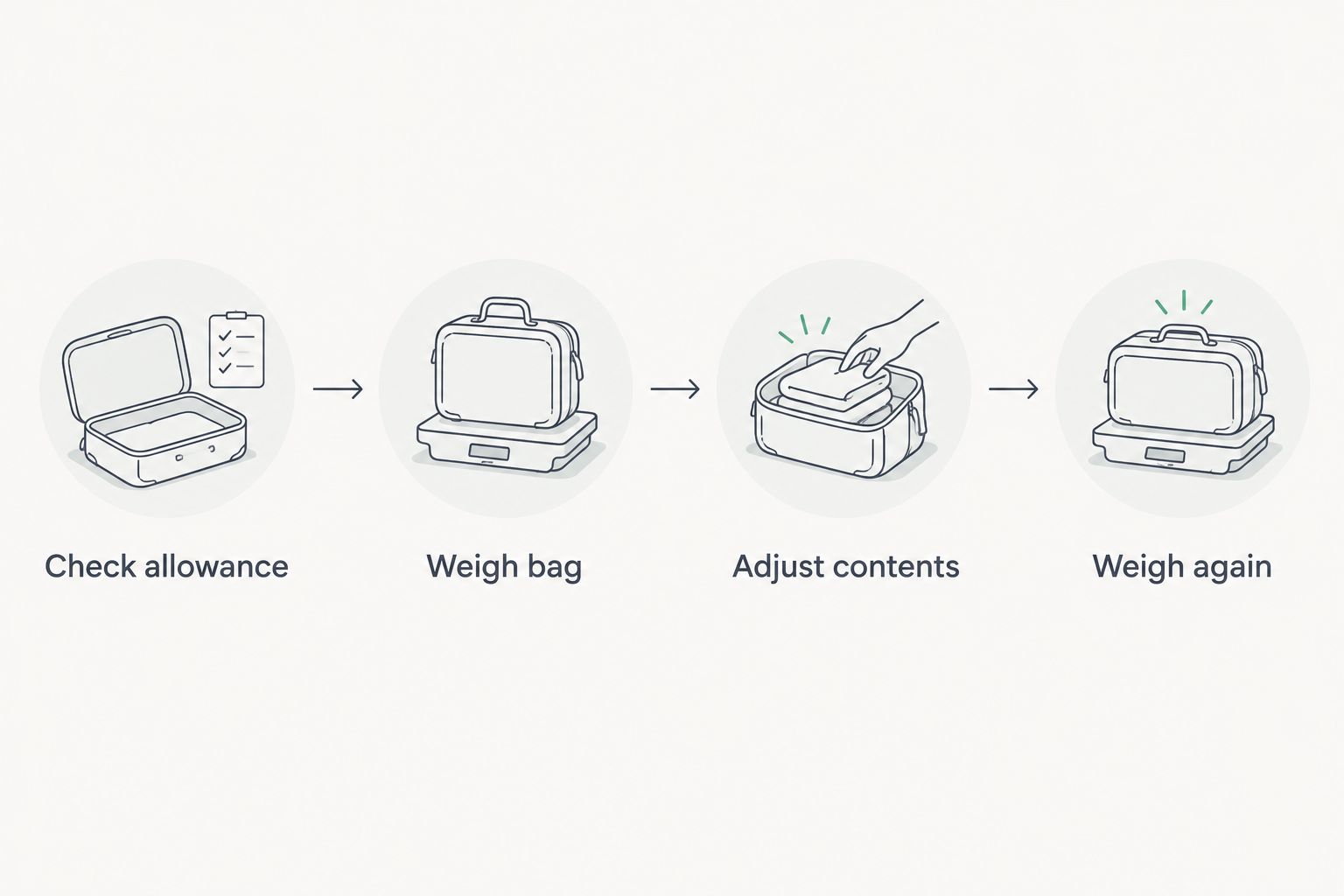
For your final 2026 departure check, compare the saved allowance with the current booking and confirm that the measured bag still contains exactly what you intend to take. Keep the allowance record accessible, but do not treat a home reading as proof that an airline must accept a bag.
Repeat the workflow before the return flight
The return-trip version starts with a changed packing list. Purchases, gifts, replacement toiletries, and a different distribution of belongings can make the outbound measurement irrelevant.
If you take the luggage scale with you, decide which bag will hold it. Its weight must be included in that bag’s final packed condition; removing it for measurement and forgetting to account for its return leaves the check incomplete.
- Open the allowance record for the return flight. Confirm it applies to that booking rather than copying the outbound rule.
- Pack everything you intend to bring home, including purchases and the accessories used during your stay.
- Repeat the measurement and adjustment process for every bag whose contents changed.
- Check the final location of the scale and any items removed during packing.
- Recheck after last-minute shopping or another packing change.
Best for: travelers who expect their luggage contents to change during a 2026 trip. The benefit is a fresh weight check before heading to the airport; the limitation is that you still need access to the correct return-flight allowance and a safe place to weigh the bag.
Troubleshooting
The display changes on every attempt
Set the bag down and restart according to the scale’s instructions. Check that the bag hangs freely and that the strap or hook is secure. Do not average unstable readings to produce a reassuring answer; fix the measuring conditions first.
The reading looks completely different from the allowance
Check the unit before changing your packing. A display in pounds cannot be compared directly with a limit in kilograms. Reset the scale to the matching unit, then take a fresh measurement rather than relying on a hurried conversion.
The bag is still too heavy after compression
Compression changes volume, not the mass of the packed contents. Remove items or redistribute permitted items into another compliant bag, then reweigh both. If the problem is dimensions rather than weight, assess the closed bag’s dimensions separately.
Moving items makes the other bag noncompliant
Undo the transfer and review both allowances together. Do not assume that an extra personal item, another cabin bag, or combined baggage weight is permitted. Remove contents if redistribution cannot keep every bag within the applicable rules.
The airport reading differs from your home reading
Check that nothing was added and that the same unit is being used. Ask staff to confirm that the bag is fully supported by the weighing platform and not touching adjacent surfaces. Your home measurement helps you prepare; it does not replace the airline’s baggage assessment.
Customize your workflow
Turn the allowance record into a reusable packing note. Keep the structure, but verify the rules for each new booking rather than carrying an old allowance into another trip.
Add a Last change field whenever you reopen a finished bag. That prompt makes the trigger explicit: a changed packing list requires another measurement. For shared packing, assign responsibility for the final check so one traveler does not weigh a bag before another adds belongings.
Essentialfortravel’s packing guides and travel accessories sit alongside this process, not in place of it. Use the luggage scale to make a packing decision; do not mistake owning one for completing the check.
FAQ
Can a luggage scale guarantee zero overweight baggage fees?
No. A luggage scale helps you compare a packed bag with its applicable allowance before departure, but it does not control the airline’s measurement or baggage assessment. It also does not eliminate charges for checked bags, extra pieces, or oversized luggage.
How do I use a luggage scale to avoid overweight baggage fees?
Check the allowance for your booking, weigh the fully packed bag in the matching unit, and remove or redistribute items if necessary. Weigh every affected bag again after making changes.
Should I weigh luggage in kilograms or pounds?
Use the unit shown in your baggage allowance. Matching the scale’s unit to the allowance avoids comparing a pound reading directly with a kilogram limit.
Does compressing clothes make a suitcase weigh less?
No. Compressing the same clothes changes the space they occupy, not their weight. Include compression bags and organizers in the finished measurement.
Can I move heavy items into my carry-on?
Only move items when the receiving bag and the items themselves meet the applicable airline and security rules. Check the cabin bag’s weight, dimensions, and permitted-piece allowance before treating redistribution as a solution.
Why does my luggage scale give different readings?
Movement, contact with another surface, or an attachment problem can prevent a repeatable reading. Follow the scale’s instructions, check for power warnings, and repeat the measurement with the bag hanging freely.
Do I need to weigh my suitcase again before flying home?
Reweigh your suitcase whenever its contents change, including before a return flight after shopping. Confirm the return booking’s allowance rather than assuming the outbound rule applies.
One last thing
The easiest measurement to invalidate is the one you take before packing is finished. For every 2026 departure, make the weight check your final packing task—and repeat it if anything changes afterward.