
Picture this: you arrive at the airport, bag in hand, only to have it flagged at the gate because it does not fit the overhead bin. Suddenly, you are paying unexpected fees and scrambling to reorganize your belongings. It is a stressful situation that happens to thousands of travelers every single day, and the good news is that it is completely avoidable.
Understanding carry on luggage size requirements is one of the most important things you can learn before any trip. The tricky part is that size limits are not the same across every airline. What works on one flight might get you flagged on another, and the rules seem to change more often than you might expect.
That is exactly why we put together this complete 2026 guide. Whether you are preparing for your very first flight or simply want to travel smarter, this post will walk you through the size limits for all major airlines, explain what measurements actually matter, and give you the practical tips you need to pack with total confidence. No surprises, no extra fees, just smooth travels from start to finish.
Standard Carry-On Size: What Most Airlines Allow
If you’ve ever wondered why your bag got flagged at the gate despite being sold as a “carry-on,” the answer almost always comes down to one misunderstood rule: airlines set their own size standards, and those standards are stricter than most travelers expect.
The widely accepted standard for most major U.S. airlines is 22 x 14 x 9 inches. This applies to American Airlines, Delta, United, JetBlue, and Alaska Airlines. That measurement is not just the bag shell. It includes the wheels at the bottom, the extended handle at the top, and any hardware that adds bulk to the frame. When a gate agent slides your bag into a sizer, they are measuring the entire physical footprint of the bag, fully assembled.
This brings up a critical detail that many first-time travelers overlook: airlines measure total exterior dimensions only. How much clothing you can fit inside is completely irrelevant to compliance. What matters is the outside. Spinner wheels, side grab handles, and external zip pockets that protrude beyond the main body all count toward those measurements. According to the real rules for carry-on luggage, soft-sided bag leniency has also largely ended, meaning agents no longer allow travelers to compress a bag to force it into a sizer.
Some carriers express their size limits as total linear inches, which is simply the sum of all three dimensions added together. The standard 22 x 14 x 9 equals exactly 45 linear inches (22+14+9=45). Knowing this number helps when comparing bags across different airline policies.
Southwest Airlines is the most notable exception among major U.S. carriers, allowing carry-ons up to 24 x 16 x 10 inches. That translates to 50 linear inches, roughly 20% more space than the standard allowance. If you fly Southwest regularly, you have more flexibility. However, if your itinerary ever includes a different carrier, that same bag could be oversized.
This leads to perhaps the most important takeaway for any traveler shopping for luggage: a bag labeled “carry-on” by a retailer is not automatically compliant with every airline. According to carry-on luggage size restrictions by airline, bags sometimes measure larger when fully packed, and compliance depends entirely on how a gate agent measures the bag at that specific airport. Always verify your bag’s dimensions against your airline’s published policy before traveling, not after purchasing.
Carry-On Size Limits by Airline in 2026: Full Comparison
Not all airlines play by the same rules, and knowing the exact limits before you pack can save you from unexpected fees at the gate. Here is a clear breakdown of carry-on size limits across the major carriers flying in 2026.
Major U.S. Carriers: The 22 x 14 x 9 Standard
Five of the biggest U.S. airlines share an identical carry-on size policy. American, Delta, United, JetBlue, and Alaska Airlines all enforce a 22 x 14 x 9 inch maximum, measured across the full exterior of the bag, including wheels and handles. None of these carriers impose a weight limit on carry-ons for domestic economy passengers, which gives travelers significant flexibility in how they pack. This shared standard is why 22 x 14 x 9 has become the practical benchmark when shopping for a compliant carry-on bag.
| Airline | Max Size (in) | Weight Limit |
|---|---|---|
| American Airlines | 22 x 14 x 9 | None (domestic) |
| Delta Air Lines | 22 x 14 x 9 | None (domestic) |
| United Airlines | 22 x 14 x 9 | None (domestic) |
| JetBlue | 22 x 14 x 9 | None (domestic) |
| Alaska Airlines | 22 x 14 x 9 | None (domestic) |
| Southwest Airlines | 24 x 16 x 10 | None |
| Frontier Airlines | 18 x 14 x 8 (free) | None stated |
| Spirit Airlines | 18 x 14 x 8 (free) | None stated |
| Ryanair | ~21.5 x 15.5 x 7.5 | ~22 lbs |
| Lufthansa | ~21.5 x 15.5 x 9 | ~17.5 lbs |
| Air France | ~21.5 x 13.5 x 9.5 | ~26 lbs cabin |
Southwest: The Most Generous Major U.S. Carrier
Southwest Airlines stands out from the crowd by permitting carry-on bags up to 24 x 16 x 10 inches with no weight cap. This makes it the most lenient major U.S. airline for carry-on size, and a meaningful advantage if you are traveling with a slightly larger bag. If you regularly fly Southwest, you have more packing room than passengers on most other domestic carriers.
Budget Carriers: Smaller Limits, Bigger Fees
Frontier and Spirit operate under a very different model. Their free carry-on allowance applies only to bags measuring approximately 18 x 14 x 8 inches, which is closer to a personal item than a traditional carry-on. If your bag exceeds that threshold, fees start at $60 and jump to $100 if you pay at the gate. Travelers who are not aware of this distinction often get hit with fees that cost more than the original ticket fare on budget routes. Always check your specific fare class before assuming your bag qualifies as a free carry-on.
International Carriers: Size Plus Weight Requirements
Flying internationally adds another layer of complexity. European and Asian carriers including Ryanair, Lufthansa, and Air France enforce both size restrictions and weight limits ranging from 15 to 22 pounds, depending on the carrier and route. This is a critical difference from U.S. domestic standards, where weight is rarely a factor. A bag that passes easily on a domestic American Airlines flight may be flagged as overweight on a Lufthansa connection. If your trip includes an international leg, always verify both the dimensions and the weight limit for every carrier on your itinerary.
Packing a lightweight carry-on bag becomes especially important for international travel. A quality luggage scale (available at Essential for Travel) removes all the guesswork before you leave home, ensuring your bag meets weight requirements for every carrier on your route.
Budget Carrier Rules: Frontier, Spirit, and Ryanair Explained
Flying budget carriers requires a fundamentally different mindset than booking with major airlines. The rules are stricter, the fees are steeper, and the structural definition of what counts as a “free” bag is completely different from what most travelers expect.
How Budget Carriers Redefine “Carry-On”
The biggest trap travelers fall into is assuming all airlines use the same free carry-on standard. On Delta, American, or United, your standard 22 x 14 x 9 inch roller bag flies free in the overhead bin. On Frontier and Spirit, that same bag will almost certainly trigger a fee. Both carriers restrict their free item, what they call a personal item, to approximately 18 x 14 x 8 inches. Anything larger requires purchasing a carry-on add-on before you ever board. Frontier’s published personal item maximum is specifically 8 inches deep by 18 inches wide by 14 inches tall, including handles, wheels, and straps. That is a meaningful size difference, and millions of travelers discover it at the gate rather than at checkout.
The Fee Structure You Need to Know
If your bag exceeds the free personal item limit on a budget carrier, you will pay for it. Fees start around $60 when added online in advance or at the ticket counter, but climb to approximately $100 if your bag is flagged at the boarding gate. That gate fee is one of the most avoidable yet commonly paid surprise costs in budget travel. On a round trip with two passengers, you could be looking at $400 in unexpected bag fees, often more than the cost of the original ticket. Frontier’s optional services page outlines its current fee structure, though pricing is subject to change.
Ryanair: The Most Restrictive Policy Globally
Ryanair operates on an entirely different model compared to U.S. budget carriers. A small personal bag is allowed free, but a larger cabin bag requires purchasing a Priority or Plus fare upgrade. Ryanair’s cabin bag limit sits at 21.6 x 15.7 x 7.8 inches (55 x 40 x 20 cm), which is notably shallower in depth than most U.S. standard carry-ons. The standard American roller bag many travelers own will exceed Ryanair’s depth restriction. The carry-on is not simply a fee add-on at checkout; it is tied directly to your fare class selection. According to low-cost airline baggage policy guidance, these structural differences between budget and full-service carriers are a consistent source of traveler confusion globally.
Always Verify Before You Fly
Budget carrier policies change frequently and sometimes vary by route, booking class, or promotional period. The 72-hour window before departure is the most reliable time to confirm current rules directly on the airline’s website. Do not rely on what you paid for at booking or what applied on a previous trip. As travel creator Rylee Smith notes, airlines are enforcing existing rules more strictly in 2026, even without publishing new size standards.
The Smart Workaround: Maximize Your Personal Item
The most effective strategy for budget carrier travel is to eliminate carry-on fees entirely by packing within the personal item limit. A structured sling bag, chest bag, or compact under seat backpack can hold a surprising amount when packed intentionally. These bag styles fit comfortably under the seat in front of you, meet personal item dimensions on Frontier, Spirit, and Ryanair, and eliminate fee exposure completely. Essential for Travel carries several options in exactly these categories, designed specifically to maximize packing capacity within tight airline size restrictions.
International Carry-On Rules: Weight Limits Most Travelers Miss
Most travelers who fly domestically within the United States rarely think about how much their carry-on bag weighs. U.S. domestic carriers almost never stop passengers at the gate to weigh a carry-on bag. That changes the moment you board an international flight. European and Asian carriers routinely enforce carry-on weight caps ranging from 15 to 22 pounds, and these limits are applied regardless of whether your bag passes the size sizer. For a first-time international traveler, this can come as a costly and stressful surprise at the boarding gate.
The weight problem is more common than most people expect, because a standard 22 x 14 x 9-inch carry-on bag can weigh between 18 and 25 pounds once fully packed, even before you factor in a personal item. The bag shell itself often weighs 6 to 8 pounds before a single item goes inside. Add a few days of clothing, shoes, a laptop, and toiletries, and you can breach a 15-pound cap without realizing it. This is why weighing your bag at home is not optional when you are flying internationally; it is a necessary step in your pre-travel routine.
A compact digital luggage scale is the simplest solution to this problem. These scales are small enough to tuck into a side pocket and weigh just a few ounces themselves. Weighing your bag before you leave for the airport gives you time to remove items, redistribute weight into your personal item, or use vacuum compression bags to reduce bulk. You can explore lightweight and space-efficient packing tools at Essential for Travel to help you stay within international limits.
Carriers such as Air France, Lufthansa, Singapore Airlines, and Cathay Pacific enforce carry-on weight as a separate compliance check from size. A bag can clear the gate size frame and still be pulled aside for exceeding the weight ceiling. These carriers treat weight compliance independently, meaning both checks must be passed before your bag is allowed in the overhead bin. Reviewing each carrier’s specific policy before departure is essential, as limits differ even between routes operated by the same airline.
Travelers with connecting itineraries face an additional layer of complexity. A flight that begins on a lenient U.S. domestic segment and connects to an international carrier may be governed by two entirely different sets of rules. The stricter international carrier’s policy often applies to the full itinerary once an international leg is included, but this is not always the case. Checking each segment individually through the airline’s official baggage policy page, or consulting a carry-on luggage size and weight guide for 2026, removes any ambiguity before you reach the airport.
Hard-Sided vs. Soft-Sided Carry-Ons: What Changed in 2026
The material of your carry-on bag has always mattered less than its dimensions, but in 2026, that truth became impossible to ignore. For years, travelers with soft-sided bags operated with an unspoken advantage: gate agents would allow a lightly overpacked bag to be compressed just enough to squeeze through the metal sizer frame. That informal grace period is over. Airlines have shifted from relying on the honor system to active, uniform measurement at the gate, including the use of automated scanners that apply the same standard to every bag, regardless of what it is made from.
Why Soft-Sided Bags Lost Their Edge
The old logic made sense at the time. A soft bag that was a half-inch too wide could be squeezed, tilted, or angled through a sizer with minimal resistance. Hard-sided bags had no such flexibility, which made them seem like the riskier choice for travelers packing close to the limit. That dynamic has reversed. If your soft bag bulges beyond the exterior sizer dimensions at the gate today, it will be flagged and checked, full stop. The material is no longer a factor in the gate agent’s decision.
The Case for Hard-Sided Bags in 2026
Hard-sided carry-ons now offer a meaningful compliance advantage: predictability. The exterior profile of a hard-sided bag does not change when you pack it. What you measure at home is exactly what a gate agent or scanner will measure at the airport. For travelers flying major U.S. carriers where the standard limit is 22 x 14 x 9 inches, including wheels and handles, that consistency removes one significant variable from the travel equation.
How to Choose Wisely
Soft-sided bags are not obsolete. They remain lighter when empty and offer more flexible interior storage, which is genuinely useful for fitting irregularly shaped items. The critical adjustment for 2026 is this: always measure your soft-sided bag while it is fully packed, not empty. A bag that measures compliant when empty can exceed the limit by an inch or more once loaded. Travelers researching what carry-on size works across multiple airlines in 2026 are finding that real-world dimensions often differ from marketed measurements.
Whether you choose hard or soft, prioritize bags that are specifically marketed as airline-compliant and tested against the 22 x 14 x 9 inch standard. A bag labeled “carry-on size” without specific dimension verification is not a guarantee of compliance.
Your Personal Item: The Second Bag Most Travelers Underuse
Every major airline allows one personal item in addition to your carry-on, and most travelers treat it as an afterthought. That is a costly mistake. The personal item slot is a genuine second bag allowance, and using it strategically can mean the difference between paying checked baggage fees and flying completely free of extra charges.
The most widely shared personal item size limit is 18 x 14 x 8 inches, a standard used by American Airlines, Allegiant, Frontier, and Spirit. However, dimensions vary by carrier. JetBlue sets its limit at 17 x 13 x 8 inches, and United uses 9 x 10 x 17 inches, so always confirm with your specific airline before packing. Frontier enforces its sizing with physical bag sizer frames at the gate, and the airline has publicly stated that 14″H x 18″W x 8″D is exactly right for a compliant personal item, handles and all.
As carry-on enforcement tightens in 2026, the personal item has become the smarter traveler’s secret weapon. Structured sling bags, chest bags, and compact backpacks are the best choices for this slot because they pack densely, keep your essentials organized, and slide cleanly under the seat without wasted space. A soft tote may technically fit, but a structured bag gives you more usable volume and easier access during the flight.
A thoughtfully packed personal item can carry a laptop, tablet, noise-canceling headphones, a travel neck pillow, snacks, and even a change of clothes, functioning as a fully operational second bag. Pairing a compliant carry-on with a maximized personal item lets most travelers avoid checked baggage fees entirely on domestic and short-haul routes, saving anywhere from $30 to $80 per bag, per flight. On budget carriers like Frontier, where carry-on fees alone reach $89 to $99 at the gate, that savings adds up fast.


Myth: Is There a New Universal TSA Carry-On Size for 2026?
A viral claim spread rapidly across social media platforms in late 2025 and into early 2026, asserting that the TSA had introduced a new universal international carry-on size standard. Travel influencers amplified the message across YouTube, Instagram, and Facebook, with some videos accumulating over one million views. Despite the widespread circulation, the claim could not be verified through any official TSA or airline source. When travelers searched for corroborating information, they found nothing from any government body or airline to support it.
Here is the fundamental fact every traveler needs to understand: the TSA does not set carry-on size limits. The TSA’s legal authority covers security screening, prohibited items, and identification requirements. Baggage dimensions are entirely the responsibility of individual airlines. This is precisely why size limits differ so significantly across carriers. Most major U.S. airlines allow 22 x 14 x 9 inches, while Southwest permits 24 x 16 x 10 inches, and budget carriers restrict free carry-ons to roughly 18 x 14 x 8 inches. There is no coordinating body setting a single standard, and there never has been.
The real-world harm from this myth was significant. Travelers expressed genuine anxiety about bags they had used for years, believing those bags were suddenly non-compliant. Some consumers reported purchasing new luggage over the holiday season based entirely on unverified influencer content. One traveler described watching corrective content on YouTube only after already buying a new suitcase. No airline announced any coordinated policy shift connected to a 2026 TSA standard. What actually changed in 2026 was stricter enforcement of existing rules, not the rules themselves.
Filtering out misinformation is a practical skill that saves money and reduces pre-trip stress. Before every flight, verify your bag dimensions against your specific airline’s official baggage policy page. Treat all social media and YouTube content as unverified until confirmed by a primary source. The TSA website and your airline’s website are the only authoritative references worth trusting.
How to Measure Your Carry-On Bag the Right Way
Knowing the rules is only half the equation. Measuring your bag correctly before you leave home is what keeps you out of trouble at the gate. Follow these five steps every time you travel.
Step 1: Measure height from the bottom of the wheels to the top of the retracted handle.
Place your bag upright on a flat surface and measure from the very base of the wheels or rubber feet all the way up to the top of the tallest handle in its fully collapsed position. Many travelers measure only the main shell and forget that wheels and handles count toward the total. Wheels alone can add one to two inches to your bag’s official height. Airlines measure the full external height, not the shell alone, and automated gate scanners in 2026 catch this mistake with no room for negotiation.
Step 2: Measure width at the absolute widest point.
Run your tape measure from side to side at the broadest part of the bag, including any protruding pockets, exterior zippers, side compression straps, or reinforced hardware. Bags with curved corners or molded edges need to be measured at their fullest lateral extension. If a strap buckle sticks out half an inch beyond the body, that half inch counts.
Step 3: Measure depth when the bag is fully packed.
A soft-sided bag that measures eight inches front to back when empty can easily reach ten inches once loaded. Always measure depth with your bag packed to realistic travel weight. As of 2026, soft-sided bags receive no compression leniency at the gate. If it does not fit the metal sizer frame, it gets checked and fees follow.
Step 4: Compare your numbers to your specific airline’s published limit.
The 22 x 14 x 9 inch standard applies to American, Delta, United, JetBlue, and Alaska. Southwest allows 24 x 16 x 10 inches. Budget carriers restrict free carry-ons to roughly 18 x 14 x 8 inches. International and regional carriers apply their own separate rules. Always verify the limit on your airline’s official website before you pack, not after.
Step 5: Test a borderline bag in an airport sizer before travel day.
If your measurements land close to the limit, visit an airport before your actual departure and drop the packed bag into one of the carry-on sizer frames, typically found near check-in counters or gate areas. This simple test can save you from a gate fee that starts around $60 and climbs to $100 if paid at the departure door. For a deeper look at carry-on fit rules that most travelers overlook, this breakdown covers the practical gaps between what bags claim and what gates actually accept.
How to Pack a Compliant Carry-On Without Leaving Things Behind
Packing smart is just as important as buying the right bag. Even a perfectly sized carry-on can fail at the gate if it is packed in a way that causes it to bulge, bow outward, or exceed its measured frame. These five strategies will help you pack efficiently, stay within airline size limits, and avoid leaving essential items behind.
1. Use Vacuum Compression Bags for Clothing
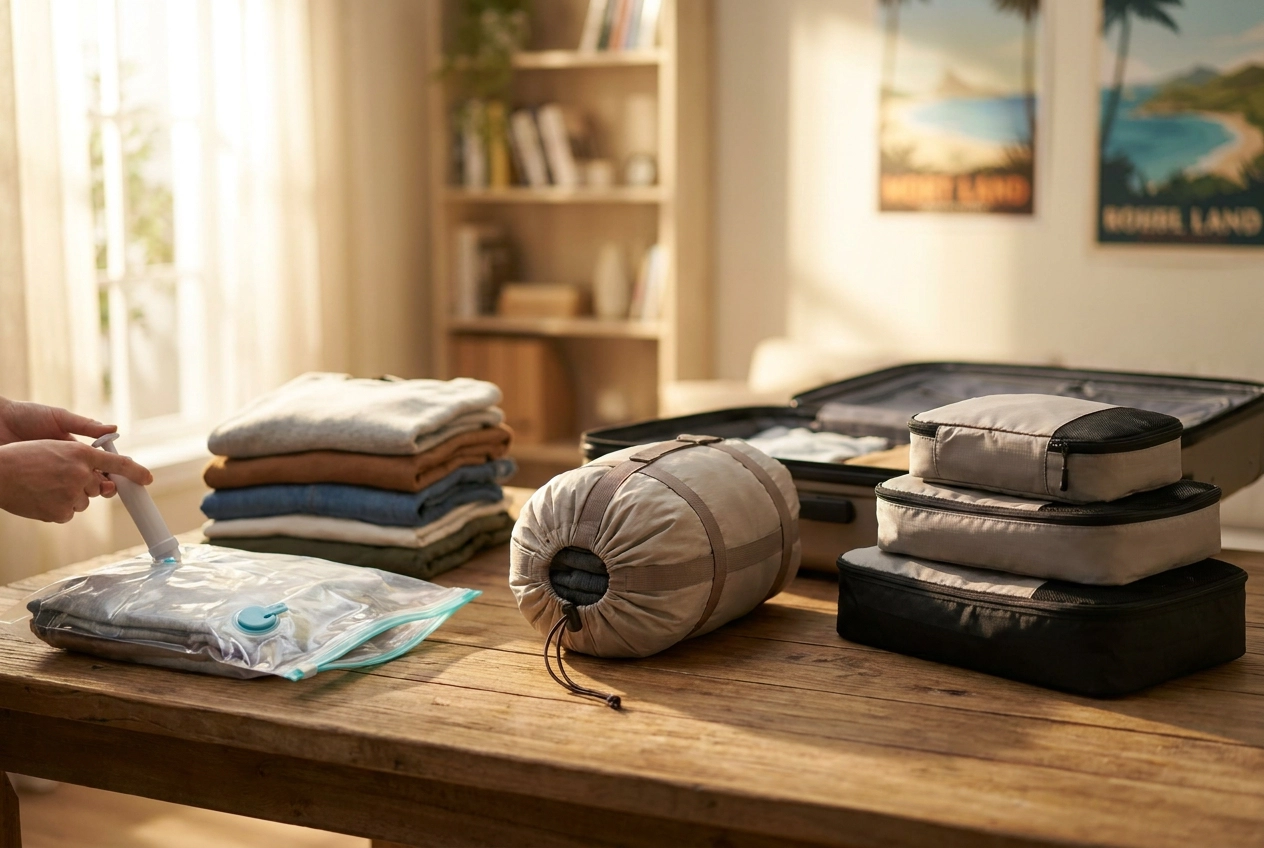
Vacuum compression bags are among the most effective tools available for reducing the physical volume of soft clothing items. By removing the air trapped between fabric layers, these bags can compress a stack of shirts, underwear, or lightweight pants down to a fraction of their original depth. This can free up several inches of vertical space inside a standard 22 x 14 x 9 inch carry-on, giving you room for additional items without changing the bag’s exterior dimensions. Compression works best on single-destination trips where you will not need to re-compress mid-journey.

2. Use Packing Cubes and Organized Storage Bags
Organized storage bags and packing cubes solve one of the most common causes of an overstuffed bag: loose packing. When items are distributed randomly inside a carry-on, soft goods fill irregular gaps and push outward against the bag’s sides and zipper. Segmenting clothing, toiletries, and electronics into dedicated cubes compresses contents into compact rectangular blocks that stack cleanly within the bag’s frame. Clear or mesh cubes add a secondary benefit; TSA agents can visually inspect contents without requiring you to unpack.


3. Roll Clothes Instead of Folding Them
Rolling squeezes residual air from fabric and reduces the volume of each garment compared to flat folding. Rolled items also slot naturally into the corners and cylindrical spaces inside a carry-on that folded stacks cannot reach. For maximum efficiency, combine rolling with compression bags to layer rolled garments under additional compression before sealing.

4. Replace Bulky Fixed-Shape Items With Collapsible Alternatives
Rigid accessories consume disproportionate space because their shape cannot conform to available gaps. Replacing a standard water bottle with a collapsible version, using a compact foldable toiletry holder, and traveling with a flat-folding travel adapter all recover meaningful space. These items perform the same function but compress flat when not in use, making them ideal for size-limited carry-ons.


5. Wrap a Luggage Strap Around the Exterior
A luggage strap is typically thought of as a security accessory, but it also serves a direct compliance function. Cinching a strap around the widest point of a soft-sided carry-on physically prevents the bag from expanding beyond its measured dimensions during handling and storage. This is especially useful after packing, when a bag may sit just at the edge of its size limit. Secure the strap snugly before heading to the airport to maintain consistent exterior dimensions from home to gate.
Travel Accessories That Keep Your Carry-On Compliant and Secure
Packing the right bag is only part of the equation. The accessories you bring along determine whether your carry-on stays compliant, organized, and secure from the moment you leave home to the moment you arrive at your destination.


1. A Digital Luggage Scale
International carriers enforce weight limits between 15 and 22 pounds for carry-on bags, and exceeding those limits can result in fees or forced gate checking. A digital luggage scale removes all guesswork by letting you weigh your bag at home before you ever reach the airport. This single step is the most reliable way to avoid overweight charges at check-in, where fees can climb quickly depending on the airline and route. Compact and lightweight, a quality luggage scale takes up almost no space in your bag and pays for itself on a single trip.


2. Apple AirTags and Wallet Trackers
With airlines enforcing carry-on size rules more strictly in 2026, gate agents are pulling bags more frequently for last-minute checking. Placing an Apple AirTag or a compact wallet tracker inside your carry-on gives you real-time location visibility if your bag is suddenly checked at the gate. You can monitor your bag through the entire journey without anxiety, knowing exactly where it is throughout the process. This small investment delivers significant peace of mind on full flights where overhead bin space disappears fast.


3. RFID-Blocking Passport Holder and Anti-Theft Waist Bag
Busy airports during boarding rushes are high-risk environments for pickpocketing and electronic data theft. An RFID-blocking passport holder shields your passport and credit cards from wireless skimming, while an anti-theft waist bag keeps your most sensitive items close to your body and out of reach. These two accessories work together to protect your identity and finances in crowded terminals.


4. Electronic Cable Organizer
Security screening moves faster when your bag is organized. An electronic cable organizer keeps charging cables, travel adapters, and earbuds separated and tangle-free, so you spend less time digging through your bag at the checkpoint. Organized packing also makes it easier to spot and remove electronics quickly when required.

5. Portable Door Lock and Travel Adapter
Once you reach your destination, a portable door lock provides an added layer of security for hotel rooms and hostels where your carry-on may be stored. A universal travel adapter ensures all your devices stay fully charged across different international socket types, keeping you connected throughout your trip
.
Final Takeaways: Fly Smarter With the Right Carry-On Strategy
Flying smarter starts with five habits every traveler should lock in before each trip.
1. Always verify your airline’s current carry-on policy before you travel. Size limits differ by carrier and change without broad public announcements, particularly on budget and international routes. Budget carriers like Frontier and Spirit cap free carry-ons at 18 x 14 x 8 inches, while major U.S. airlines allow 22 x 14 x 9 inches. Check the airline’s official website before every trip, not just the first time you fly with them.
2. Measure your bag fully packed, including all external features. Wheels, handles, and exterior pockets all count toward your total dimensions. A bag that measures correctly when empty can fail a gate sizer when packed.
3. Pair your carry-on with a maximized personal item. Sling bags, chest bags, and structured backpacks are ideal formats for this strategy, letting you carry significantly more gear at no additional cost.
4. Use the right tools to stay compliant. A luggage scale, vacuum compression bags, packing cubes, and luggage straps help you control both size and weight without leaving essentials behind.
5. Never rely on social media for airline rules. The viral 2026 TSA universal size claim was unverified. Always cross-check against the airline’s official website or tsa.gov for accurate information.
Conclusion
Traveling with carry on luggage does not have to be stressful or unpredictable. By understanding the key size limits for your specific airline, measuring your bag before you leave home, and packing with intention, you can sidestep costly fees and frustrating gate surprises. Remember that size requirements vary between carriers, and checking the latest rules before every trip is always worth the few minutes it takes.
Now it is time to put this knowledge to work. Before your next flight, pull out your luggage, grab a measuring tape, and compare your bag against your airline’s current guidelines. Bookmark this guide so you always have a reliable reference handy.
Smart packing starts with being informed. When you know the rules, you travel with confidence, and confidence makes every journey more enjoyable from the moment you leave your front door.
carry-on-luggage-size-guide-2026
-
#CarryOnSizeGuide
-
#TravelSmart2026
-
#AirlineRulesExplained
-
#TravelEssentials
-
#FlyBetter
- Shop Now essentialfortravel.com